
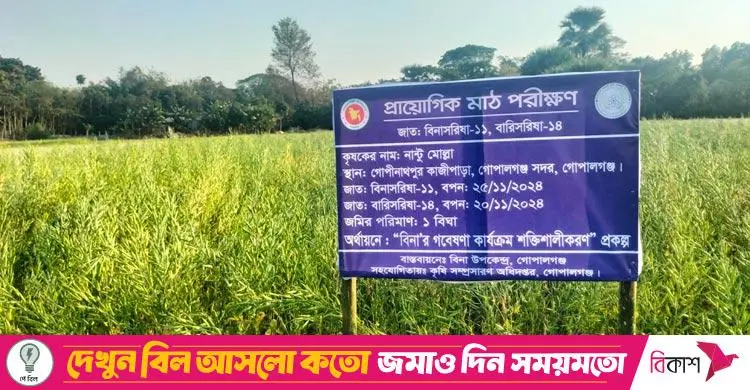
An adaptive trial of BINA Sarisha-11 alongside BARI Sarisha-14 and a local mustard variety was grown in Kazipara village of Gopinathpur union in Gopalganj Sadar upazila, funded by the Bangladesh Institute of Nuclear Agriculture (BINA) research strengthening project with the cooperation of the Department of Agricultural Extension (DAE). BINA Sarisha-11 gave the highest yield, at 1.95 tonnes a hectare. BARI Sarisha yielded 1.25 tonnes, and the local variety only 600 kg.
Dr Md Harun-or-Rashid, officer in charge and chief scientific officer of BINA's Gopalganj sub-station, gave this information.
He said 80 percent of the country's edible oil demand has to be met by imports, costing about Tk 30,000 crore a year. The foreign exchange spent on oil imports puts pressure on the reserves. "If we are aware, if we can make farmers aware, and if the media publicise it widely, we can raise oil production using our own soil, water and our own variety BINA Sarisha-11, and reduce oil imports," he said.
Bigger seeds, more oil
Sourav Adhikari, scientific officer at BINA's Gopalganj sub-station, said BINA Sarisha-11 produced 40 seeds in one pod in Gopalganj, against 20-25 for BARI Sarisha-14 and only 10 for the local variety. BINA Sarisha-11 has bold seeds with 44 percent oil. With good care it can yield 2.1 tonnes a hectare, and by raising oil production the variety can reduce import dependence.
Nantu Molla, a farmer in Kazipara village of Gopalganj Sadar upazila, said: "BINA Sarisha-11 has given a huge yield on my land. The field is nothing but mustard. I have never seen so much mustard in my life. Seeing my field, many people are showing interest in growing this variety."
A. Kader Sardar, deputy director of the DAE's Gopalganj Khamarbari, said the short-duration BINA Sarisha-11 yields more than 2 tonnes a hectare and is profitable to grow. After the mustard is harvested, boro rice can be grown in the field, so two-crop land yields three crops a year. "We will expand cultivation of this mustard to fill the oil shortfall," he said.
A roadmap to halve imports
Dr Md Mahbubul Alam Tarafdar, project director of the BINA research strengthening project, said the bulk of the country's total edible oil demand depends on imports. Mustard tops the oils produced in the country, while soybean, sesame, groundnut, sunflower and one or two unconventional oilseeds are grown only in small amounts. A large share of land lies fallow between the boro and aman crops. The government is implementing a three-year roadmap to halve import dependence by using this fallow land and increasing oilseed production.
Under the roadmap, efforts have begun to expand mustard cultivation widely along with several other oil crops, and the benefits are starting to show: mustard cultivation has risen sharply across the country this year. He expressed hope that the government's roadmap would be achieved if the high-yielding BINA Sarisha-11 could be spread across the country.
Source: Jagonews24. First published in Bengali on The Agro News.

Comments
(0)