
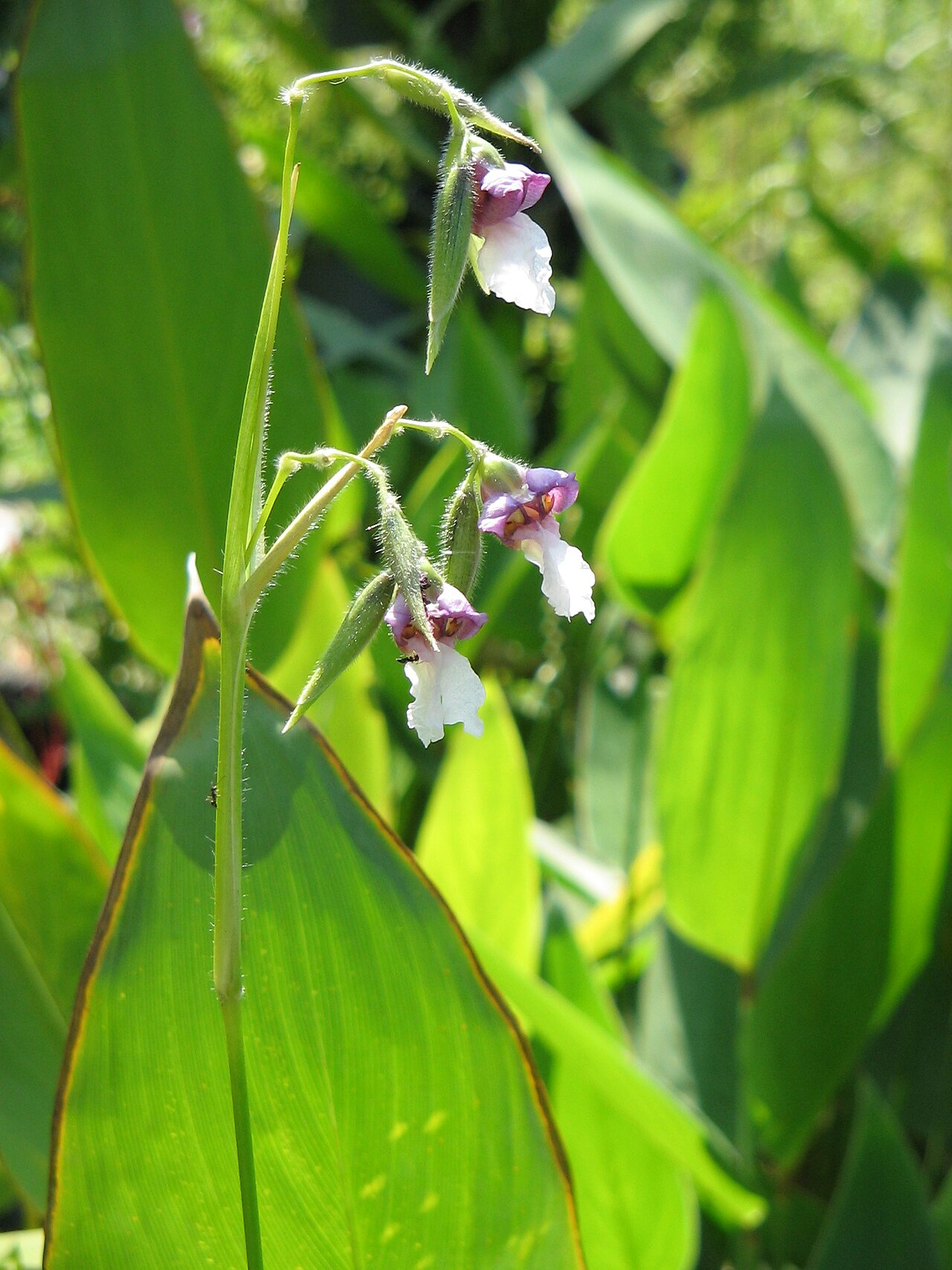
Its leaves look like those of the canna, but it grows in water or on wet ground, which is why one of its English names is water canna. A plant profile published in Samakal proposes the Bengali name jal kalaboti. The writer first saw it in a water garden in Sultanpur village of Harirampur, Manikganj, kept by a man named Tanvir who grew 50 to 60 kinds of ornamental aquatic plants; it has since been seen flowering in Ramna Park in Dhaka.
The botanical name is Thalia geniculata, of the family Marantaceae, and it is also called bent alligator-flag, arrowroot and fire-flag. It is native to the Americas and grows wild in the south-eastern United States, Mexico, Central America, the Caribbean and South America.
It is a perennial, evergreen aquatic shrub that can reach three metres, and about two metres in Bangladesh. The lime-green leaves are 20 to 75 centimetres long and 5 to 30 centimetres wide, held upright like flags on stiff red stalks. From among the leaves slender stems carry zigzag clusters in which purple-and-white flowers open one after another for several days. It can flower in any season and at any time of day.
New plants grow from underground rhizomes and also from seed. Growth is moderate to fast, and once established it is hard to remove. As an ornamental it is planted in water-filled pots and tubs and along the edges of ponds and pools.
In Africa and South America its leaves are used for thatch and for wrapping food, to which they lend a particular aroma, and the split stems can be woven into mats. The caterpillars of several moth species feed on the leaves.
The article notes that the newcomer has been added to the country's plant records: the database of the Bangladesh Agricultural University Botanical Garden in Mymensingh lists two species of the genus, Thalia geniculata and Thalia dealbata, both of which can be used in landscaping and in treating dirty water.
Photo: Meneerke bloem / Wikimedia Commons (CC BY-SA 3.0)
Source: Samakal
Comments
(0)