
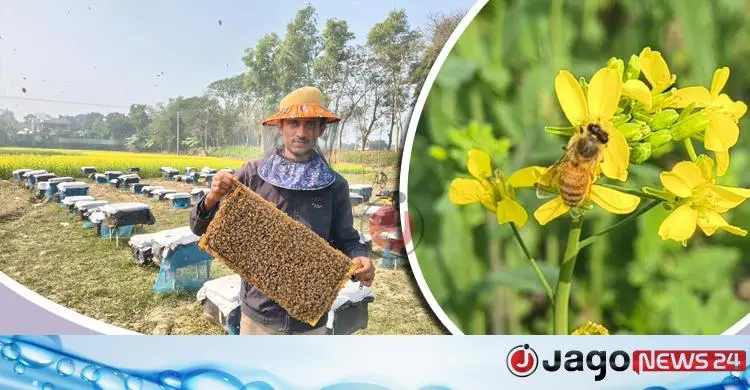
Pallab Roy, a beekeeper from the Bardi area of Narayanganj, and several other young men are earning about Tk 3 lakh to Tk 3.5 lakh a month keeping bees in boxes in Goalanda, Rajbari. For about six to eight months a year they move around the country, setting up their boxes in different places to collect honey from different flowers.
They profit from the honey, while farmers profit from higher output as the bees pollinate their crops. Apart from their own food and lodging and caring for the bees, box beekeeping involves little extra cost, so it has become known as a profitable occupation.
Pallab Roy and his partners have set up 110 boxes beside a mustard field in Nagar Roy Para of Goalanda municipality. Within 12 to 15 days of setting up the boxes, the beekeepers harvest the honey by their own methods. In sunny weather they collect 20 to 25 maunds of honey a month in four to five harvests, and sell it wholesale at Tk 14,000 a maund. Mustard honey collection lasts about two months; after that they collect honey from coriander, black cumin (kalojira) and other flowers, spending about six to eight months of the year this way.
Mustard fields and pollination
Mustard has been grown in Goalanda and other parts of the district, and the fields are bright with yellow flowers. Mustard is a profitable crop at low cost, so bee boxes have been set beside the fields to raise output through pollination. Bees fly over the fields and gather nectar from the flowers. This edible oil crop is several times more profitable than its cost, so the area under mustard is growing day by day. This time, however, fog stopped the beekeepers collecting honey for some days.
According to the district Department of Agricultural Extension (DAE), mustard has been grown on 5,832 hectares in the district this year: 2,165 hectares in Goalanda, 1,835 in Rajbari Sadar, 957 in Baliakandi, 475 in Kalukhali and 400 in Pangsha. Production of 7,873 tonnes is expected. The varieties grown in the district are Tori-7, BARI 14, 15, 17 and 18, and BINA 4, 9 and 11.
Locals raise pesticide concern
Local resident Md Manik told Jagonews: "This mustard honey is very good. We have eaten it. When the sun comes out, the bees leave the boxes and spread over the fields with a humming sound. It is nice to watch, and many people come from far away to see it."
Abdul Halim told Jagonews: "Beekeepers from other districts come to Goalanda and set up boxes to collect honey. The honey is genuine, but since farmers use too much pesticide in their fields, there are questions about how safe it is. The agriculture department should make farmers aware of this."
What the beekeepers say
Abu Hasnat, who looks after the bees, told Jagonews: "If the weather is good we can collect honey four times a month and get more than about 20 maunds in those four harvests. We send this honey to Dhaka and sell it at Tk 13,000-14,000 a maund. We stay at the mustard fields for about two months, then go to black cumin and coriander fields. After about two months there we will go to the litchi orchards. After that there are no more fields, so we stay in one place for about six to seven months and look after the bees ourselves."
Pallab Roy told Jagonews: "We have about 110 bee boxes here. We collect honey every seven to eight days, which gives about six to eight maunds. We send all our honey to Dhaka and sell it retail at Tk 600 a kg."
Golam Rasul, training officer at the Rajbari district DAE, told Jagonews: "The district will produce 7,800 tonnes of mustard. It is grown to a greater or lesser extent in five upazilas, but most in Goalanda. In many places bees are being kept beside mustard fields. The bees raise output by pollinating the mustard flowers, and beekeepers profit from collecting honey. At the start of this month, honey collection was somewhat disrupted by fog."
Source: Jagonews24. First published in Bengali on The Agro News.

Comments
(0)