
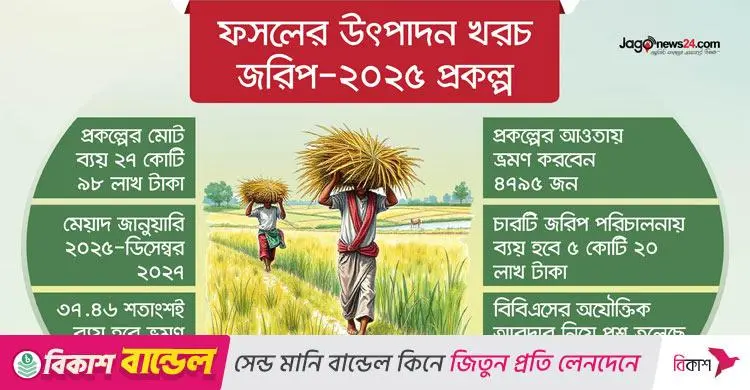
The Bangladesh Bureau of Statistics (BBS) wants Tk 27 crore 98 lakh to find out the production cost of 10 of the country's crops. Of this, Tk 10 crore 48 lakh 50 thousand, or 37.47 percent, would be spent on travel, and 4,795 people would travel across the country with the money.
Under the project, Tk 5 crore 20 lakh would go on conducting four surveys and Tk 2 crore 60 lakh on in-house training. The request has been made to the Planning Commission under the "Crop Production Cost Survey-2025" project. The Planning Commission has questioned several of what it sees as unreasonable demands from the BBS.
An evaluation committee meeting on the project was held at the Planning Commission on Monday (7 April). Before that, on 19 February, a review meeting was held chaired by Md Sayeduzzaman, chief additional secretary of the commission's Agriculture, Water Resources and Rural Institutions Division, which recommended that the travel cost be reduced to a reasonable level.
The project is to run nationwide from January 2025 to December 2027.
The crops and the aims
The 10 crops include six major crops, Aus, Aman and Boro rice, wheat, potato and jute, and four minor crops, maize, onion, mango and aubergine. The BBS wants to calculate their production cost, production and productivity.
Four surveys would be conducted in four quarters, and the results published as reports. The data and experience are expected to improve the quality of yield estimates for these crops later, and the four reports will help the government frame agricultural policy. Better agricultural statistics would allow proper planning in the sector, and the data would also help prepare accurate reports on the SDG targets on sustainable consumption and production.
How the money would be spent
Besides Tk 5.20 crore for the four surveys, Tk 2.60 crore would go on in-house training and Tk 70 lakh on seminars, conferences and workshops. Computers and accessories would cost Tk 2.21 crore and computer software Tk 52 lakh. Office equipment would take Tk 18 lakh 35 thousand, furniture Tk 18 lakh and travel Tk 10 crore 48 lakh 50 thousand. Stationery would cost Tk 49 lakh, outsourced staff Tk 53 lakh and vehicle hire Tk 48 lakh 60 thousand.
Md Sayeduzzaman told Jagonews24 that the project's main job is collecting data, which requires travel. "But spending cannot be had just by asking. There are government rules on travel costs. The cost will be reduced. There is no scope for excess travel spending. Government officials and employees get travel allowances according to their grade. How much can be spent by air, bus and train is fixed in advance. What is needed will be given. There is no scope for extra spending," he said.
The BBS declined to comment on the unusual travel cost. Md Abdur Rob Dhali, director (Planning and Development Cell) of the BBS, said: "This is the Agriculture Wing's project. They can say. We cannot say anything about why the travel cost is high." Alauddin Al Azad, director of the BBS Agriculture Wing, also declined to comment.
Planning Commission recommendations
The Planning Commission made several recommendations. It said the project period could be set at two years and six months instead of three years. Outsourced staff and casual workers should be provided for in line with the recommendations of the Finance Division's manpower committee, and the minutes of that committee's meeting could be attached to the project.
The activities section should set out clearly how the surveys on production cost, production and productivity of the 10 crops will be conducted, including the process, steps and methods.
Tablets for the survey must be taken, as needed, from those bought under the "Population and Housing Census-2021" project; only if enough cannot be found may the shortfall be bought under this project. The various cost heads could be reset.
The commission said provision for books and periodicals, conveyance, copying and motor vehicle repair and maintenance could be dropped. It asked for cuts in repair of furniture, computers and other equipment, and recommended reducing honoraria, entertainment, postage and courier, internet, fax and telex, printing and binding, stamps and seals and other stationery. Under electrical equipment, provision could be kept for only two air conditioners.
It said a maximum of Tk 5 lakh could be kept for venue hire, Tk 30 lakh for computer consumables, Tk 10 lakh combined for petrol, oil and lubricants and gas and fuel, and Tk 5 lakh for furniture. Office equipment could get up to Tk 10 lakh, computer software up to Tk 40 lakh and ICT equipment up to Tk 10 lakh. Under computers and accessories, provision could be kept for four desktop computers, four heavy-duty black-and-white laser printers, one colour laser printer, one laptop and one smart LED board. The commission told the BBS plainly that after cutting the project period by six months, all other cost heads should be reset accordingly.
Why the survey matters, according to BBS
One of the project's aims is to contribute to agricultural policymaking by preparing and supplying statistics on the production cost of crops grown in the country, and to improve the quality of agricultural statistics. Crop-cutting experiments in the field and farmer interviews will be used to determine and verify yield rates, and reports and analytical research will be supported.
Instead of the cluster survey method, lists of farm households will be made in selected mouzas so that crop area, production and production cost surveys can be run regularly by the mouza survey method. Officials and staff will be trained to improve the quality of agricultural statistics.
The BBS agriculture wing currently gives area and production estimates for six major crops (Aus, Aman, Boro, jute, wheat and potato) and 140 minor crops. It says updating these estimates with modern methods, following those of developed countries, is very important.
The BBS says Bangladesh has made considerable progress in food security and nutrition over the past decade and has largely achieved self-sufficiency in terms of per capita calorie availability. Rising incomes and falling poverty indicate that the availability of rice has also improved over time.
The report notes that despite shrinking farmland, population growth and climate-driven floods, drought and salinity, Bangladesh is now an example to the world in food grain production. It is third in the world in rice production, third in vegetable production and fourth in fish production, and is moving ahead in developing flood-, drought-, salinity- and disaster-tolerant crop varieties.
According to the BBS, it is the national statistics agency responsible for preparing and publishing accurate and timely statistics on demography, public health, society, economy, agriculture, trade, environment, climate change, disasters, natural resources and biodiversity, and it regularly publishes household income and expenditure survey statistics used to show poverty and socio-economic conditions.
There is heavy demand for agricultural statistics, especially on food production and crop use, from the finance, agriculture and food ministries and all district administrations. The BBS says the project's statistics will support the government's poverty reduction measures at the grassroots, five-year plans and the Sustainable Development Goals. Production cost data are essential for price setting, and the survey's data will also help set yield rates of major crops for calculating GDP.
Source: Jagonews24. First published in Bengali on The Agro News.

Comments
(0)