
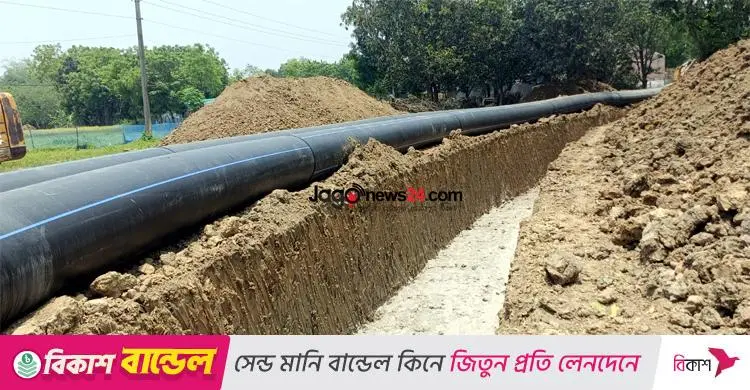
A new irrigation policy has taken effect in Rajshahi's Barind region from the current boro season, and it has hit farming. More than 10,000 hectares could not be cultivated because of the water shortage, and rice production is falling. But a project to supply Padma river water to the Barind area and expand irrigation by the "double lifting" method (EIDL) is offering hope to farmers.
Under the project, water will be brought from the Padma (from 18.5 km away) to provide irrigation to about 10,250 hectares, benefiting at least 30,000 farmers. About 20 per cent of the work is done, and those involved hope to finish in 2027.
Boro area falls
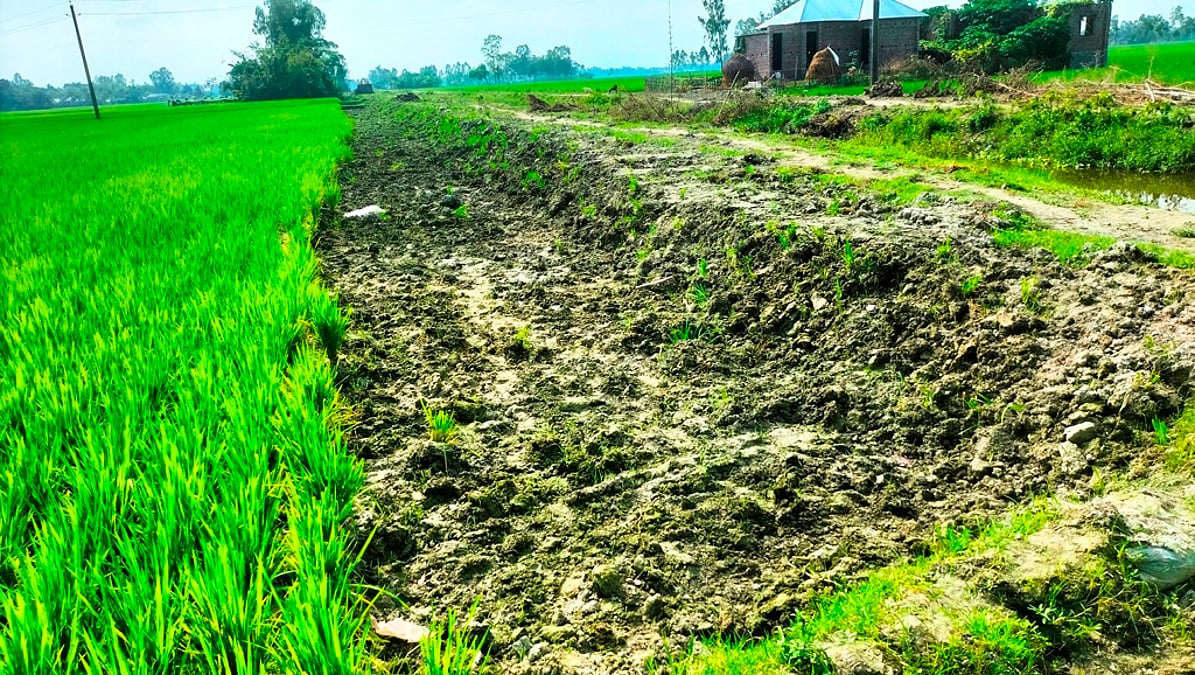
According to the Department of Agricultural Extension (DAE) in Rajshahi, the Rajshahi division's agricultural region covers Rajshahi, Natore, Naogaon and Chapainawabganj. In FY2023-24 the boro target was 375,165 hectares, and it was exceeded by 865 hectares, for a total of 376,030 hectares. In the current 2024-25 year, rice farming has fallen. The target was 376,110 hectares, but because of the water shortage 365,830 hectares were planted, 10,200 hectares less than last year.
Of that fall, Rajshahi district accounts for 1,905 hectares, Naogaon 540 hectares, Natore 3,500 hectares and Chapainawabganj 4,205 hectares.
Data from the Barind Multipurpose Development Authority (BMDA) show it has 3,588 working deep tube wells in the eight upazilas facing water shortage, of which 1,960 are in areas of acute shortage. Depending on groundwater availability, each tube well can irrigate 24 to 40 hectares.
Under the BMDA's new policy, to keep the groundwater level stable, a deep tube well will run 1,960 hours a year in total, including 980 hours in the boro season from 15 February to 15 May. As a result, boro farming on land under these tube wells will be cut from half to zero. Because of the water shortage, rice was grown this year on 365,830 hectares, 10,200 hectares less than last year. The BMDA has taken an initiative to overcome this crisis.
The project
The BMDA says it has taken up the Tk 548 crore project to supply Padma water to the Barind area and expand irrigation by the double-lifting method. Since 4 February this year, work has been under way on a 1,000 mm diameter HDPE pipeline to carry water from the intake pump station at Jot Gosaidas Sarangpur in Godagari municipality, via the Booster-1 and Booster-2 pump stations, to the Dudhai canal. The water will cross the two stations and go to the khari (water body).
When the project is complete, 10,250 hectares of uncultivated land in the region will come under cultivation, benefiting 30,000 farmers and producing an extra 140,000 tonnes of crops a year, which the BMDA hopes will add a new dimension to the national economy.
Abdul Latif Sarkar, assistant engineer of the BMDA's Godagari-1 zone, told Jago News that lifting groundwater through deep tube wells has caused an acute water crisis in the Barind region, and the project was taken up to ease the crisis and raise crop output. Water will go from the intake pump station at Jot Gosaidas Sarangpur via the two booster stations to the Dudhai canal and then to farmland, through 18-20 km of pipeline.
He added that the work is being done by the leading industrial group RFL. The HDPE pipes will supply 120 cusecs of water, and 120 LLP pump stations will be installed, from which farmers can bring their fallow land under cultivation. About 20 per cent of the project is now complete.
Farmers wait
Sultan Islam, a farmer from Basudebpur in Godagari upazila, told Jago News: "This time too I couldn't farm my land for lack of water. Every year in the rice season I can't farm more than half my land, and it causes big losses. But when the project is finished, we'll be able to farm our land as we wish."
Another farmer, Nasir Uddin, said: "The water shortage for farming goes back a long way. For lack of water we can't farm most of our land, especially rice. The project will help us."
Source: Jagonews24. First published in Bengali on The Agro News.


Comments
(0)