
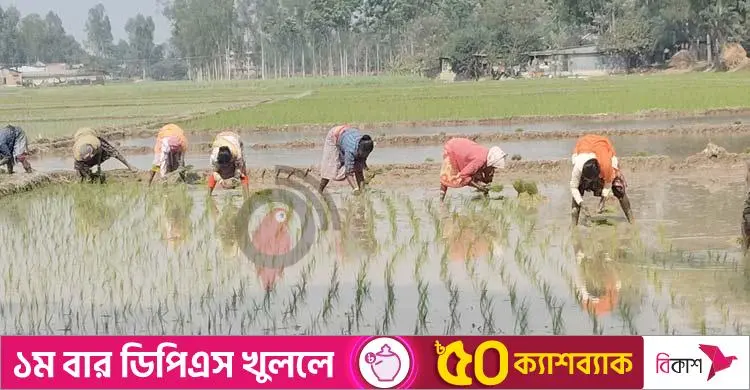
The Barind region is facing a severe water crisis after decades of unplanned and excessive extraction of groundwater. In this situation, the Barind Multipurpose Development Authority (BMDA) has moved to restrict Boro cultivation in eight upazilas of the region.
Under the recent decision, Boro cultivation on farmland served by BMDA deep tubewells in these upazilas will be cut to between half and zero, depending on the area. As a result, farmers will not be able to grow Boro paddy on more than about 40,000 hectares of cultivable land in eight upazilas of Rajshahi, Chapainawabganj and Naogaon this season.
According to BMDA officials, Godagari and Tanore in Rajshahi; Nachole, Gomastapur and part of Sadar upazila in Chapainawabganj; and Sapahar, Porsha and Niamatpur in Naogaon are suffering the worst water shortage. In some places in these upazilas, no groundwater layer could be found at all.
Groundwater falling
According to a survey conducted between 2018 and 2021 in 25 upazilas of Rajshahi, Naogaon and Chapainawabganj districts by the Institute of Water Modelling, a national government research institute, the average groundwater level in the region has fallen to 8 to 18 metres over the past three decades. In some specific areas, such as Gomastapur upazila, the average groundwater level has fallen from 21 metres to 46.87 metres.
BMDA officials say they were more or less forced to restrict Boro cultivation to stop the eight upazilas from running out of water. They have recently drawn up a new policy, under which a deep tubewell in water-stressed areas cannot be run for more than 980 hours during the current Boro season.
According to BMDA officials, the eight water-stressed upazilas have 2.19 lakh hectares of cultivable land. About 95,000 hectares of it is served by BMDA deep tubewells, and the remaining 1.24 lakh hectares by private and individually owned tubewells.
BMDA data show the organisation has a total of 3,588 working deep tubewells in the eight upazilas, of which 1,960 are in areas with an acute water shortage. Depending on the availability of groundwater, each tubewell can irrigate between 24 and 40 hectares of land.
The new policy
Under BMDA's new policy, to keep the groundwater level stable, a deep tubewell will be run for a total of 1,960 hours a year. Of this, a deep tubewell will run a total of 980 hours during the coming Boro season from 15 February to 15 May. As a result, Boro cultivation on land served by these tubewells will be cut to between half and zero.
Jahangir Alam Khan, additional chief engineer of the organisation's irrigation wing, said: "In the eight upazilas, 1,960 of our tubewells are located in areas with an acute water shortage. On the land served by more than half of these tubewells, we are asking farmers not to grow any Boro paddy."
He added: "We have also been urging farmers to grow Boro paddy on half the land served by the remaining 830 deep tubewells and other crops such as maize and wheat on the other half, because Boro paddy needs five to six times more water than other crops."
A tubewell operator in Godagari upazila, speaking on condition of anonymity, said a recent letter from the head office instructed him to supply water for Boro cultivation on only one-fifth of the total land served by his tubewell.
Farmers fear losses
Farmers fear the new policy will reduce Boro production, and that farmers in the eight water-stressed upazilas will face losses if they cannot grow Boro on all their land.
Md Mamun, a farmer from Kalidighi village in Godagari upazila, Rajshahi, said: "I prepared a seedbed two months ago to grow Boro paddy. The seedlings are now ready for transplanting. Fifteen days before transplanting, BMDA is saying we cannot cultivate all our land. We will suffer financially."
Rafiqul Islam, a farmer from Purbhara village, leased 12 bigha of paddy land for Tk 1.68 lakh to grow Boro. Now BMDA says he can grow Boro on only two bigha this season and must grow crops such as wheat or maize on the rest. But the time for planting wheat or maize ended long ago.
Md Awal of Shekherpara village said the paddy he gets from his one bigha of land feeds him for the whole year, but now he will have to buy rice, because under BMDA's new policy he will be able to grow Boro only once every four or five years.
He said: "A bigha gives 25 to 30 maunds of Boro paddy. If you grow wheat there, you get 8 to 10 maunds. Since paddy can be stored all year, it fetches a good price on the market throughout the year. But because farmers have no way of storing wheat or maize, the wheat market is relatively low at the peak of the season. So if we cannot grow paddy, we will suffer losses."
Farmers from small ethnic communities will suffer the most under the new policy, farmer Bappi Mardi fears. He said those with money will use their wealth and influence to install their own tubewells privately and grow Boro, but poor farmers like them do not have that option. As a result, water inequality in the Barind region will become even starker: the rich will get richer and the poor poorer, he said.
What officials say
Shamsul Hoda, additional chief engineer of BMDA, said they will soon write to the government about unplanned and uncontrolled groundwater extraction by individuals, recommending that private tubewells be brought under control.
BMDA chairman Dr Md Asad Uz Zaman said: "We have taken this decision in areas where there is a water crisis. Running our deep tubewells brings a profit, but doing so harms everyone. So in areas where water is scarce, we have asked farmers to grow wheat or other crops instead of paddy."
Umme Salma, deputy director of the Department of Agricultural Extension (DAE) in Rajshahi district, said BMDA has been campaigning on the irrigation policy for quite some time. They are not setting operating hours everywhere, only in areas where the water table has dropped. This will, however, reduce Boro cultivation somewhat, she said.
Source: Jagonews24. First published in Bengali on The Agro News.


Comments
(0)