
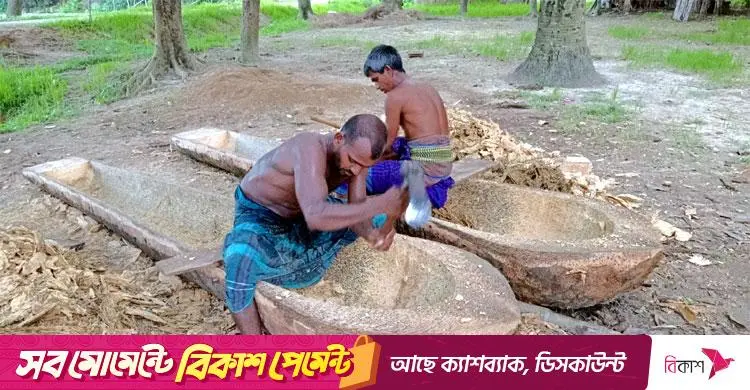
Bariadi is a small village in Jangalia union of Kaliganj upazila in Gazipur. The village once had a different identity: it was famous for making konda, the dugout boats carved from palm trunks. When the monsoon came, the village seemed to come alive again, and more than a hundred men would throw themselves into making konda. Cut from palm trees, then rubbed and trimmed, the konda were made with precision and once spread to many parts of the country. With changing times, the tide of technology, the decline of the beels and waterbodies and the harsh grip of pollution, the craft is now on the way to extinction. Bariadi's traditional konda survives only as a memory among a few families.
A visit to the village found that most people have changed their occupation. Yet in this same village, the sight of palm trees being cut into konda in every courtyard, under trees or in open fields was once part of daily life. A few craftsmen still carry on the handiwork as keepers of that tradition: Abdul Kadir, son of Nurul Islam Bepari; Nazmul Shikder, son of Afsar Uddin Shikder; and Lal Mia, son of Faizuddin Shikder.
'Nobody wants to buy konda any more'
Veteran craftsman Hanif Bepari said: "In our time every man in this village could make a konda. I learned to make them with my father and uncles. I won prizes at many fairs. But the demand is no longer there. In the digital age nobody wants to buy a konda. Konda have become a thing of memory."
Abdul Kadir and Nazmul Shikder, craftsmen of the present generation, said: "Every household used to need a konda. There were fish in the beel, so everyone bought konda to catch them. Now factory waste has ruined the beel's water. There are no fish, so there is no demand for konda either. So we no longer make them commercially, only a few as a hobby. If we take them to market they hardly sell. Some people come to the house and order one, and that is mainly how they sell."
A week of work for Tk 12,000–13,000
The craft rests on fine skill and endless patience. A good-quality konda takes more than a week to make. Palm trees are collected from various parts of Kaliganj, Kapasia and Sreepur. The trunk is cut to the required length and split in two, so one tree yields two konda. The finished konda are sold at the Saturday market in Pubail in Gazipur city. A good konda costs about Tk 12,000–13,000. With demand now low, the craftsmen cannot even recover their costs.
Bariadi's konda is not just a fishing tool. It reflects the village's history, heritage and culture. In the words of local people: "This konda has given Bariadi its own identity. We want this craft not to be lost. With help from the government or some organisation, our heritage might be able to stand up again."
Bariadi's konda is no longer an everyday necessity, but it is a cultural marker that can keep a village's history alive. Its existence may survive in the hands of a few craftsmen, but it needs social and institutional recognition, support and publicity. Otherwise, in the near future, the word "konda" may be found only in the pages of books.
Source: Jagonews24. First published in Bengali on The Agro News.
Comments
(0)