
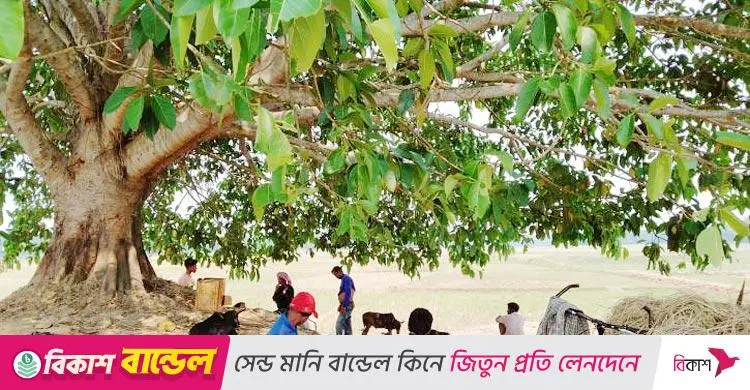
The banyan is a tree every village in Bengal knows, sometimes called the "king of trees". It belongs to the Urostigma subgenus of the Ficus, or fig, genus. Its original home is the Bengal region (the Bengali-speaking lands), and it is a very large tree.
Rural Bengal's culture grew up around the banyan. In the past, any village fair or event was held under the biggest banyan tree, and in some places it still is, though with time much of this has faded away. The banyan was the centre of village celebrations, and children's games, village arbitrations and meetings all took place in its shade. Villages have no large convention halls, hotels or function rooms like towns, and the familiar banyan has met these needs for generations.
Social, religious and ecological value
The banyan is like a natural centre of fresh air given by the Creator, bringing villagers physical and mental peace with its breeze and shade. It also has religious importance: the tree is considered sacred in India, and temples are often built under it. In various parts of India and some other South Asian countries, cutting banyan trees is forbidden for religious reasons. Because of its benefits and religious importance, the banyan has been given the status of India's national tree.
The banyan does not only meet human needs. It shelters about 350 species of birds and insects. Its fruit is a favourite food of crows, mynas and bats, and it is a safe refuge for vultures and similar birds. A mature banyan releases an average of 60 to 70 gallons of water vapour a day, which plays a special role in controlling an area's humidity.
Low-grade rubber is made from its sap, and fibre from its bark is used for rope and other purposes. Its leaves are beneficial for leprosy. All this plays an important role in the country's economic and social development. Hundreds of works of literature, poems and novels have also been written around the banyan, and they still live in readers' hearts.
Lost to modernisation
But with time people are moving towards modernisation, cutting trees to build large buildings even in villages, which is also a threat to the environment.
In the name of modernisation we are doing nothing but destroying the environment. We should therefore conserve rural Bengal's traditional banyan trees and run various public and private programmes to raise awareness about trees.
Written by Sanjana Rahman Juthi.
Source: Jagonews24. First published in Bengali on The Agro News.
Comments
(0)