
The last aman season did not go well for farmers. In some districts they could not get the fertiliser they needed even at higher prices, and had to plead with dealers. What they did get fell well short of demand, which hit production. There is no such fear this boro season: the Bangladesh Chemical Industries Corporation (BCIC) says the country now has enough urea in stock.
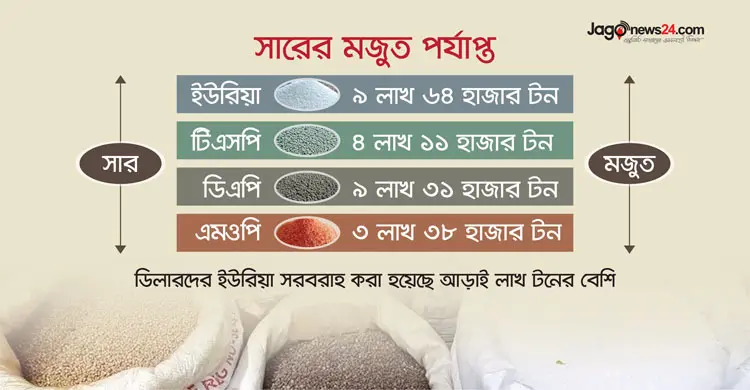
The state-owned BCIC is responsible for producing and importing urea. Its data show that urea supply to the local market has risen above demand and stocks are growing too. It holds 9 lakh 64 thousand tonnes of urea, 1 lakh 44 thousand tonnes more than at the same time last year.
Stocks and pipeline
Of this, more than 2.5 lakh tonnes of urea has recently been supplied to dealers in markets around the country. Warehouses hold 5 lakh 82 thousand tonnes, and another 3 lakh 80 thousand tonnes is waiting to be unloaded at port.
The country also has 4 lakh 11 thousand tonnes of TSP (triple super phosphate), 9 lakh 31 thousand tonnes of DAP (diammonium phosphate) and 3 lakh 38 thousand tonnes of MOP (muriate of potash) in stock. Stocks of every fertiliser are above last year's and above boro season demand.
Government figures put urea demand until March at 15 lakh 36 thousand tonnes. Against that there are 9 lakh 64 thousand tonnes in stock and another 13.5 lakh tonnes in the import pipeline, meaning a surplus of 7 lakh 78 thousand tonnes of urea after March. Likewise, there will be a surplus of 2 lakh 1 thousand tonnes of TSP, 2 lakh 78 thousand tonnes of DAP and 1 lakh 82 thousand tonnes of MOP.
The BCIC said a total of six lakh tonnes of fertiliser was imported from Saudi Arabia in two phases under the government-to-government (G2G) system in the latest round. LCs for some contracts were cancelled at one point because of the dollar crisis, but the situation returned to normal on the government's instructions, leaving imports and stocks at a comfortable level.
BCIC director Saiful Islam Khan told Jagonews: "Besides imports, we are producing five lakh tonnes of fertiliser at the Karnaphuli fertiliser factory. The other four urea factories, Jamuna, Shahjalal, Ashuganj and Chittagong Urea, have a target of seven lakh tonnes more this fiscal year. Overall there is no more cause for worry about fertiliser."
Why supplies were tight
From the middle of this year most of the country's urea factories were shut because of mechanical faults, putting extra pressure on imports. Just as imports became more important, the dollar crisis made supply fragile, and a scramble for fertiliser began.
Balai Krishna Hazra, additional secretary of the fertiliser management and inputs wing at the Ministry of Agriculture, told Jagonews there is no longer any problem with fertiliser. Farmers will get enough for boro, stocks are above demand, and instructions have been given to ensure adequate supply so there is no shortage anywhere.
The country needs 26 lakh tonnes of urea a year, of which state factories supply about 10 lakh tonnes. This year gas shortages halved that output. The government meets the rest of demand through G2G imports from Saudi Arabia, Qatar and Dubai.
Annual demand is also 7.5 lakh tonnes of TSP, 16.5 lakh tonnes of DAP and 8.5 lakh tonnes of MOP, and much of this too is met by imports.
People in the farm sector say, however, that there was not really much of a shortage last season either; dealers across the country exploited the small gap to manipulate the market, and the risk of a similar situation remains this season.
Source: Jagonews24. First published in Bengali on The Agro News.


Comments
(0)