
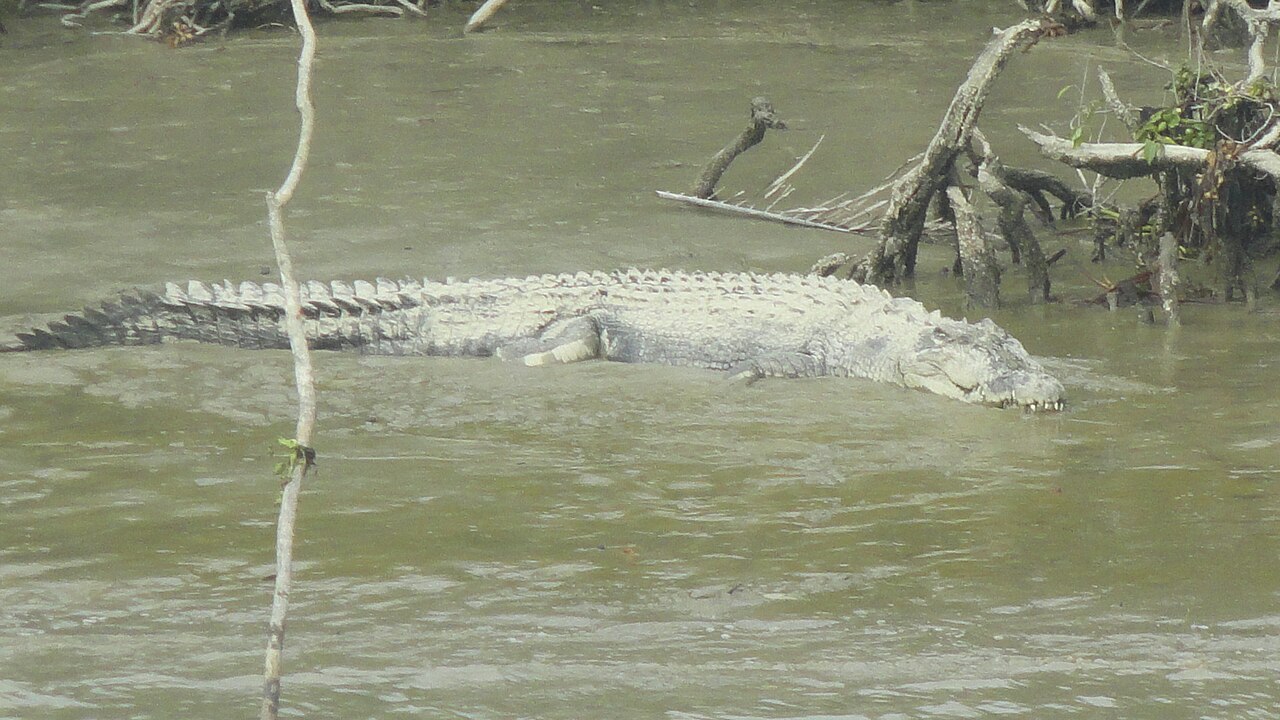
On the afternoon of 26 January 2013, on the bank of the Pasur river in the Sundarbans, what looked from a distance like a dead tree trunk turned out, once the photograph was enlarged at home, to be a saltwater crocodile basking in the late sun. So writes Dr A N M Aminur Rahman, a specialist in bird and wildlife breeding and medicine, in Desh Rupantor.
He saw crocodiles again several times over the following years: on the Harbaria creek bank, by the Andharmanik river, between Dudhmukhi and Supati, and between Supati and Kochikhali. Once, as his small launch drew close while he took pictures, the animal slid off the mudbank with a splash and dived. His most recent sighting in the Sundarbans was in March 2023.
The saltwater or estuarine crocodile, Crocodylus porosus, is a rare and endangered reptile in Bangladesh, found only in the Sundarbans. Elsewhere it lives in India, Sri Lanka, China, Southeast Asia, Papua New Guinea, the Solomon Islands, Australia and Micronesia.
It is the largest living reptile. Males are usually 4.3 to 5.2 metres long and weigh 400 to 1,000 kg, reaching up to 6 to 7 metres and 2,000 kg. Females are much smaller, 2.4 to 3 metres and around 100 kg. Hatchlings are only 25 to 30 cm long and weigh 70 grams.
It lives in coastal rivers, estuaries and mangroves, sometimes entering fresh water. Each animal keeps its own range, where fish, crabs, reptiles, birds, mammals and even people can become prey.
In Bangladesh it breeds from September to October. The female builds a mound nest of mud, leaves and rotting vegetation on a secluded bank above the tide, and the heat of the decaying plants incubates the eggs. Between November and March she lays 40 to 60 eggs, which hatch in 80 to 90 days. Females mature at 10 to 12 years and males at 16, and they live 40 to 80 years.
Photo: RFR-113 / Wikimedia Commons (CC BY-SA 4.0)
Source: Desh Rupantor

Comments
(0)