
By Moazzem Hossain Tipu
Bangladesh is called a land of rivers. Rivers are not just part of its landscape: agriculture, fisheries, water transport, industry, biodiversity and the livelihoods of millions are directly tied to them. Yet under the weight of untreated industrial effluent, urban sewage and solid waste, many of the country's rivers are now overwhelmed by pollution.
Various government reports on rivers and water quality paint a worrying picture of rivers near the main cities and industrial areas. A national water-quality assessment by the Department of Environment says municipal and industrial solid waste, untreated sewage and industrial effluent are important sources of pollution in rivers around large cities and urban centres. Information on the River Pollution Monitoring System of the Water Resources Planning Organisation (WARPO) also identifies rapid urbanisation, industrialisation and unplanned waste management as major causes. According to its website, a 2022-23 survey found 56 rivers severely polluted by industrial, municipal and plastic waste.
Dhaka's rivers worst hit
The crisis is clearest in the rivers around Dhaka. The Buriganga, Turag, Balu and Shitalakshya have long carried the burden of industrial effluent, sewage, solid waste and urban pollution. Analysing 2022 data, the Department of Environment's assessment found high BOD, COD and turbidity in the Buriganga, Balu and Turag. High BOD and COD levels were recorded in the Buriganga at various times in 2022, and high pollution in the Balu and Turag as well.
The same report says water in the rivers around Dhaka deteriorates more in the dry season than in the monsoon; water quality improves somewhat when flow increases. BOD, or biochemical oxygen demand, indicates how much oxygen micro-organisms need to break down organic matter in water. High BOD risks depleting dissolved oxygen, which can harm fish and other aquatic life.
Sewage as big a problem as factories
Discussions of river pollution tend to focus on factory waste, but urban sewage is just as important. A World Bank report published in February 2026 says only about 20 per cent of Dhaka's residents are connected to piped sewerage and about 2 per cent more use effective faecal sludge management. As a result, more than 80 per cent of Dhaka's untreated sewage ends up in interconnected waterways. This is not only an environmental problem: untreated sewage entering rivers and water bodies increases organic pollution and can create public health risks through pathogens and other pollutants.
The concentration of industry around Dhaka has made the crisis worse. According to the World Bank's 2026 data, more than 7,000 factories in and around Dhaka release an estimated 2.4 billion litres of untreated wastewater into waterways every day, and the Bank identifies this industrial pollution as an acute problem for Dhaka's water. But blaming factories alone does not give the full picture. Inadequate sanitation, weak solid waste management, urban drainage and the habit of dumping waste straight into rivers are part of the same crisis; river pollution is essentially the combined result of many sources.
Treatment plants must actually run
Effluent treatment plants (ETPs) for industrial waste and sewage treatment plants (STPs) for urban sewage are key infrastructure, but having the facilities is not enough; it must also be ensured that they are operated regularly and effectively. The World Bank's 2026 programme to tackle Dhaka's water pollution emphasises industrial effluent treatment, water reuse, a realistic pollution monitoring system and river restoration planning. It also mentions an integrated river restoration plan centred on Dhaka's four main rivers and a digital real-time pollution monitoring system. Clearly, tackling river pollution now requires bringing four things into one system: identifying pollution sources, treating waste, regular monitoring and accountability, rather than relying only on raids or fines.
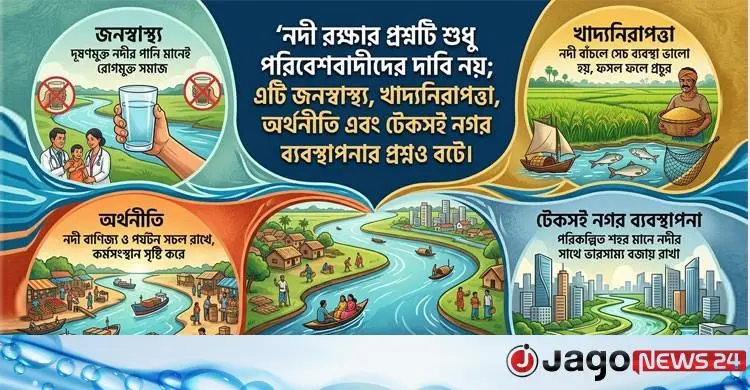
When river water is polluted, the effects do not stay in the river. Habitats of fish and other aquatic animals are damaged, the livelihoods of people who depend on rivers are put at risk, and public health can suffer when people come into contact with polluted water. The Department of Environment's national assessment also names sewage, solid waste, and industrial waste and liquid discharges among the main causes of surface water pollution, with industrial pollution one of the main causes in urban areas. Protecting rivers is therefore not just an environmentalists' demand; it is a question of public health, food security, the economy and sustainable urban management.
Stop pollution at the source
The first task in reducing river pollution should be to stop it at the source. Preventing polluted water from entering rivers is far more effective than cleaning it up afterwards.
Saving Bangladesh's rivers from pollution is not impossible, but it requires moving away from the old approach of cleaning up after waste is dumped and controlling pollution at its source. The government has already taken up a large-scale programme to cut water pollution in the Dhaka region, and the World Bank's 2026 programme considers sanitation, solid waste management, industrial effluent control, real-time pollution monitoring and river restoration together. But any project or programme will succeed only when it is implemented transparently, consistently and accountably.
Is untreated waste killing Bangladesh's rivers? The answer lies not only in the colour and stench of the water but in government water-quality data, the sources of pollution and the current state of urban waste management. What is needed now is to accept that reality and shut off the sources of pollution, because no country can move towards sustainable development by making its rivers the final destination for its waste.
The writer is an environment and public health development worker.
Source: Jagonews24. First published in Bengali on The Agro News.


Comments
(0)