
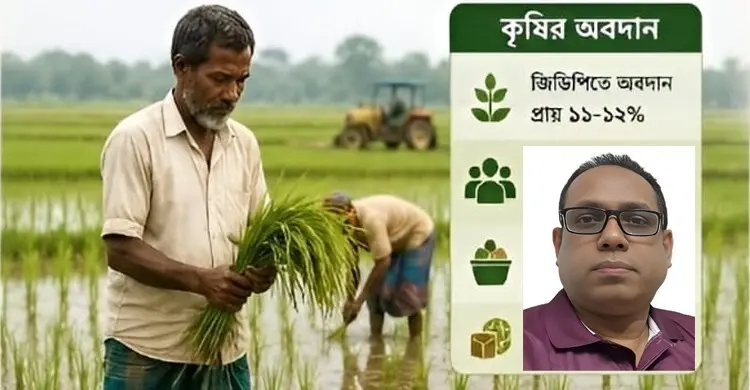
Agriculture is one of the main foundations of Bangladesh's economy, food security and rural livelihoods. Since independence the sector has made an important contribution to development, poverty reduction and self-sufficiency in food. Although its percentage share of GDP has fallen as industry and services have expanded, the employment of a huge share of the population, the food supply and the vitality of the rural economy still depend on agriculture. Its place in the national budget is therefore not just an allocation to one economic sector; it is a strategic matter directly linked to national security, social stability and sustainable development.
Agriculture has become even more important in today's world. Global wars, climate change, energy crises, volatile international markets and rising food prices have become major challenges for developing countries. In such a situation a strong agriculture budget can play an effective role in protecting domestic food security and maintaining economic stability. Agriculture should be seen not merely as a production sector but as one of the tools for safeguarding the nation's existence.
Food security first
The biggest importance of agriculture in the national budget is ensuring food security. Bangladesh's population keeps growing while arable land is shrinking. In this reality, adequate allocations for improved seed, fertiliser, irrigation, farm machinery and technology-based farming are essential to raise food production. When the government gives farmers subsidies, incentives and other support, production costs fall and farmers are encouraged to produce. The country can then stay self-sufficient in food and meet people's needs even in a crisis.
The government's farmer card programme has made the farm support system more transparent and effective. It has made it possible to list genuine farmers, so that subsidies, incentives, seed, fertiliser and farm credit can reach them directly. Investment is needed in the national budget to make the farmer card system more digital and data-based. In smart farm management, a farmer database, mobile-based advice and the expansion of digital services will help modernise agriculture.
Subsidies and the rural economy
Farmers work amid many kinds of risk. Natural disasters, falling market prices and rising production costs all push them into losses. That is why farm subsidies in the national budget are so important. Subsidies on fertiliser, diesel, electricity and farm machinery help cut farmers' production costs. Special incentives, seed support and rehabilitation programmes for small and marginal farmers also play an important role in keeping production going.
Agriculture is the centre of Bangladesh's rural economy. When farmers earn more, local markets, small businesses, transport and other services come alive. Investment in agriculture is therefore not only about developing farmers; it keeps the whole rural economy moving. Raising budget allocations for agro-based small industries, food processing and rural entrepreneurship would create jobs and ease the pressure of migration to cities.
Technology, water and climate
Modern technology is now essential for sustainable farm production. Developed countries are raising output through drones, sensors, artificial intelligence, smart irrigation and IT-based farming systems. Bangladesh too needs special budget allocations to modernise agriculture. Farm mechanisation, smart soil sensors, weather-based advice and digital farm platforms can make farmers' decisions easier. Expanding technology-based farming through coordination between agricultural universities, research institutes and private innovators is now a need of the times.
Agriculture in Bangladesh depends heavily on water. Because of climate change, drought in some places and excessive rain in others are putting farming at risk. The national budget needs long-term plans for digging canals, conserving reservoirs, improving irrigation and managing water. In many areas rivers and canals have silted up, causing water shortages for farming. Planned re-excavation of canals and modern irrigation can play an important role in raising production.
Bangladesh is one of the countries most at risk from climate change. Cyclones, floods, drought, salinity and irregular rainfall are having a major impact on agriculture. The farm budget must therefore stress climate-resilient agriculture. Research and extension for salt-tolerant rice, drought-tolerant crops, floating agriculture and climate adaptation technology must be expanded, and farmers need training and awareness about climate risks.
Exports and agro-industry
Bangladesh's farm products are gradually gaining popularity in international markets. There are opportunities to earn foreign currency by exporting vegetables, fruit, tea, jute, spices and processed food. But limits in meeting international standards, storage and market management mean the export potential is not being fully used. Higher budget allocations for cold storage, processing, quality control and export support could increase farm exports significantly.
Many industries in Bangladesh depend on agriculture. The food, jute, sugar, textile and dairy industries get their main raw materials from the farm sector. When farm production rises, industry grows stronger too, so adequate investment in agriculture is needed to sustain industrialisation. The growth of agro-based industries would ensure fair prices for farmers' produce and create new jobs.
Agriculture is not only about producing food; it is also linked to social stability. Its role in raising rural incomes, reducing poverty and narrowing social inequality is very important, and it plays a key part in meeting the Sustainable Development Goals. The budget needs long-term plans for environment-friendly farming, the use of organic fertiliser and safe food production.
Credit, insurance and research
Most farmers in Bangladesh are small and marginal. Lacking enough capital, many are forced to borrow at high interest, which raises production costs and exposes them to financial risk. Farm credit on easy terms and the expansion of digital banking are therefore urgent. Introducing and expanding crop insurance to protect farmers from crop losses is also much needed. If farmers hit by natural disasters can recover quickly, farm production will stay steady.
There is no alternative to research and training for agricultural development. The Bangladesh Agricultural Research Institute, agricultural universities and other research bodies are playing an important role in developing new varieties. But a lack of adequate budget allocation for research often slows progress. Long-term investment is needed to develop high-yielding, disease-resistant and climate-resilient varieties. Training farmers in modern cultivation, soil management and the use of technology will also raise productivity.
The gap between allocation and reality
Although agriculture receives an allocation in the national budget every year, many farmers in practice miss out on the expected benefits. The dominance of middlemen in the market, rising production costs, the lack of fair prices, adulterated fertiliser and seed, and storage shortages are major problems for farmers. Budget announcements are often not matched by implementation on the ground, so farmers do not get the benefits they expect. It is not enough simply to enlarge the budget; good governance, transparency and effective implementation must also be ensured.
In this reality, giving the farm sector top priority in the national budget is a need of the times. Agriculture is not just a production sector; it is one of the foundations of the country's food security, economic stability, employment and national security. Even in times of global war, climate crisis or volatile international markets, a strong agriculture budget makes the country able to cope.
Long-term, practical plans must therefore be made with the coordination of agricultural universities, research institutes, government agencies and private innovators. A farmer-friendly, technology-based and timely budget will not only increase food production but also strengthen the path to poverty reduction, higher export earnings, rural development and sustainable economic progress. The importance of agriculture in Bangladesh's national budget is thus not merely economic; it is one of the main strategic foundations of the country's future security and sustainable development.
Source: Jagonews24. First published in Bengali on The Agro News.


Comments
(0)