
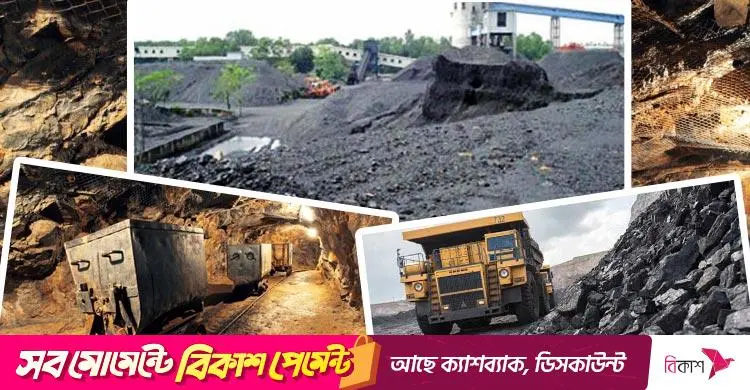
By Dr Forkan Ali
Natural resources matter enormously to any country's economic development. The more natural resources a country has, the greater its potential for growth. By using the country's labour, talent, capital and technology to make good use of natural resources, economic development can be secured. Proper use of natural resources helps rapid industrialisation, raises national income and improves living standards. Bangladesh has considerable natural resources, but for lack of the necessary initiative, capital and technology, it has not been possible to extract and use them properly. As a result, despite plentiful natural resources, Bangladesh is still counted among the world's less developed countries. For the sake of economic development, extracting natural resources and using them well is urgent.
Natural resources are nature's gift, and help economic activity directly or indirectly. A country's geographical position, climate, rainfall, soil, rivers, agricultural resources, mineral resources, forests, fisheries and energy are all natural resources. Life on earth depends on them. In economic development, natural and human resources complement each other. The nature and distribution of natural resources differ from country to country, and they contribute greatly to production and overall economic activity. Bangladesh has its own features here, with several major natural resources, among which mineral resources stand out.
What Bangladesh has
Bangladesh is rich in minerals, but extraction is very low compared with need, so most of the minerals required have to be imported. The country's minerals include coal, mineral oil, limestone, china clay, copper and silica sand, and the atomic minerals zircon, monazite, ilmenite, magnetite and leucoxene. Sulphur, gravel, mineral sand (radioactive sand), hard rock, natural gas and salt are also especially important. Bangladesh has no salt mine, but a great deal of salt is produced in the coastal districts by trapping seawater. Natural gas is made up of methane (CH4), the simplest and lightest hydrocarbon, and is Bangladesh's main mineral resource.
Recently the Geological Survey of Bangladesh (GSB) estimated the market value of the country's mineral reserves. By its calculation, they are worth more than $2.26 trillion (2 lakh 26 thousand crore dollars), or Tk 241.97 trillion (2 crore 41 lakh 97 thousand 300 crore taka). This does not include the value of natural gas reserves. If natural gas were counted, the estimated value would rise by several trillion dollars more.
People in the sector say that despite the huge reserves, governments have shown little interest at various times. If exploration and extraction were pursued, minerals could become a big source of foreign exchange, and could also solve the current energy crisis and even ensure energy security. Energy experts and geologists say: "Among the minerals in the country, only natural gas is being extracted on a large scale, and its proven reserves are now running out. We believe there is more gas in the country and it can be extracted. There are five mines in the north. There is also a huge amount of limestone underground in Joypurhat, which is not extracted either."
Calls for exploration and investment
There is mineral sand at Cox's Bazar and in the Brahmaputra river. White clay is extracted locally to some extent, along with some glass sand, but only on a small scale. Md Farid Uddin, a former Petrobangla official who also served as country director of the US energy exploration company United Meridian, said: "Bangladesh has huge natural resources at sea and on land. The gas and coal reserves in particular are proven. There has been no proper exploration or investment to extract them, which is why, year after year, dependence on imports has risen as gas supply has fallen." According to this energy and mineral expert, "Leaving other resources aside, the Chattogram region alone has strong potential for gas and oil reserves. Various international consultancies have recommended exploration, but no step has been taken. Sadly, the energy division has planned to drill 46 wells, yet there is no plan to explore in Chattogram. The government should invest properly in potential areas and come out of import dependence. Otherwise the energy sector will remain in uncertainty."
The GSB also says the monetary value it has put on the discovered minerals is essentially a notional figure based on reserves. If feasibility studies could be done, the quantity of minerals would increase, their true size would become clear, and their real value at market prices could be assessed.
The GSB's figures
The Ministry of Power, Energy and Mineral Resources says the GSB has valued eight types of discovered minerals at 2,26,140 crore dollars. They include more than 725 crore tonnes of coal, worth 1,26,890 crore dollars at $175 a tonne. Probable peat reserves are about 60 crore tonnes, worth about 3,590 crore dollars (35.9 billion) at $60 a tonne. There are 2,527 crore tonnes of limestone, worth 75,810 crore dollars at $30 a tonne; 20.10 crore tonnes of hard rock worth 542 crore dollars; 23 crore tonnes of white clay worth 2,990 crore dollars; 511.70 crore tonnes of glass sand worth 6,140 crore dollars; 220 crore tonnes of gravel worth 3,300 crore dollars; and 62.5 crore tonnes of iron worth 6,880 crore dollars.
The GSB director general said: "We have set an approximate value on these resources. A land survey or feasibility study of them would give a complete picture. The amount could then go up or down." The GSB believes detailed research is needed on whether the discovered minerals can be extracted. On coal in particular, its senior officials say the discovered coal lies very deep underground, and technology to extract coal from such depths is not yet readily available in Bangladesh.
According to information on the GSB website, coal reserves are 105.30 crore tonnes at Jamalganj in Joypurhat, 10.20 crore at Barapukuria in Dinajpur, 14.30 crore at Khalashpir in Rangpur and 40.20 crore tonnes at Dighipara in Dinajpur. Peat reserves are 28.20 crore tonnes at Hakaluki Haor in Moulvibazar, 15 crore at Baghia-Chanda Beel in Gopalganj, 7.5 crore at Derai and 5.20 crore at Shalla in Sunamganj, 3.20 crore at Bijoynagar in Brahmanbaria and 80 lakh tonnes at Kolamouza in Khulna.
On limestone, the GSB says the largest reserves are in the northern district of Naogaon, with more than 2,500 crore tonnes at Tajpur, Badalgachhi and Bhagabanpur. There are also 10 crore tonnes at Joypurhat Sadar and 5.90 crore at Panchbibi upazila in Joypurhat, and 1.70 crore at Baghalibazar, 1.29 crore at Tekerghat and 1.29 crore tonnes at Lalghat in Sunamganj. Valuable white clay is found at Madhupur in Tangail (12.5 crore tonnes), Madhabpur in Habiganj (6.80 crore tonnes) and Bijoypur in Netrokona (2.5 crore tonnes), with reserves also identified in several other districts. The agency reports large gravel reserves in six districts, totalling 220 crore tonnes. There are 65 crore tonnes of iron ore at Hakimpur in Dinajpur, and glass sand reserves of more than 3,200 crore tonnes. Proper extraction and use of these minerals could meet the country's needs and become a source of much foreign exchange.
The writer is a researcher and former principal.
Source: Jagonews24. First published in Bengali on The Agro News.

Comments
(0)