
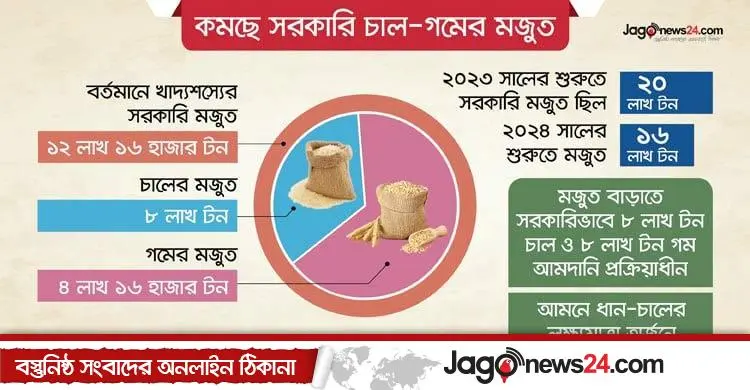
Government food grain stocks are steadily falling. Public warehouses now hold a little over 12 lakh tonnes of rice and wheat. The food-friendly programme starts in March and will take a large share of the stock. Rice prices are also up. To build stocks and control the market, the government has moved to buy 16 lakh tonnes of rice and wheat.
According to the Ministry of Food, public grain stocks stood at 12 lakh 16 thousand tonnes on Sunday (5 January), of which about 8 lakh tonnes was rice and the rest wheat. At the start of 2023 public stocks were about 20 lakh tonnes, and at the start of 2024 around 16 lakh tonnes.
Why stocks have fallen
Officials of the Ministry of Food and the Directorate General of Food said the previous government imported no rice towards the end of its term. Instead, rice was distributed to one crore families under family cards, which is why stocks are somewhat lower than before. This time too, 50 lakh families will get 30 kg of rice each at Tk 15 a kg under the programme, and a large part of current stocks will go to it.
Food secretary Md Masudul Hasan told Jagonews: "In the last fiscal year the government did not really import rice. On the other hand, under the TCB's one crore family cards we have to give each family five kilograms of rice a month. That figure is very big, which is why stocks have fallen somewhat."
A visit to Dhaka markets found that although new aman rice has arrived, rice prices have risen by Tk 2 to 6 a kg over the past two weeks. No rice is available below Tk 62 a kg at retail; the rice at that price is coarse Swarna and Paijam, both of which came to market this aman season.
Rice mill owners say they raised rice prices because paddy prices rose. Farhad Chakdar, general secretary of the Naogaon Rice Mill Owners Group, told Jagonews there is no paddy at the mokams (wholesale hubs). Paddy prices have been high from the start this time and have risen by Tk 70 to 80 a maund over the past week to ten days, so rice prices had to rise naturally.
Checks found that at the major rice hubs of Khajanagar in Kushtia, Naogaon and Dinajpur, Swarna paddy is selling at Tk 1,420 to 1,470 a maund, up Tk 50 a maund from the previous week. Over the same period the price of a sack of rice has risen by Tk 200 to 250, with a 50 kg sack selling at Tk 2,600 to 2,700 in those areas.
Moves to build stocks
The government is importing 8 lakh tonnes of rice and 8 lakh tonnes of wheat to build stocks, and rice and wheat have started arriving. Rice is also being imported privately, and aman paddy and rice procurement has been stepped up. Officials said stocks will be raised to 20 lakh tonnes by June.
Directorate General of Food officials believe that once imported rice arrives in full, market prices will fall and stocks will be in a good position.
Officials said that when the rice market is unstable, the government tries to stabilise it by widening the coverage and allocation of open market sale (OMS) of rice at subsidised prices. Rice is also distributed through the food-friendly programme and other social safety net programmes. The government builds its stocks mainly through domestic procurement and imports.
Officials of the Ministry of Food and the Directorate General of Food said the government is making a strong push to import rice and wheat. It will be possible to import 8 lakh tonnes of rice and 8 lakh tonnes of wheat in the next few months, and the process has begun. The first ship carrying 24,000 tonnes of rice arrived from India on 25 December, and another ship with 27,000 tonnes of rice is due on 10 January.
Food secretary Md Masudul Hasan told Jagonews: "We are importing rice and wheat from abroad to build stocks. Ship after ship is arriving. The process of bringing in 8 lakh tonnes of rice and 8 lakh tonnes of wheat is in the pipeline. If there are no weather or other problems, this rice and wheat will reach us in the next few months."
The secretary added: "The food-friendly programme will begin in March and rice will go there. But we have done that calculation. We will not face any crisis situation, Insha'Allah."
Imports from India, Myanmar and beyond
Md Monirujjaman, director (procurement) of the Directorate General of Food, told Jagonews: "Rice is already coming from India. We have tendered for three lakh tonnes of rice, all of which will come from India. Besides this, a government-to-government agreement has been signed with Myanmar to bring one lakh tonnes of rice."
He said talks are also under way with Vietnam: "We want to bring one lakh tonnes of rice from there. Talks are going on to bring another one lakh tonnes of rice from India on a G2G basis. Talks are also under way with Pakistan for one lakh tonnes; even if not one lakh, we can say we will get 50,000 tonnes."
Monirujjaman said: "One and a half lakh tonnes of wheat is also in the pipeline. 50,000 tonnes has come from Ukraine. Another one lakh tonnes will come from Argentina. The tenders and agreements are done."
Aman procurement lags
A large share of government stocks comes from buying paddy and rice on the domestic market. The target for this aman season is 10 lakh tonnes of paddy and rice: three and a half lakh tonnes of paddy, five and a half lakh tonnes of parboiled rice and one lakh tonnes of atap (sun-dried) rice. Purchases of parboiled rice and paddy began on 17 November and will continue until February; atap rice will be procured until 10 March.
Parboiled rice is being bought at Tk 47 a kg and paddy at Tk 33 a kg, and atap rice at Tk 46 a kg. But because market prices of paddy and rice are higher than the set prices, the government cannot buy as much as it wants. So far the food department has procured only about two lakh tonnes of rice and very little paddy. The government has therefore taken a tough stance to procure rice in line with the aman target.
The Directorate General of Food recently sent letters to field-level food officials to take action against mills that did not sign contracts this aman procurement season, or signed but did not supply rice.
The letter said that before the current aman procurement season (2024-2025), the numbers of eligible parboiled and atap rice mills reported to the directorate were 9,284 and 997 respectively. Within the deadline, 6,909 parboiled and 847 atap mills signed contracts. The number of parboiled mills that did not sign is 2,375, and of atap mills 150.
It also said a review of daily procurement reports showed procurement in some districts, upazilas and centres was still negligible, and at some centres it had not even begun, which was undesirable and unwarranted. It did not appear that officials and staff at these facilities were properly carrying out the duties assigned to them.
The letter gave three directives. Eligible mills that did not sign contracts this aman season are to face action under paragraph 7 of the Essential Food Grain Procurement, Management and Control Order, 2022, though for mills in flood-hit areas action must take account of the reality on the ground.
Anti-hoarding drives are to be conducted with the help of local administrations at eligible mills that did not sign contracts, or signed but have not yet supplied rice. District food controllers are to be instructed to take necessary action under the contracts, including issuing show-cause notices, against mill owners who signed but did not supply rice.
Where procurement in districts or upazilas has fallen short of the contracts, and negligence of duty is found on the part of district food controllers, upazila food controllers or officers-in-charge of warehouses, the Directorate General of Food is to be informed so that administrative action can be taken after show-cause, the letter said.
Eight officials have also been assigned to the eight divisions of the country to monitor progress towards the aman paddy and rice procurement target.
Millers warned
Director (procurement) Md Monirujjaman said: "Last year the aman rate was Tk 44; this time it is Tk 45. The market is now above 45, so millers are a little less keen to give rice to the government. On average about 10,000 tonnes of rice is coming in daily. If it continues like this, we hope to get close to the rice target."
He said: "But the price we set for paddy, the farmer is getting at home. At the price he gets sitting at home, he will naturally not come to the government warehouse to sell. So very little paddy is coming in. For paddy, the government wants to give farmers price support. Farmers are getting that. The goal of ensuring fair prices for farmers on paddy has been met."
The director added: "If millers do not give rice, they will face punishment. We have already informed them by letter. Those who do not cooperate with the government and those who give rice to the government cannot be treated the same way."
To keep the rice market stable, the government has already withdrawn all duties on rice imports. Since all duties were withdrawn on 1 November, permission has been given in four phases to import a total of 14 lakh 81 thousand tonnes of parboiled and atap rice privately.
Food secretary Masudul Hasan said 87,000 tonnes have already arrived since private imports were opened. "We have another 27 new applications, which will get permission. Those who already have permission will also get more time. We hope the domestic rice market will remain stable in the coming days," he said.
Source: Jagonews24. First published in Bengali on The Agro News.


Comments
(0)