
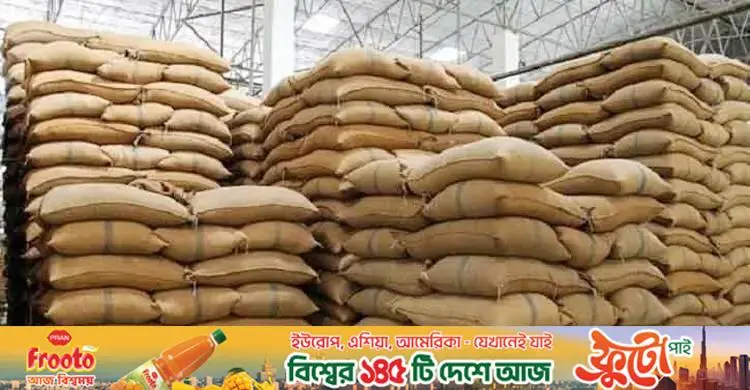
Public food grain stocks have risen since the BNP government took office, as part of efforts to ensure food security. On 10 February this year the country's public food grain stock stood at 22,10,670 tonnes. By 9 September it had risen to 23,59,154 tonnes, an increase of 1,48,484 tonnes over the period.
Storage capacity has grown too. It used to be about 24 lakh tonnes, but under a special BNP initiative there is a plan to raise it to 34 lakh tonnes within the next five years. It has already reached 27 lakh tonnes.
The safe stock threshold is also being raised. Previously a stock of 13.5 lakh tonnes was considered the safe limit, but the new government led by Tarique Rahman has set the safe limit at 16 lakh tonnes.
Officials at the Ministry of Food say that thanks to the government's food-friendly policies, there is now no worry about food in the country.
What is in the stores
According to the latest figures from the Ministry of Food and the Directorate General of Food, the public food grain stock is at a satisfactory level. It comprises 20,36,102 tonnes of rice, 2,32,183 tonnes of wheat and 34,070 tonnes of paddy.
Including floating stock, public food grain stocks total 23,59,154 tonnes, of which 68,723 tonnes of wheat is floating stock.
Earlier, on 4 August 2025, when the interim government marked one year in office, the combined rice and wheat stock was 21.31 lakh tonnes: 19.54 lakh tonnes of rice and 1.77 lakh tonnes of wheat. Compared with then, the total public stock has now risen by 2,28,154 tonnes.
The upward trend is even clearer compared with the Awami League government's time. According to the ministry's comparative figures for the same period, the food grain stock in 2024 was 16,84,330 tonnes, so the current public stock is about 6.75 lakh tonnes higher than in 2024.
Those involved say adequate stocks will play an important role in keeping market supplies normal, keeping prices stable and dealing with any emergency.
Procurement and imports
The current Boro procurement drive has also made good progress. In the 2025-26 Boro procurement, a total of 16,83,195 tonnes of paddy and rice had been procured by 9 September.
This comprises 5,78,140 tonnes of paddy, 12,01,568 tonnes of parboiled rice and 1,05,313 tonnes of atap (sun-dried) rice. In addition, 523 tonnes of wheat have been procured.
Imports are also continuing to cover shortfalls and keep stocks strong. From 1 July to 9 September of the 2026-27 financial year, 8,27,700 tonnes of food grain were imported by the public and private sectors: 65,860 tonnes by the government and 7,61,840 tonnes privately.
Ministry officials said the government is working with an integrated plan covering production, procurement, imports and stocks to ensure people's food security, and is monitoring the stock situation regularly to keep supplies adequate.
The current stock is about 10 lakh tonnes above the long-standing safe stock standard of 13.5 lakh tonnes, so the country's food security system is in a strong position. However, taking population growth and food consumption into account, the government has moved to raise the safe stock to 16 lakh tonnes.
The government has also set a target of raising the overall grain storage capacity of public warehouses to 34 lakh tonnes over the next five years, and the Ministry of Food has already started work towards it.
The ministry's departments say stocks and procurement are being closely monitored to ensure adequate grain supplies in the market, keep prices stable and keep food distribution under social safety net programmes running smoothly.
What officials say
Mohammad Kamrul Islam Chowdhury, joint secretary of the ministry's procurement wing, told the media that this season's domestic food grain procurement drive is being carried out successfully and satisfactorily. He thanked farmers and all other stakeholders involved.
He said government food warehouses now hold adequate and safe stocks of rice and wheat, which will serve as a strong base for dealing with any situation and ensuring national food security.
Kamrul Islam Chowdhury said the government is fully prepared to keep rice prices stable and to continue food distribution under social safety net programmes.
Md Mahbubur Rahman, director general of the ministry's Food Planning and Monitoring Unit (FPMU), said the government is working steadily to align food grain stocks and storage capacity with growing national demand.
He said there has been enough rain this year, so the government is hopeful of meeting its Aman cultivation target, and expects Aman procurement, like Boro, to exceed its target.
Mahbubur Rahman said international wheat prices are rising gradually, which could increase import costs. But the government has an alternative plan, such as providing rice instead of wheat in the food-friendly programme, so under the present situation there is no chance of any crisis or problem.
On food procurement and supply management, Md Jamal Hossain, additional director general of the Directorate General of Food, said the country's food security situation is very satisfactory. Along with ensuring adequate grain stocks in public warehouses, top priority is being given to proper storage and maintaining food quality.
He said Boro paddy and rice are being procured from marginal farmers across the country in a transparent and orderly process, so farmers are getting fair prices for their paddy and rice. Grain storage capacity used to be about 24 lakh tonnes and has now risen to 27 lakh tonnes.
Work is under way to raise public grain storage capacity to 34 lakh tonnes over the next five years, Jamal Hossain said, one of the goals announced in the current government's election manifesto.
Source: Jagonews24. First published in Bengali on The Agro News.

Comments
(0)