
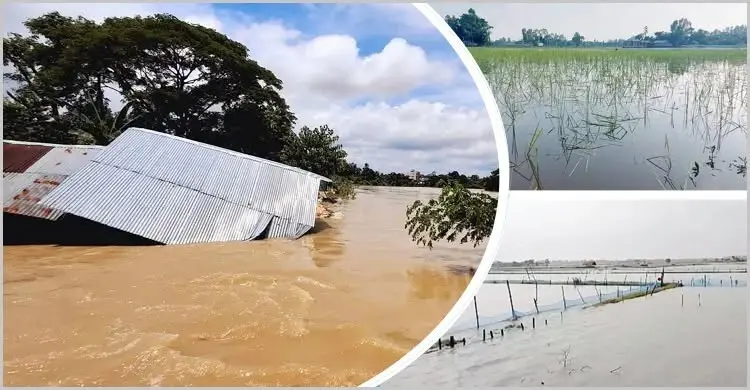
Continuous very heavy rain across the country has so far damaged the farm sector in 43 districts. By Monday, 13 July, crops on a total of 114,723 hectares had been damaged in these areas, 107,425 hectares of it in the 16 worst-hit districts. Over the same period, fisheries and livestock suffered losses of about Tk 400 crore.
According to the agriculture ministry, more than 500,000 farmers have been hit by the disaster. Damaged crops include Aus paddy, Aman seedbeds, summer vegetables, ginger, turmeric, papaya and other produce.
Of the total damaged land, 79,500 hectares are Aus paddy fields, 10,504 hectares Aman seedbeds and 17,800 hectares summer vegetables.
Experts say the widespread crop damage has raised fears of supply shortages that could further fuel food inflation in the country.
The 16 worst-hit districts
The figures show the 16 worst-hit districts are Chattogram, Cox's Bazar, Rangamati, Khagrachhari, Noakhali, Cumilla, Habiganj, Naogaon, Jashore, Meherpur, Bagerhat, Barguna, Bhola, Barishal, Jhalakathi and Patuakhali. Crops on 107,425 hectares were damaged in these districts, more than 90 per cent of all affected cropland in the country, and 456,076 farmers were affected there.
The Department of Agricultural Extension (DAE) has submitted this report on farm losses to the agriculture ministry. Md Obaidur Rahman Mondal, director of the DAE's Field Service Wing, said the flood situation was being closely monitored and the full picture of actual losses in the field could be assessed once the water recedes.
He said the top priorities now were to determine the actual crop losses, estimate likely losses and list the affected farmers. Steps to help affected farmers are also under consideration.
New seedbeds on government land
Mohammad Amin Ur Rashid, Minister for Agriculture, Fisheries and Livestock, said Aman seedbeds had suffered most in the ongoing floods. To make up for this, new seedbeds are being prepared on government land, and the seedlings raised there will be distributed to affected farmers. Aman seedbeds can be prepared until 15 August. Since Aman has not yet been transplanted on a large scale, the risk of major crop loss is relatively low, he said.
He said union-level DAE officers were collecting field data round the clock, and the Bangladesh Agricultural Development Corporation (BADC), the Bangladesh Rice Research Institute (BRRI) and other bodies had been told to be ready to prepare alternative seedbeds quickly in affected areas.
Tk 399 crore loss to fisheries and livestock
The Department of Fisheries and the Department of Livestock Services have confirmed the losses in their sectors. A review of their two reports shows a total loss of Tk 399.12 crore.
According to the reports, Chattogram, Cox's Bazar, Bandarban, Rangamati and Khagrachhari were worst hit in this sector. In 156 unions of these districts, 157,300 cattle, 4,148 buffaloes, 112,655 goats, 24,795 sheep, 1,191,020 chickens and 24,028 ducks were caught in the floods.
In these areas 45 cattle, 123 goats, 40 sheep, 101,198 chickens and 1,521 ducks have already died. Sixty-five livestock farms and 63 poultry farms were damaged, and 118 tonnes of cattle feed were destroyed.
According to the Department of Fisheries, 12,043 tonnes of white fish, 14,000 tonnes of shrimp, 18 lakh fingerlings and 259 lakh fry were washed away by floodwater in 602 unions across the country. Losses to boats came to Tk 167 lakh and to fishing nets Tk 123 lakh, while losses to infrastructure, sluice gates, ponds, enclosures and other items stood at Tk 4,382 lakh.
Source: Jagonews24. First published in Bengali on The Agro News.


Comments
(0)