
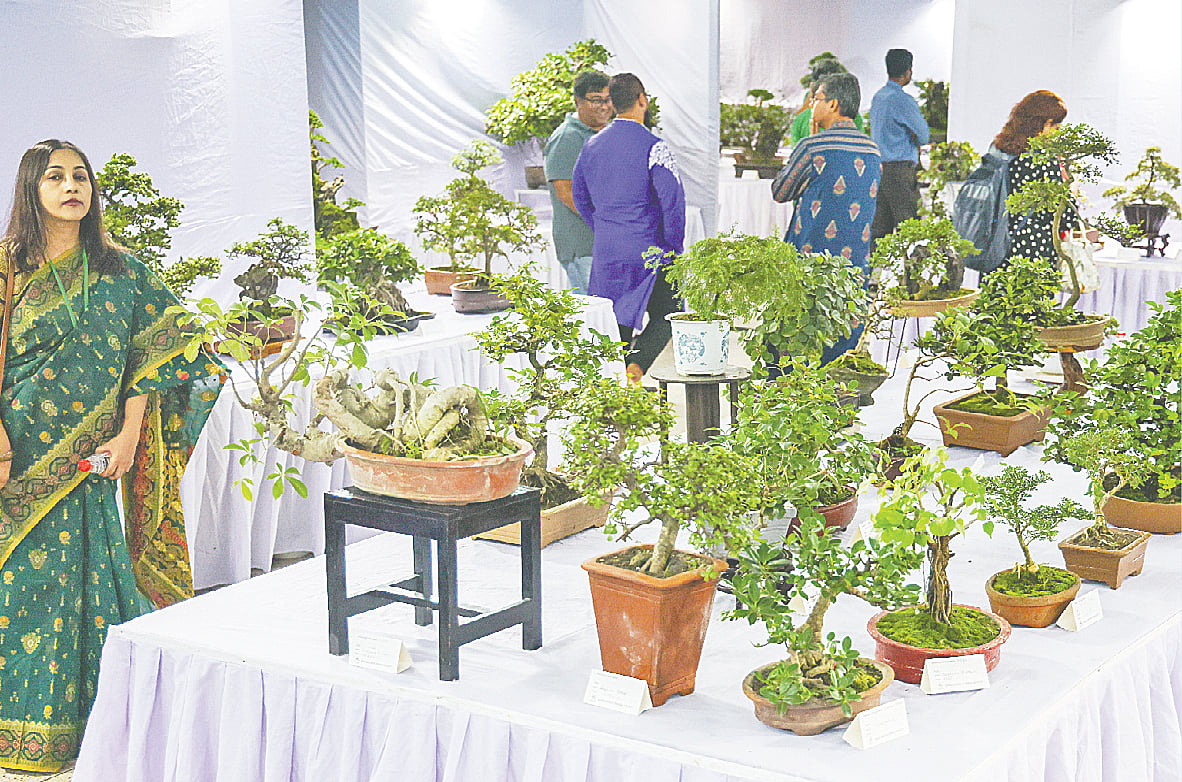
It is more than fifty years old, has never grown in size, and still flowers regularly. The kamini bonsai tended by Anisul Haque carries a price of Tk 6 lakh and is the oldest tree at the bonsai exhibition that opened on Thursday at the WVA auditorium on Road 27 in Dhanmondi, Dhaka. The Bangladesh Bonsai Society (BBS) is holding its 25th annual exhibition this year; the four-day show is open to all from 10am to 8pm daily.
Organisers said more than 300 bonsai are on display, priced from Tk 500 to Tk 6 lakh. Alongside flowering, fruiting, medicinal and familiar species, the aim this year is to introduce city dwellers to rare native trees such as boichi, tamal, ghurni and khoya babla. Native species popular for bonsai include banyan, pakur, tamarind, hijal, kamini, arjun and sheora, and the tables also hold bougainvillea, jade, ficus, premna and Chinese elm.
The exhibition was opened in the morning by the artist Mostafizul Haque, supernumerary professor at the Faculty of Fine Arts of Dhaka University and chairman of Shanto-Mariam University of Creative Technology. He said the practice of bonsai has become popular in the country, that its use in decorating offices and homes is growing, and that the art can keep young people away from social-media addiction. With BBS president Nazma Shafiq in the chair, the opening was also addressed by Takahashi Minori, deputy head of the public relations and culture section of the Embassy of Japan, the actress Afsana Mimi and BBS general secretary Anisul Haque; Mohammad Shahabuddin moderated.
Nazma Shafiq said the society began its work in 1999, when many people were practising bonsai in isolation, and has since brought enthusiasts together through training and exhibitions. Age is not the only measure of a bonsai: the tree's form, the shape of its pot and the soil at its base all count. The show includes compositions that use moss, grasses, rock and dry stumps to evoke a forest or hillside, and bonsai arranged on wooden frames with small sculptures, including figures of Japanese sages.
Whatever the prices, bonsai has yet to become a profession in Bangladesh, Anisul Haque said. The practice is confined to cities, yet most tenants in the capital have no roof or balcony on which to keep trees. Rooftop farming has caught on because it pays and produces food; bonsai offers neither. A bonsai cannot be left behind on a long trip, and some unscrupulous nurseries sell poor-quality trees that later die.
In Japan, China, Vietnam and Malaysia bonsai are grown commercially in gardens and small bonsai gardens are laid out in front of buildings, arrangements that do not exist in Bangladesh. A promising branch of the nursery and horticulture trade therefore remains, for now, within the bounds of a private hobby.
Source: Prothom Alo
Comments
(0)