
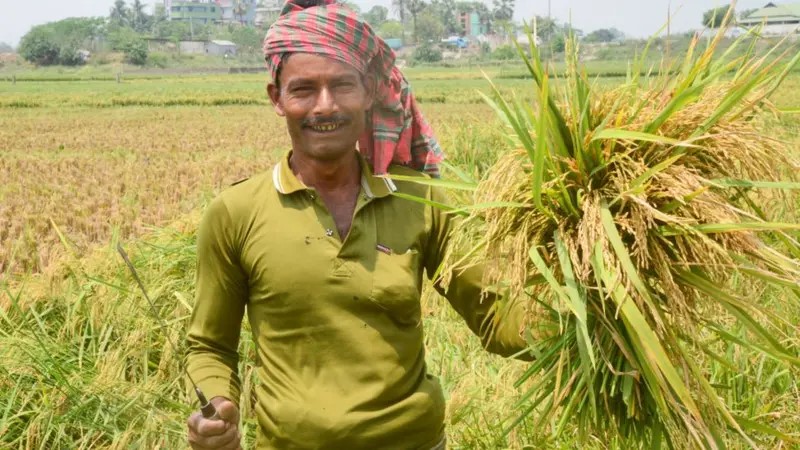
A few visitors from the city stood in front of a house with a shiny new tin roof in a village in Tangail, resting after a tour of the fields. They had come to see how the area was faring since farmers had switched from the local Chamara rice to high-yielding varieties.
Seeing the townspeople, the householder came out and asked who they were. "We are from the Bangladesh Rice Research Institute," they told him.
"We were not at all prepared for what happened next," said Dr M A Salam, a former scientist at the Bangladesh Rice Research Institute (BRRI).
"The man shouted with joy and hugged me. He said, 'Allah has sent you as angels.' We were stunned. We could not understand what was going on."
From Chamara rice to high-yielding varieties
That was in 1996. River training works for the construction of the Jamuna bridge had by then made the area free of floods. Before, farmers there grew only the local Chamara rice, which grows with the floodwater and can be cultivated in three to four feet of water, but its yield was very low. With the area now flood-free, farmers had begun growing high-yielding rice for the first time.
The farmer then pulled Dr Salam and his colleagues by the hand into his house. "This tin-roofed house you see, I built it with the money from selling rice," he said. "Fourteen generations of my family lived in huts. Growing Chamara, we barely had enough to eat. Now look how much rice I have. You have changed our lives."
In a career of several decades as a successful rice scientist, it is one of Dr Salam's sweetest memories.
Four tonnes a hectare
"Across the three seasons of Aus, Aman and Boro, rice is now grown on a total of 11 to 11.5 million hectares in our country. We now get an average of four tonnes per hectare. That is why we now have a surplus in rice production. Otherwise, if we had stayed at one and a half to two tonnes per hectare, it would have been impossible to feed and clothe Bangladesh's 170 million people," he said.
Across the Old Brahmaputra river from Mymensingh town lies the village of Char Ishwardia. In the autumn of 1974, when Bangladesh faced one of the most terrible food crises in its history, severe want struck that village too.
Source: BBC Bangla. First published in Bengali on The Agro News.
Comments
(0)