
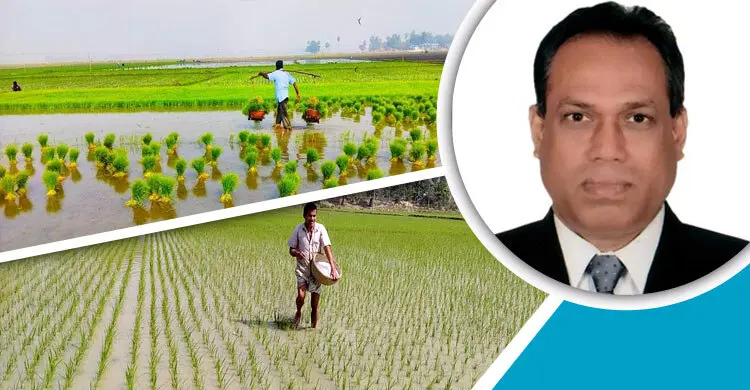
Bangladesh is small in area but densely populated, and it is also recognised around the world as a country rich in crop production. At this moment the whole world is bracing itself, because of the inequality and corruption lurking in societies and countries, wars, climate change and various pandemics. The harmful effects of climate change have been felt in Bangladesh and around the world for several years.
According to the Food and Agriculture Organization (FAO), 45 countries now face the greatest risk of severe food insecurity due to shortages. Nine of them are in Asia, including three in South Asia, Bangladesh among them. By the FAO's estimate, global grain production will fall by 1.4 per cent this year, and Bangladesh will not be spared. With this in mind, the relevant ministry of the interim government must adopt effective steps and programmes to keep Bangladesh's production plans on track.
Bringing fallow land under cultivation
Of Bangladesh's roughly 1 crore 61 lakh of cropland, total cultivable land is about 86 lakh 29 thousand hectares, of which cultivable fallow land is about 4 lakh 32 thousand hectares. If this cultivable land can be brought under cultivation, it will help tackle our food crisis and also benefit rural socio-economic development.
Bangladesh has about 253.60 lakh homesteads covering 5.40 lakh hectares, with an average homestead size of 0.02 hectares. There are 165.62 lakh farming families, and cultivable fallow land amounts to 2.23 lakh hectares. To bring this land into production, it is vital that the government's Department of Agricultural Extension brings fallow land under cultivation and gets homestead yards planted with vegetables.
There is also plenty of land in the hills. A Ministry of Agriculture survey found that at least 5 lakh hectares lie uncultivated in the hill districts of Rangamati, Khagrachhari and Bandarban. Unused land belonging to Bangladesh Railway, government educational institutions, parks, libraries and places of worship could easily be brought under cultivation. Rooftop gardening could also become a popular activity. This is also the time to make agriculture sustainable and up to date by expanding the use of modern farm machinery, following good agricultural practices and integrating artificial intelligence technology.
Inputs for the rabi and boro seasons
For the coming 2023-24 fiscal year, it is vital to ensure support and access to farm inputs (fertiliser, seed, pesticides, irrigation, fuel oil, electricity and farm credit) to expand cultivation and production of boro rice, wheat, maize, mustard, sunflower, groundnut, winter mung bean, various winter vegetables, onion and other rabi crops. BRRI's high-yielding modern rice varieties are now grown on 82% of the country's boro (winter rice) area, 36% of the aus (summer rice) area and 47% of the transplanted aman (monsoon rice) area. BRRI rice is currently grown on 75% of the country's rice land and accounts for 85% of total rice production. BRRI's high-yielding modern varieties play a key role in raising rice output every year. So now is the time for the Ministry of Agriculture of Bangladesh's interim government to give maximum consideration and attention to agriculture and farmers for a successful rice harvest in the coming boro season.
Good agricultural practices
Good agricultural practices (GAP) are an overall set of farming activities that, when followed, make safe and quality food and non-food farm products readily available and strengthen environmental protection, the economy and society. By giving top priority to safe food production, producing safe food and exporting food products under Bangladesh's good agricultural practices policy will further consolidate the country's agriculture. Implementing GAP in on-farm production and post-harvest processes is extremely important to ensure safe, quality food from the farm to the consumer.
If agriculture survives, the people of the country can survive with two handfuls of food to eat. The present interim government must grasp this with the utmost seriousness. In its World Economic Outlook report published last October, the IMF said the world economy could face a severe recession in 2023-24. The government of Bangladesh, and the agriculture adviser in particular, must now weigh the overall importance of agriculture and give the highest consideration to agricultural development and farmers' welfare. There is no alternative.
Source: Jagonews24. First published in Bengali on The Agro News.
Comments
(0)