
Farmland is shrinking constantly because of a growing population, unplanned urbanisation, housing and various development activities. A process to make a law protecting farmland began long ago but never saw the light of day. Now, at the initiative of the interim government, a tough ordinance to protect agricultural land is on the way.
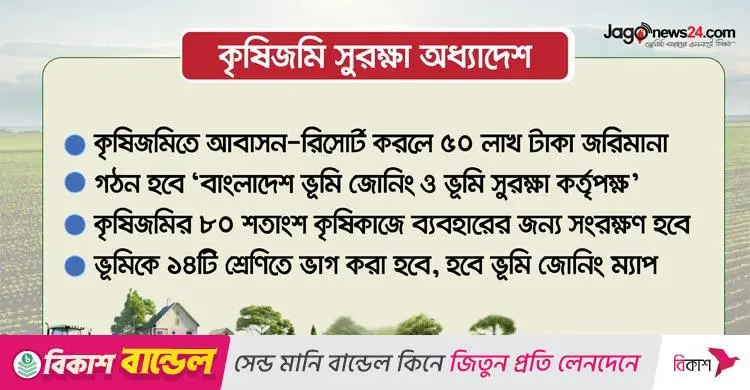
The land ministry has drafted the "Land Use and Agricultural Land Protection Ordinance, 2025". The draft stresses protecting farmland and adds strict rules; using farmland for non-agricultural activities will bring severe punishment. The maximum penalty for breaking the law is two years in prison and a fine of Tk 1 crore.
Under the draft, a "Bangladesh Land Zoning and Land Protection Authority" will be formed. The authority will preserve 80 per cent of farmland for agriculture. The proposed ordinance also says specific geographic areas will be divided by use, or zoned, after examining existing land use, natural features and landforms through images captured with advanced technology, field inspection and analysis.
Officials said the draft would soon be sent to the Advisory Council for approval after gathering the views of all parties and completing other procedures.
Ministry's view
Md Moinul Hasan, deputy secretary (Law-2) at the land ministry, told Jago News: "We have many people but little land, so we must protect our farmland. Under the leadership of the land adviser, the environment and forest adviser and the agriculture adviser, we have drafted an ordinance whose main focus is protecting farmland."
He said: "The draft was placed once before the Advisory Council, but the council sent it back with observations and asked us to put the emphasis on protecting farmland. We are drafting it accordingly." He added: "We are taking opinions on the draft. Then we will hold an inter-ministerial meeting, finalise it and soon send it to the Advisory Council for approval."
Penalties in the draft
The draft says anyone who fails to follow the authority's directions to prevent harmful changes to the land surface, including on land other than farmland, will face punishment. Using farmland for non-agricultural work other than building a homestead according to the rules will also be punished. The authority may remove unauthorised structures, confiscate them and sell them at auction.
In these cases the maximum penalty is one year in prison or a fine of Tk 10 lakh, or both. A repeat offence doubles the penalty, to two years in prison or a fine of Tk 20 lakh, or both.
Any real estate company or housing society that builds a housing estate on farmland without approval for commercial purposes, or holds large amounts of farmland to build one, will also face punishment.
If any person, group, company, industrialist, businessman, bank, insurance company, capitalist, NGO or club holds more farmland than the amount set by rules, without approval, for a commercial or entertainment centre, resort or any purpose other than farming, everyone involved in its management will face up to two years in prison or a fine of Tk 50 lakh, or both. For a repeat offence the penalty doubles, and in this case the draft says two years in prison and a Tk 1 crore fine must be paid.
The draft also says a court may, if it sees fit, seize materials and evidence of an offence, confiscate them and arrange their sale at auction.
The new authority
The authority will have a chairman and four members. The chairman will be an officer of additional secretary rank, and two members will be appointed from officers serving at least as joint secretary.
Until the authority is formed, the Land Reform Board will exercise all its powers and duties. Divisional commissioners, deputy commissioners, upazila nirbahi officers and assistant commissioners (land) will exercise the authority's powers in their own jurisdictions, the draft says.
To protect farmland and ensure planned, zone-based land use, the authority will, across the country at once or in phases, examine existing use, natural features and landforms of specific areas or mouzas and prepare a "land use zoning map" and spatial plans for the whole country using mouzas, plots or other marks or boundaries. It will maintain a database and update it regularly.
It will arrange land protection based on classification by use. It will measure the country's farmland and take steps to preserve at least 80 per cent of the total for agriculture.
For zoning, land may be divided into 14 classes: agricultural zone, agriculture-fisheries zone, rivers and canals, water bodies, transport and communication zone, urban residential zone, rural settlement zone, mixed-use zone, commercial zone, industrial zone, institutional and civic facilities zone, forest and plantation zone, cultural heritage zone, and hills and hillocks.
The draft details how zoning maps will be prepared. A district committee led by the deputy commissioner (DC) will receive, hear and settle objections to a zoning map, and a divisional committee led by the divisional commissioner will hear appeals against the district committee's decisions.
Rules for farmland
The ordinance says all farmland must be protected under the law. Without the authority's permission, farmland may not be used for another purpose, have its class changed, or be used in a way that changes its class. There will be no bar on using non-agricultural or other land for farming.
Land that grows two or more crops may never be used for anything other than agriculture. Single-crop land must also be used as farmland. However, considering national importance and the public interest, the minimum necessary amount of single-crop land may be allowed for government or private development projects, roads, educational institutions, industries, agriculture-related commercial activities or other special needs.
A person may use the minimum necessary amount of their own farmland to build a homestead, place of worship, graveyard, tomb, warehouse, family pond, shops, cottage industry and other structures linked to the homestead. They may not use more than that without the authority's approval.
Ceilings for land use may be set by rules. Forest, wetland, river, hill and hillock land, and sea and coastal land, may not be used for any other purpose without the authority's approval.
In the interest of food security, the government may, in line with the zoning map and after informing the land ministry, preserve any region or area as a "special agricultural zone". If fuel, mineral or archaeological resources are found, or are likely to be found, on any land, the law will not prevent the government from taking steps to explore or extract them, but the land ministry must be informed.
Source: Jagonews24. First published in Bengali on The Agro News.
Comments
(0)