
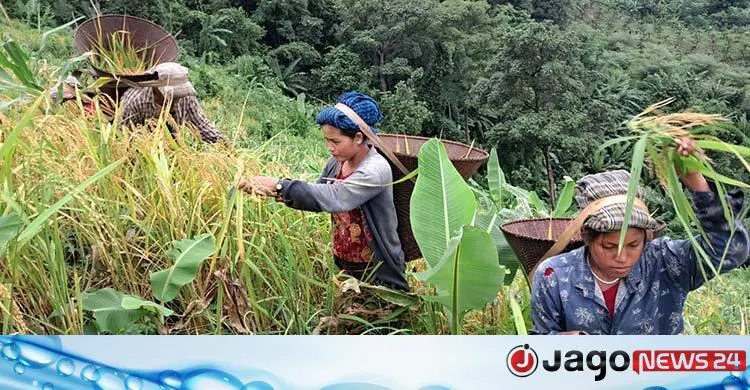
The slopes of the green hills now glow with ripe jhum paddy. In some places harvesting is in full swing, while elsewhere jhum farmers are guarding their ripe crop. Alongside the paddy, they are busy bringing in the other crops grown on their jhum plots.
This was seen at Jamini Para in Tarachha union of Rowangchhari upazila in Bandarban on the morning of 4 September. With the harvest of jhum paddy, grown on hill slopes and dependent on nature, under way, the farmers are smiling with relief. As far as the eye can see, patches of ripe golden paddy appear between the green hills.
Timely rain this year meant there was little delay in sowing, and yields have been comparatively good in many areas. But because rain does not fall evenly across the hills, jhum paddy does not ripen everywhere at once. Those who sowed after the first rain at the start of Boishakh have crops ready for harvest earlier.
A retired policeman returns to jhum
Ring Lot Mro, 57, was cutting ripe paddy with his family and eight women working on a labour-exchange basis. He said he sowed three ari (10 kg each) of seed paddy on about three acres of hill land this year, and the yield has been fairly good thanks to timely rain.
"In the past, jhum paddy did well when sun and rain came on time," he said. "Now they don't come on time. It's as if nature has turned upside down." Even so, he is satisfied with this year's harvest. He hopes to get about 150 to 200 ari of paddy from the three acres, and said up to 250 ari would have been possible with a better yield.
Ring Lot Mro retired in June this year after 25 years in the police. Rather than sit idle, he has returned to jhum, his forefathers' traditional occupation.
"Jhum doesn't only give paddy," he said. "There are 30 to 35 kinds of companion crops, including brinjal, marfa, sesame, barley, maize, chinal, chilli and roselle. We only need to buy salt and nappi (a kind of dried fish) from the market. Jhum is like a market for us; we get many of the vegetables we need from here."
Songdong Mro, 19, busy cutting paddy, said: "What would we eat if we didn't do jhum? We have to do it. We farm jhum every year. It's our tradition." She said sweet pumpkin, marfa, brinjal, maize, sesame, chilli, okra and other companion crops are grown alongside paddy, meeting the farmers' own needs and bringing in some money when sold at market.
The jhum calendar
Jhum is a long farming process that follows nature and the seasons. Each November-December, the site for next year's jhum is chosen, and in January-February the forest on the chosen hill is cut. After the cut vegetation dries in the sun, it is burned in March-April within a set "firing line". The site is then cleared throughout April and prepared for sowing paddy and companion crops.
Farmers wait for the first rain. If it comes at the start of Boishakh, paddy and companion crop seeds are sown. Those who sow quickly after the first rain see their paddy ripen earlier; those who sow later harvest later.
Area and output rising
According to the Department of Agricultural Extension (DAE) in Bandarban, the area under jhum is increasing every year. In 2023-24 the target was 7,162 hectares and 9,956 tonnes; in the event 8,540 hectares were farmed and 10,489.71 tonnes produced.
In 2024-25 the target was 8,487 hectares and 12,624 tonnes of rice; 8,267 hectares were farmed, producing 12,499.41 tonnes of rice.
For the current 2025-26 fiscal year, the target area is 11,895 hectares, and the agriculture department says the same area has been farmed. The production target is 13,387.93 tonnes of rice. Ripe jhum paddy is now being harvested in various remote parts of the district.
Agriculturist Toufiq Ahmed Noor, additional deputy director of the DAE in Bandarban, said jhum was grown on about 11,895 hectares this year, producing various companion crops as well as paddy. "A good jhum yield is expected this year," he said. "But because this is a hill region, rainfall is not even everywhere, so yields vary from area to area."
He said harvesting has already begun in remote areas of Rowangchhari, Ruma, Thanchi and Alikadam upazilas and will start in other upazilas in phases. The agriculture department gives various advice to increase jhum production.
A harvest festival is now under way on the hill slopes as people rejoice at bringing in the fruit of a year's labour. For jhum farmers who survive by contending with nature, this paddy is not just food but their life, their livelihood and part of a tradition handed down through the generations.
Source: Jagonews24. First published in Bengali on The Agro News.
Comments
(0)