
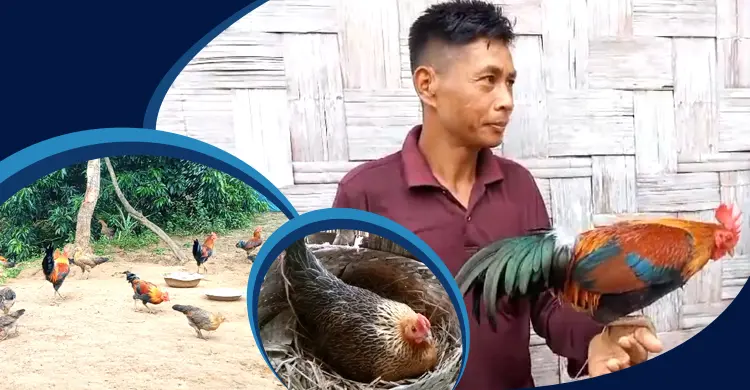
The jungle fowl is a very clever bird of the hills and forests, described as a vanishing species, and is regarded as the ancestor of domestic chickens. The cock measures 60-70 cm and the hen 40-50 cm, and their average weight is 600 to 800 grams. They look more handsome than domestic chickens and behave differently. Because supply falls short of demand, they are much sought after in local markets.
It is commonly said that jungle fowl cannot be tamed. Proving that belief wrong, Hla Shwe Aung Marma (40), of Mewa Para in Rajbila union of Bandarban Sadar upazila, is raising them at home and hopes to become self-reliant.
From three eggs to a farm
"About five years ago, on my way to cut jhum in the hills, I found a jungle fowl's nest with six or seven eggs," Hla Shwe Aung Marma said. "I brought three of them home and put them in a local hen's nest to be hatched naturally. One egg went rotten, and the other two hatched into a cock and a hen. They grew up with the local chickens."
"After a while the two chicks fell ill and lay on the grass. I tried hill creepers and leaves and forest herbs to cure them, but they would not recover. After some time I started feeding them hard grains of paddy. They got somewhat better after I brought ant eggs and various insects from the jungle and fed them," he said.
He then realised that the feeding habits of local chickens and jungle fowl are different. From then on he fed them separately with grasshoppers, insects and paddy grains, and even built housing that recreates something of a forest environment with trees, creepers and leaves. The flock has multiplied since then into a large jungle fowl farm.
His farm now has more than 150 jungle fowl. Of these, 22 are laying hens, 13 are cocks and two are hunting cocks (specially trained), along with chicks and brooding hens. Because the birds are in good demand locally, he sells mature cocks for Tk 3,000 each and hens for Tk 1,000 to Tk 1,500 each.
This year he has sold eight hens and five cocks and has more orders, Hla Shwe Aung Marma said. Asked about their weight, he said: "They are not like local chickens in weight. They are smaller and lighter. A mature cock weighs at most 700-800 grams, and a hen 600-700 grams."
Officials on the law and animal health
Md Tohidul Islam, Bandarban divisional forest officer (pulpwood), said: "Chickens that grow up naturally in the forest are called jungle fowl. If anyone catches them in the forest and sells or kills them, there is a legal process to bring them under the Wildlife Conservation Act. Since Hla Shwe Aung Marma somehow collected the eggs and is raising the birds with domestic animals, he cannot be brought under the Wildlife Conservation Act."
District livestock officer Dr Palash Kanti Chakma said: "We usually rear chickens free-range, semi-free-range or confined. Jungle fowl suffer less disease than local chickens, but they do get Ranikhet, cholera and pox, which can be prevented with vaccines. If the farmer contacts the livestock office, we will give all-round support, including advice on treatment and care."
Source: Jagonews24. First published in Bengali on The Agro News.

Comments
(0)