
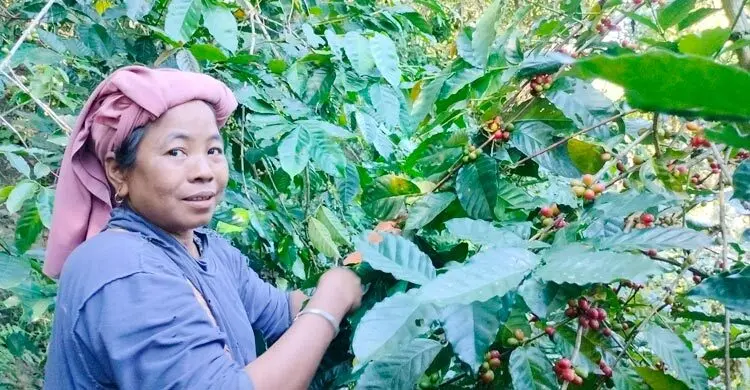
Nguiin Mro, who lives in the Chimbuk area of Bandarban, planted coffee in the hills alongside his fruit orchard. With good yields and good market prices, he now dreams of changing his fortunes through coffee. Many coffee species are grown around the world; in Bandarban, besides arabica and robusta, farmers grow Chandragiri, and many are turning to it because it yields more than arabica and robusta.
In the hills of the Babupara area of Tarachha union in Rowangchhari upazila, on Chimbuk hill, he has grown coffee on 10 acres alongside mango, pomelo, dragon fruit and litchi. Red and green coffee cherries, ripe and unripe, hang from the trees.
From 1,000 plants to 4,000
Nguiin Mro said he planted 1,000 Chandragiri coffee saplings in 2015 on the advice of a relative. He now has about 4,000 coffee trees. About 1.5 tonnes of cherries a year come from 1,000 of those trees, worth about Tk 2 lakh 55 thousand as cherries. If all the trees bear fruit at the same time, at least 10 tonnes of coffee cherries will be produced a year, worth Tk 10 lakh 20 thousand.
He said his coffee trees give good yields from three years after planting until 80 years. This variety suffers little disease and needs little care, so production costs are low and profits good. His 800 mango, 400 dragon fruit and 100 pomelo trees earn him Tk 2 lakh 30 thousand a year, while the cherries from just a portion of the coffee trees bring in Tk 1 lakh 20 thousand.
Demand and prices
Coffee specialist Toidu Ram Tripura said he has been working with coffee for 15 years. Demand for coffee has risen in Bangladesh, he said, and because there is no syndicate in selling the coffee produced, farmers get fair prices. Since production falls short of demand, coffee is also imported from Ethiopia, Brazil and other countries.
He said that because local growers are in direct contact with a coffee trading firm, Northern and Coffee Roast Company, ripe coffee cherries with the skin on from Bandarban sell for Tk 170 a kg. Chandragiri coffee is grown in the Chimbuk, Rowangchhari, Ruma and Lama areas of the district.
M M Shah Newaz, deputy director of the Department of Agricultural Extension (DAE) in Bandarban, said that from 2020–21, with the Chattogram Hill Tracts Development Board and its support, arabica and robusta coffee cultivation began on 250 acres across the district. Since then 7,500 farmers have been trained step by step. On their advice, the two varieties are now grown on 1,850 acres, yielding 700 kg of dried coffee beans per acre.
Source: Jagonews24. First published in Bengali on The Agro News.


Comments
(0)