
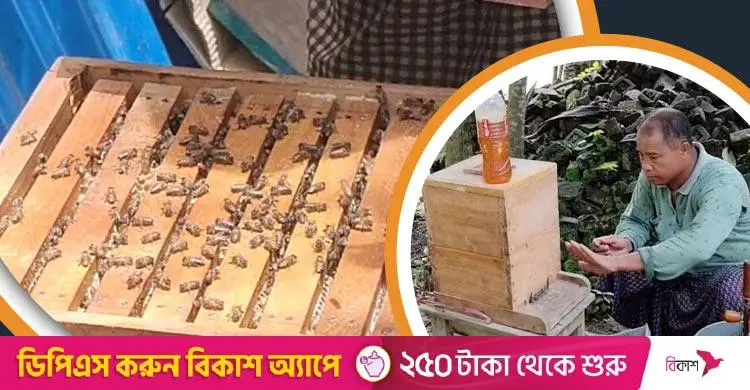
Interest in beekeeping by natural methods is growing in Bandarban. With success coming at low cost and little effort, and in the hope of extra income, many in the district are now turning to it.
According to local sources, beekeeping began in 2012-2013 with 15 entrepreneurs at Tetulia Para in Rowangchhari. Bees are now kept in all seven upazilas, including Ruma, Thanchi, Lama, Alikadam, Naikhongchhari and Sadar.
Beekeepers say they have had success since starting on a trial basis. Alongside their main income, the money from beekeeping plays a large part in household spending. If a farmer keeps bees in at least five boxes, the income will exceed their main income. With strong demand for pure honey and assured sales, the sector has great potential to make people self-reliant, and they hope that with adequate government support it could achieve revolutionary success.
Backyard honey
A visit to Tetulia Para in Tarachha union of Rowangchhari upazila found more than 60 bee boxes in the yards of 90 per cent of the households. Two to three kilograms of honey is collected from each box every two months. Because the honey is completely natural and unadulterated, there is strong demand in the local market.
Buyers come to the houses to buy it at Tk 1,800 to 2,000 a kg, and the villagers now dream of improving their fortunes through commercial beekeeping.
Ali Ahammed, the first beekeeper in the village, said he started beekeeping at Tetulia Para with 15 boxes in 2012. When two to three kilograms of honey could be collected from each box every two months, others in the village were encouraged to take it up. Now most residents are involved, and everyone is becoming self-reliant with the extra income alongside their main earnings. He hopes that with government support fully commercial production will be possible.
Kanumong Marma Karbari, the head of Tetulia Para, said he first started beekeeping after training from the sugarcane board in 2012. Now many in the village are involved and earning extra income.
Usa Mong said he had profited well from beekeeping. As soon as people hear honey has been collected, buyers crowd into the village. Those who collect honey from the jungle often sell honey containing wax, or adulterated honey in the hope of extra profit, he said, but their honey is collected in front of the customer, leaving no room for adulteration, which is why demand for it is so high.
Woman beekeeper Myalapru Marma said: "Once the boxes are made and the queen bee is collected, beekeeping does not need separate time every day. The money earned from beekeeping in the yard plays a big part in household spending, including the children's education." With government support, she said, it would be possible to change her fortunes through commercial beekeeping.
Government support
SM Shahnewaz, deputy director of the Department of Agricultural Extension (DAE) in Bandarban, said: "Because Bandarban is a hilly, forested district, there is a wide variety of flowers. Bees usually collect nectar within a kilometre of their hive. So in Bandarban, beekeeping by natural methods can easily be done just by collecting a queen bee."
He added: "Earlier, at least 150 people interested in beekeeping were given training and boxes. Anyone who shows interest now will also be given training and the support they need."
Source: Jagonews24. First published in Bengali on The Agro News.


Comments
(0)