
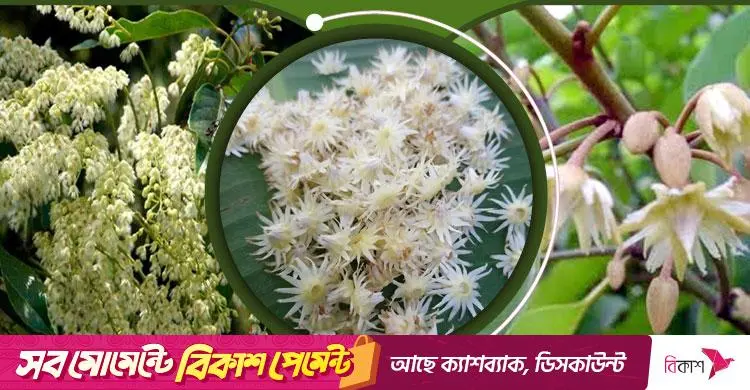
Not every falling is a decay; sometimes it becomes a symbol of beauty, writes Tanjid Shuvro. Many flowers bloom in the morning and fall by evening, but the bakul is different. It blooms in the silence of the night and falls on the path of passers-by on dewy mornings, then keeps dropping softly all day. There is no pomp, yet it leaves its mark, like someone slow, calm and gentle, easier to remember than to forget.
The bakul is a very familiar name in our lives. Childhood mornings, afternoons and evenings were all tied in some way to this small, beautiful flower: tiny white blooms like stars, a faint yellow tint in the petals. The fallen flowers looked like a floral sheet that nature had spread with its own hands. Bakul bloomed like stars in people's courtyards and school grounds.
Children made garlands of bakul. Some kept a dried flower between the pages of a diary, perhaps holding a fragment of time, unspoken words and countless memories. Even after a bakul garland dried, its scent seemed to linger in memory for a long time.
In poetry and song
Not only Rabindranath and Nazrul, but many poets, writers and even lyricists have written of the bakul. As a symbol of love, memory or waiting, it has found its place in literature. Poet Kazi Nazrul Islam wrote, "You have gone along the path strewn with bakul." The flower is also a name for a familiar sorrow. Poet Binoy Majumder wrote, "Like the bakul, at last / dried and turned brown, lasting long in a garland / will you come some day?"
The tree and its uses
The scientific name of the bakul tree is Mimusops elengi. It is a medium-sized tree covered in dense leaves. It flowers and sheds flowers all year round except in winter, blooming most in the monsoon. Even without flowers, it gives shade freely to tired travellers. Its leaves, bark and fruit are also useful. In Ayurvedic medicine, bakul is used for dental care, bad breath and digestive problems.
In today's concrete cities, bakul trees are hard to find. One or two may still stand beside an old campus or an abandoned government building, like a piece of affection frozen in time.
Even if this flower remains only a tree of memory, we should try to keep it alive. Bakul could be a leading choice in tree-planting programmes, and people can plant it on their own, so that the new generation knows its story.
The bakul lives on in our hearts, memories and stories. May our lives and love be like the bakul: quiet, humble but deep. If the world were a little more like the bakul, perhaps there would be less weariness and a softer shade over time.
The writer is a student in the Department of Botany, Bhawal Badre Alam Government College, Gazipur.
Source: Jagonews24. First published in Bengali on The Agro News.


Comments
(0)