

Sharecroppers were the farmers hit hardest by the loss of boro rice in the haor wetlands of Netrokona, Lutfozzaman Babar, the member of parliament for the Netrokona-4 constituency and a former home minister, said on Saturday, 9 May 2026. He made the remark that afternoon while visiting Fatunia haor in Kaitail union of Madan upazila, Jagonews24 reported that evening. Over the previous two weeks, heavy rain had left ripe boro paddy under water across the district's haors in the middle of the harvest, the one crop most haor families live on for the whole year.
What Babar said at Fatunia haor
According to Jagonews24, Babar said the administration had been given the job of drawing up a list of the farmers affected by the crop loss, but that the list it had prepared was not acceptable because, in his view, it contained exaggeration. He said the list would be checked and sorted again so that the real farmers received the incentive, and that arrangements would be made to give the incentive to the farmers who had genuinely suffered losses before Eid.
Babar also said that work in his area was being done on the basis of long-term planning, and that a five-year plan had been taken up for this purpose. The report did not describe what the plan contained, how many farmers were on the administration's list, how much support each family would receive, or whether the district administration had responded to his criticism of the list.
The visit to Fatunia haor was part of a two-day tour in which Babar went to haor areas in Madan, Mohanganj and Khaliajuri, the three upazilas that make up the Netrokona-4 constituency. During the tour he spoke with farmers and saw their hardship at first hand, the report said. Those present at Fatunia included Nurul Alam Talukder, president of the Madan upazila unit of the BNP; Rafiqul Islam Akanda, its general secretary; and Abu Taher, its organising secretary and chairman of the Kaitail union parishad.
Madan, Kaitail and the Mogra
Madan is one of the ten upazilas of Netrokona district in Mymensingh division. It covers 225.85 square kilometres and, at the 2022 census of the Bangladesh Bureau of Statistics, had 34,921 households and a population of 149,878, of whom 15.83 per cent lived in urban areas. It is bounded by Atpara and Mohanganj upazilas to the north, Itna and Tarail upazilas to the south, Khaliajuri to the east and Kendua to the west. Besides Madan municipality, the upazila is made up of eight unions: Fatehpur, Gobindasree, Chandgaon, Kaitail, Madan, Maghan, Nayekpur and Tiasree. Madan thana was formed in 1917 and became an upazila in 1983.
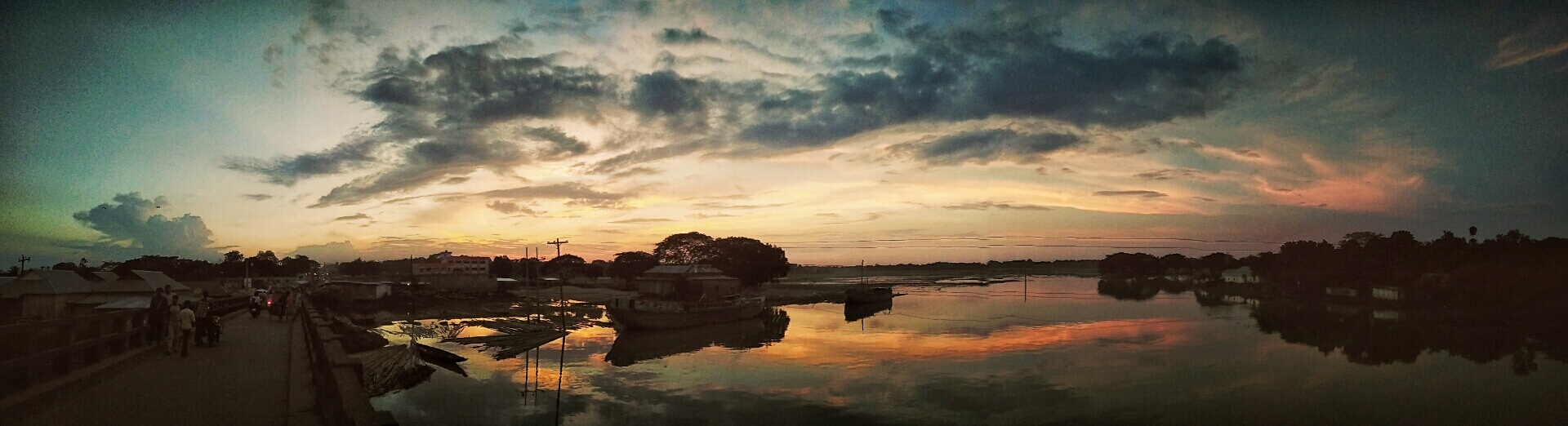
Madan is one of Netrokona's haor upazilas, and the Mogra river flows through it. In the last week of April 2026 Prothom Alo listed Gobindashree, Uchitpur and Kadamshree in Madan among the haors where ripe paddy had gone under water. According to Mizanur Rahman, the Madan upazila agriculture officer, boro had been planted on 17,650 hectares in the upazila that season; by 30 April paddy on 760 hectares there was submerged, while 68 per cent of the fields had been harvested.
A farmer from Kulihati village in Madan told Prothom Alo on 29 April that paddy on five acres of his land in Uchitpur haor had gone under water. He had hired labourers at Tk 1,400 a day, he said, but they would not go into the fields because of lightning. Two days later he said that even Tk 2,000 a day could not find workers for the paddy that was still above water.
Netrokona's haor and its single crop
A haor is a large, bowl-shaped depression that fills with river water and runoff in the monsoon and becomes a vast sheet of water, then largely dries out after the rains, exposing rich alluvial soil that is farmed for rice. Banglapedia, the national encyclopedia, describes the haors as the most productive wetlands of Bangladesh. They lie mainly in greater Sylhet and greater Mymensingh, in a basin bounded on the north by the hills of Meghalaya in India. The rivers rising in those hills supply the plains with water and sediment.
Netrokona district, with an area of 2,744.28 square kilometres and a 2022 census population of 2,324,853, borders the Garo Hills of Meghalaya to the north, Sunamganj to the east, Kishoreganj to the south and Mymensingh to the west. Its south-eastern part turns into haor during the monsoon. According to local farmers, the district administration, the agriculture department and the Bangladesh Water Development Board (BWDB), as reported by Jugantor and Prothom Alo in April 2026, the district's haor country consists mainly of Khaliajuri, Mohanganj and Madan upazilas and part of Kalmakanda. Netrokona has 134 large and small haors, 89 of them in Khaliajuri.
Boro, the dry-season rice crop, is the only crop of these haors. Farmers there depend on it for the whole year's household spending, medical costs, their children's schooling and social occasions. To protect it from early floods, 138 kilometres of submersible, temporary embankments were built in the district that season under the BWDB and the upazila administrations, at an estimated cost of Tk 31 crore. About 42,000 hectares of boro depended on these embankments. Jugantor put the market value of the crop from that area at about Tk 700 crore, and Prothom Alo reported that it produced about 300,000 tonnes of paddy.
Aminul Islam, deputy director of the Department of Agricultural Extension (DAE) in Netrokona, said in late April that boro had been planted on 185,547 hectares across the district that season, with a production target of 1,321,732 tonnes of paddy. Of this, 41,065 hectares lay in the haor area, with a target of 292,590 tonnes. In Khaliajuri alone boro covered 20,232 hectares, with a target of 148,000 tonnes, and the upazila agriculture officer said the high-yielding varieties BRRI dhan88, BRRI dhan89 and BRRI dhan92 were the most widely grown there. He also said the department had advised farmers to plant early varieties, but that many planted fewer of them in the hope of a bigger harvest.
How the rain took the harvest
The trouble began early. On 22 April 2026 the BWDB office in Netrokona advised haor farmers to cut their paddy quickly once 80 per cent of it had ripened, because heavy rain at Cherrapunji in India, upstream of the district, was coming down as hill runoff. Rain had been falling in Netrokona since the start of the Bengali month of Chaitra, the board said, and low parts of the haors were already waterlogged.
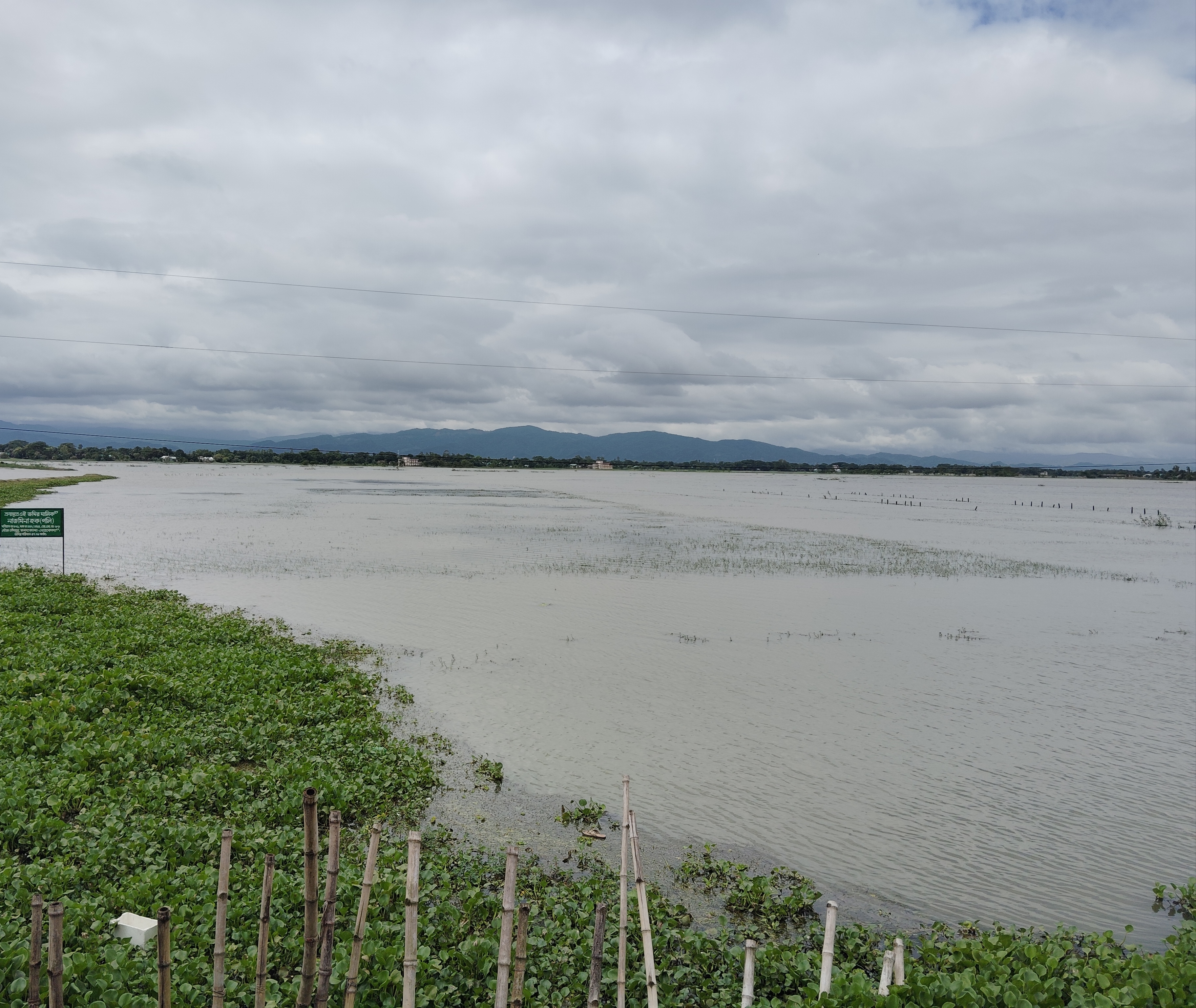
By 28 April a week of moderate to heavy rain had pushed up the Dhanu, Kangsha, Someshwari, Bhugai, Ubdakhali, Mogra and other rivers. The Dhanu at Khaliajuri rose by about four feet between the morning of 27 April and 9 am the next day, and three people were killed by lightning in Khaliajuri on 27 April. Farmers feared a repeat of the untimely flood of 2017, when they lost their crop. By the afternoon of 27 April, according to the DAE, 55 per cent of the paddy had been cut. In Kalmakanda, water entered Sonadubi, Goradoba, Angajura and Mohishashura haors and the Medi and Telenga beels, submerging ripe and half-ripe paddy on about 1,000 hectares.
Netrokona then recorded 132 millimetres of rain in the 24 hours to 9 am on 29 April, the highest of the season, and the Kangsha at the Jaria point rose 85 centimetres above its danger level. Prothom Alo reported that paddy on about 1,500 hectares had gone under in haors across Khaliajuri, Mohanganj, Madan and Kalmakanda, and that five people had been killed by lightning in the haor area over the previous month.
The official count kept rising. By the afternoon of 30 April the DAE put the submerged area at 9,625 hectares across Kalmakanda, Mohanganj, Khaliajuri, Madan, Atpara, Kendua, Sadar, Barhatta and other upazilas, including 4,985 hectares in Khaliajuri, 1,950 hectares in Kalmakanda and 650 hectares in Mohanganj. By 2 May the figure was 13,466 hectares. On 5 May the DAE's deputy director said paddy on 18,175 hectares had been ruined by the heavy rain, affecting about 72,000 farm families. At each stage local farmers told reporters that the real damage was larger, in places double the official figure, and on 3 May Prothom Alo, after touring haors in six upazilas, estimated that paddy on about 23,500 hectares was under water.
Officials stressed that this was waterlogging by rain, not a breach. The BWDB said none of the crop-protection embankments had broken. Khandaker Mushfiqur Rahman, the deputy commissioner of Netrokona, said on 1 May that no flood water had entered the haors; the paddy had been drowned by trapped rainwater that had no way out, because the haors' channels, canals and rivers had filled with silt. Farmers also blamed sluice gates that no longer worked. The sun returned on 4 May and farmers began drying what they had cut, though the Dhanu was still 14 centimetres above its danger level at Khaliajuri the next day.
Short of hands, machines and dry ground
Even where paddy stood above water, farmers struggled to cut it. Combine harvesters could not work in flooded fields. In Kalmakanda, Prothom Alo reported on 28 April, 35 harvesters were available, each needing about 120 litres of diesel a day, but a fuel shortage limited their work; one harvester owner said his machine needed 135 litres a day but the pump gave him only 80, enough for half a day's work. A Kalmakanda farmer said it cost about Tk 1,400 in wages to cut eight decimals of paddy, while paddy was selling for only Tk 700 a maund.
Labour was the other bottleneck. Wages reported by farmers rose from more than Tk 1,200 a day at the end of April to Tk 1,500 and even Tk 2,000 in early May, and still workers could not be found. In earlier years, farmers said, labourers came from Kishoreganj, Mymensingh, Jamalpur, Sherpur, Pabna and Rajshahi and stayed in the haors for the harvest, but with farmers relying on harvesters they were no longer brought in. Jugantor reported that the fear of death by lightning had also cut the number of outside workers. Some farmers went into the water with their wives and children to cut what they could, and some waded in chest-deep.
Cut paddy brought its own problem. With no sun for days, heaps of wet grain could not be dried on the khola, the open threshing yard, and began to rot and sprout. Straw, the cattle's fodder, could not be dried either; one Khaliajuri farmer told Prothom Alo he saw no way but to sell his cows. Farmers also said that because water drains from the haors late in the dry season, seedbeds and transplanting are delayed, which pushes the harvest later into the risky weeks.
Why sharecroppers carry the heaviest loss
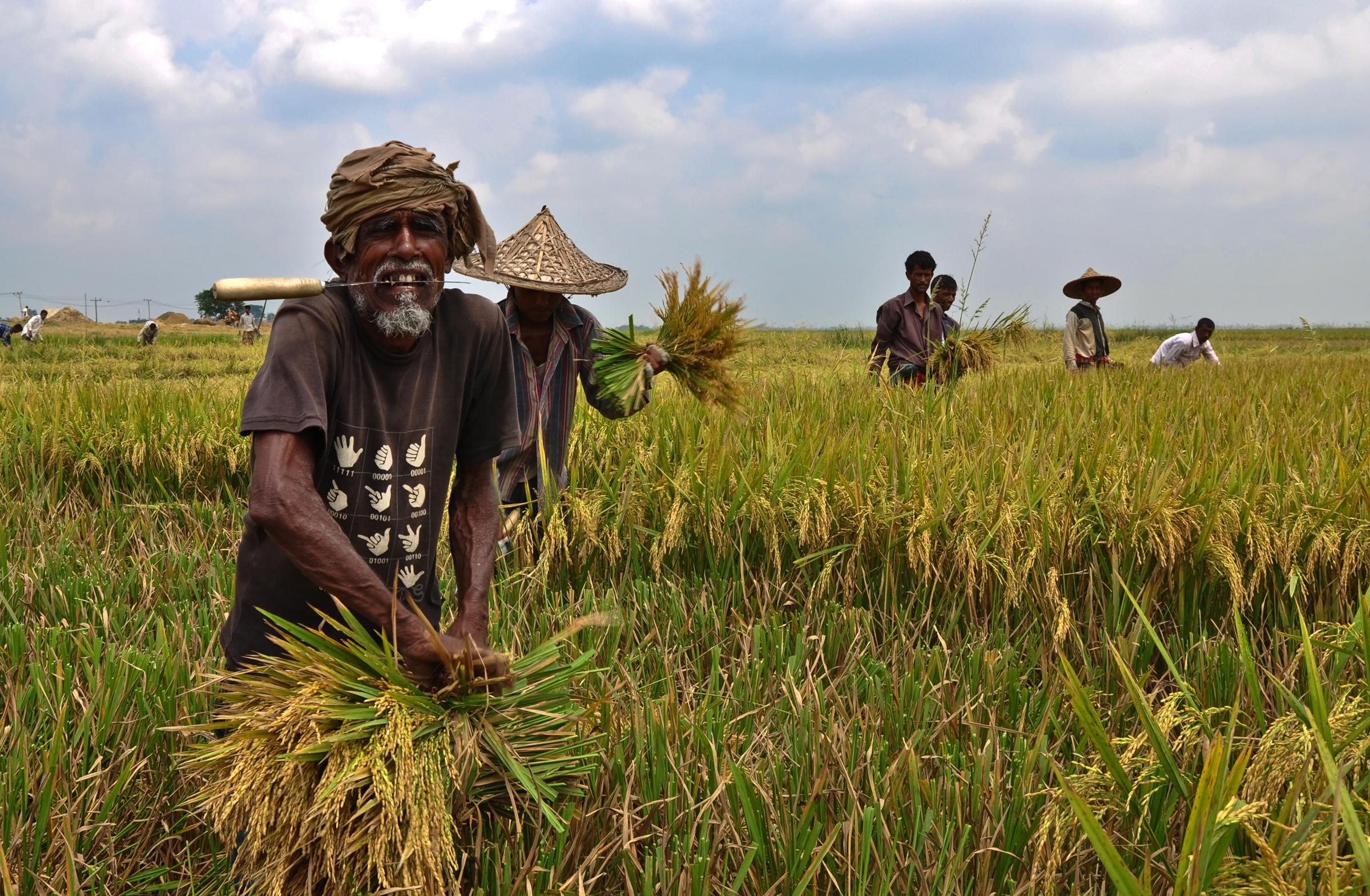
Sharecropping, known in Bangladesh as barga, is an arrangement in which a cultivator farms another person's land and shares the produce with the owner. According to Banglapedia, the share was long set by local custom, often half the harvest. The Land Reforms Ordinance of 1984 provided for one third of the produce of barga land to go to the owner and two thirds to the sharecropper, but Banglapedia notes that the law was never enforced at village level and that terms vary from area to area. It also records that the traditional barga declined from the 1960s and that landowners increasingly let out land for a fixed period against cash.
Babar's point echoed what others had said earlier in the month. At a press conference at the Jatiya Press Club in Dhaka on 3 May, organised by the Bangladesh Poribesh Andolon (BAPA), the Environment and Haor Development Organisation and Nagorik Uddyog, the writer and researcher Gawher Nayeem Wahra said that it was mainly sharecroppers who had been hurt and that they must be given support. He also warned that the list of genuinely affected farmers must be drawn up carefully so that it was not biased, and that the crop loss could lead to child marriage and children dropping out of school.
The economics of haor sharecropping explain why. Farmers in Madan and Sunamganj told the writer and researcher Pavel Partha, in a piece Prothom Alo published on 4 May, that cultivating one keyar of land, a local measure, cost Tk 8,000 in barga rent and Tk 7,000 in farming costs, Tk 15,000 in all. One keyar yields 20 to 25 maunds of paddy, and at the government price of Tk 36 a kilogram, they said, almost nothing is left for the farmer. Each of them, the farmers said, borrows heavily to farm.
Pavel Partha also described nayanbhaga, a harsh sharing practice in the haors in which labourers cut paddy that is going under water in return for half of what they cut, one share to the farmer and one to the worker. In that season, he wrote, labourers could not be found even on those terms. At the same press conference on 3 May, Shamsul Huda, executive director of the Association for Land Reform and Development (ALRD), said the crop loss would disrupt farmers' livelihoods, loan repayments, education and treatment, and that a fodder shortage was pushing farmers to sell cattle cheaply.
Aid, rice procurement and the lists
The government had announced support before Babar's visit. On 29 April, in parliament, Prime Minister Tarique Rahman said the farmers in the haor areas who had been hit by heavy rain would be identified and given government help for the next three months. He said he had spoken to the disaster management and relief minister that morning about the three districts concerned and parts of Mymensingh.
In Netrokona, the deputy commissioner said on 2 May that lists of affected farmers were being prepared and that the necessary help would be given. On 3 May the state minister for food, Abdul Bari, opened government procurement of paddy and rice at the public hall in Netrokona town, saying farmers could sell as much paddy to the government stores as they wished and that the government would help affected haor farmers for three months, extending the period if needed. The district food officer said Netrokona would procure 20,415 tonnes of boro paddy at Tk 36 a kilogram, along with 55,585 tonnes of parboiled rice and 2,340 tonnes of sun-dried rice from millers, rice at Tk 49 a kilogram. On 5 May the acting deputy commissioner said the work of preparing the list of affected farmers was still going on.
The lists themselves were already being questioned elsewhere. On 5 May in Sunamganj, Disaster Management and Relief Minister Asadul Habib said there was some talk about the lists of affected farmers and that no irregularity in preparing them would be tolerated. Affected farmers would receive government help for three months in a row and would be given cards for it, he said. That afternoon 400 affected farmers at Karchar haor in Bishwambharpur upazila of Sunamganj each received Tk 7,500 and 20 kilograms of rice, and an additional deputy commissioner said they would get this cash and rice support for three months.
Among 15 demands put forward at the Dhaka press conference on 3 May were 30 kilograms of rice and Tk 1,000 for each affected family throughout the year, direct government purchase of at least one million tonnes of paddy from haor farmers, interest-free loans and rescheduling of existing loans, community threshing centres and dryers, dredging of rivers, canals and beels, and an end to unplanned roads and embankments. Kasmir Reza, president of the Environment and Haor Development Organisation, said at least 75,000 hectares of boro had gone under water across the haor region after three spells of rain between mid-March and the end of April and breaches in crop-protection embankments.
Five-year plans and the case for change
Babar's five-year plan for his constituency was one of several long-term proposals made in those weeks. Asadul Habib said in Sunamganj on 5 May that short, medium and long-term plans would be taken to protect haor crops, and that small shelters with lightning conductors and sirens would be built in the haors to reduce deaths from lightning. The agriculture minister, Mohammad Amin Ur Rashid, said engineers had been put to work on solutions to waterlogging in the haors.
Local voices pointed to the drainage. Sanjay Sarkar, a haor researcher from Khaliajuri, told Prothom Alo on 2 May that the haors needed sustainable, coordinated planning rather than piecemeal schemes. Unplanned embankments, silted outlets and broken sluice gates kept rainwater in, he said, so the haor beds could be dredged and machines for drying paddy installed. He added that many farmers plant long-duration rice, with a growing period of 145 to 148 days, in the hope of a larger yield, and that they should be encouraged to plant varieties that mature within 140 days so the crop can be cut sooner.
Researchers at Bangladesh Agricultural University (BAU) in Mymensingh made a similar case on 4 May. Professor Habibur Rahman Pramanik of the Department of Crop Botany said an analysis of 36 years of data showed that early and flash floods had destroyed between 10 and 100 per cent of haor paddy each year, with the risk of flooding about 42 per cent in late April and about 50 per cent in May. BRRI dhan92, widely grown in the haors, takes 160 days and yields close to 9 tonnes a hectare, he said, while BRRI dhan88, BRRI dhan101, BRRI dhan105 and BRRI dhan113 take about 140 to 145 days but yield one to one and a half tonnes less, which is the main reason farmers are reluctant to grow them. His team had demonstrated these short-duration varieties in Sunamganj, Itna, Mithamain and Austagram since 2021 and called for transplanters and combine harvesters to be made easier to obtain.
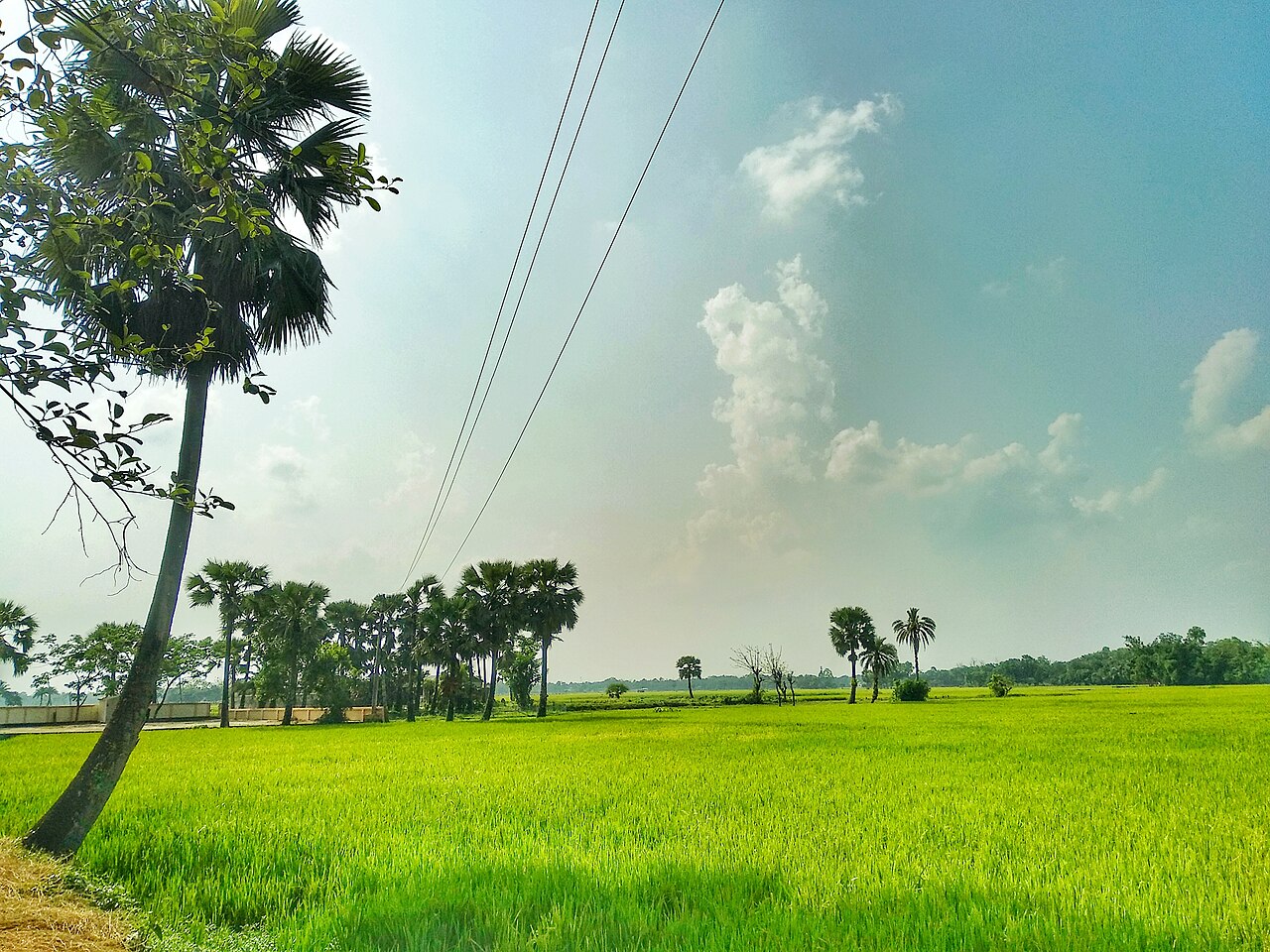
Photo: Tanin / Wikimedia Commons (CC BY-SA 4.0)
Sources: Jagonews24, Prothom Alo, Jugantor, Banglapedia, Wikipedia
Comments
(0)