
"Groundwater in many parts of Bangladesh is contaminated with arsenic. Growing rice under continuous flooding raises the level of this toxic element in rice to a worrying degree. But the 3F4D method (three days flooded and four days drained) significantly reduces inorganic arsenic in rice. Research shows that compared with continuous flooding, 3F4D cuts arsenic in rice by up to 40 per cent."
So said Professor Dr Md Rafiqul Islam of Bangladesh Agricultural University (BAU), director of the project on safe and nutritious rice production based on 3F4D.
He added that the technology could be seen as an effective step for public health as well as for producing safe food.
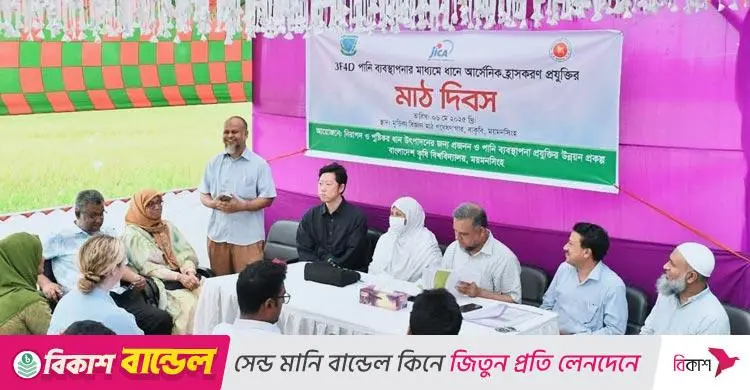
Field day at BAU
Professor Rafiqul spoke on 6 May at a field day for the project 'Development of breeding and water management technologies for safe and nutritious rice production', organised under the university's Department of Soil Science.
At the event, researchers presented how well the new 3F4D irrigation method works for safe rice production.
Lead researcher Professor Dr Rafiqul Islam said the results show that even with limited resources, farmers can use 3F4D to produce safe rice without hurting yields. There was no shortfall in rice yield under the method, and 65 to 80 per cent of irrigation water was saved, which he called a major step in tackling water scarcity.
The project is being carried out under the University Grants Commission of Bangladesh and the Secondary and Higher Education Division of the Ministry of Education, with technical support from JICA.
The chief guest was Professor Dr Md Mosharraf Uddin Bhuiyan, director of BAU's planning and development section. Dr Salma Laiju, additional director of the Department of Agricultural Extension (DAE) for the Mymensingh region, was special guest.
Source: Jagonews24. First published in Bengali on The Agro News.
Comments
(0)