
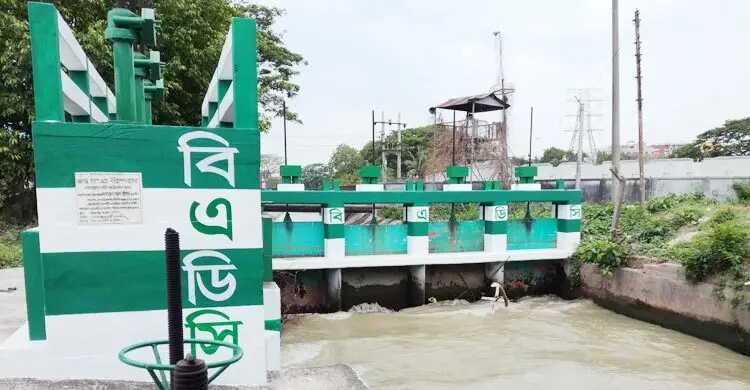
The Bangladesh Agricultural Development Corporation (BADC) has drawn up plans to spend Tk 463 crore 84 lakh 39 on expanding irrigation despite uncertainty over the scheme. The agency has proposed the project to build a canal for irrigation in Ashuganj, Brahmanbaria, and Palash, Narsingdi. The land where the canal of the proposed Ashuganj-Palash Sabuj Project would run belongs to the Roads and Highways Department (RHD).
The RHD has agreed to let the canal be built on its land, but on condition that the land be vacated on three months' notice if it is needed for road expansion. That means Tk 463 crore could go down the drain in the name of irrigation. The Planning Commission raised the issue at the project evaluation committee (PEC) meeting.
BADC's irrigation work was disrupted when a cooling reservoir was filled in through the Bangladesh Power Development Board (PDB) and the Ashuganj river port-Sarail-Dharkhar-Akhaura land port highway was upgraded to a four-lane national highway. The project has been proposed to solve that problem and will be carried out in seven upazilas of Brahmanbaria and Narsingdi districts.
Through the project, drought-prone areas would receive surface water and the soil's water-holding capacity would be raised from low to medium. It would also support the Sustainable Development Goals in the two districts by helping to end poverty and hunger and to achieve food security and better nutrition, and by expanding agriculture.
BADC says the project will run from now until June 2027 in Sadar, Ashuganj, Nabinagar and Sarail upazilas of Brahmanbaria and in Sadar, Palash and Shibpur upazilas of Narsingdi.
A five-year agreement
The commission says BADC signed an agreement with the RHD to build the canal. Although the land-use agreement has been signed, it runs for only five years, though it can be renewed in future. Yet condition 6 of the agreement states that if the road needs expanding, BADC must, on only three months' notice, remove all works, including irrigation structures it has built at its own cost, to a new alignment.
The commission said it must be considered whether investing Tk 463 crore of government money on the basis of such a temporary arrangement is justified. It has also asked for an alternative proposal instead of such an uncertain project.
The Planning Commission said an agreement was to be signed with the Power Development Board for the use of land to build a cooling reservoir, so that water from the Ashuganj power plant could be cooled and used for irrigation, but one year and two months after the PEC meeting it still has not been signed. The development project proposal (DPP) must also clearly describe how the project's activities relate to the specific goals, strategies and actions of the Bangladesh Delta Plan 2100.
In addition, no disaster impact assessment (DIA) has been carried out using the Disaster and Climate Risk Information Platform (DRIP) to identify disaster and climate risks in the project area. A DIA must be done through DRIP and ways to reduce those risks added to the DPP.
An official of the Planning Commission told Jago News: "A PEC meeting has been held on the project and we gave some directions. The canal of the Ashuganj-Palash Sabuj Project has been proposed on temporary land. That is a kind of uncertainty, and we have asked BADC to fix it. If they do, we will put it before an ECNEC meeting for approval; otherwise we will hold another PEC meeting."
No alternative site, says BADC
BADC says the PEC meeting on the Ashuganj-Palash Sabuj Project was held on 17 December 2023, chaired by AKM Fazlul Haque, a former member of the Planning Commission's Agriculture, Water Resources and Rural Institutions Division. But the question of building the canal on someone else's land was not resolved there. BADC says it has no alternative site, which is why it proposed the canal on RHD land.
Shibendra Narayan Gop, BADC's chief engineer (minor irrigation), told Jago News: "The land where the canal of the proposed Ashuganj-Palash Sabuj Project will run belongs to the Roads and Highways Department. There is no alternative site. The Planning Commission has raised questions about it, but the site was proposed because there is no alternative. If necessary, another PEC meeting will be held with the commission."
The project's main activities
Under the project, 1,100 cusecs of water from Ashuganj and 800 cusecs from the Ghorashal thermal power plant will be cooled to irrigate 24,860 hectares of land, making it possible to produce 124,300 tonnes of food. The project is being taken up to continue the Ashuganj-Palash Agro Irrigation (5th phase) project, which ended in the June 2020 financial year.
It aims to ensure higher crop production through permanent, sustainable irrigation that makes the best use of surface water, and to create self-employment and reduce poverty by engaging local farmers, men and women, in irrigation management, food grain production and processing.
BADC says the project is being taken up for various reasons. After independence, Father of the Nation Bangabandhu Sheikh Mujibur Rahman stressed how to rebuild a war-ravaged country. Hunger and famine were widespread at the time, and to free people from them he called on farmers for a green revolution. Farmers responded and brought about a revolution in agriculture that continues today.
Responding to Bangabandhu's call, local union parishad chairmen, notables, public representatives and farmers in Ashuganj started irrigation under the name Ashuganj Sabuj Project, cooling the hot water used to cool the Ashuganj thermal power plant.
Later, in 1978-79, the government took up a project called the Ashuganj Sabuj Project. At the same time a similar irrigation project grew up in the Palash area of Narsingdi. The two were merged, and ECNEC approved the Ashuganj-Palash Agro-Irrigation Project for 1990-95. It was carried out in successive phases, the fifth of which ended in June 2020.
The proposed project covers Brahmanbaria and Narsingdi districts, seven upazilas in all. The project area totals 114,985 hectares, of which 106,041 hectares are cultivable, 83,434 hectares irrigable and 64,993 hectares irrigated.
Source: Jagonews24. First published in Bengali on The Agro News.
Comments
(0)