
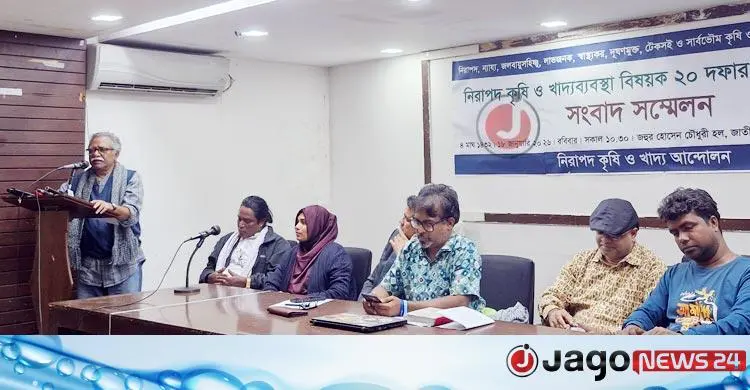
Economist Anu Muhammad, a former professor at Jahangirnagar University, has said farmers are getting cancer as a result of the country's growing agricultural development. "That 64 per cent of cancer patients are farmers did not happen by chance," he said. "It is a result of the current development model. Farmers are getting cancer, and non-farmers think it will not reach them. But ultimately it is reaching them too."
He was speaking on Sunday (18 January) at a press conference at the National Press Club organised by the Nirapad Krishi O Khaddo Andolon (Safe Agriculture and Food Movement). The press conference, titled "We want implementation of the 20 points on safe agriculture and food systems", was held to press for a safe, fair, climate-resilient, profitable, healthy, pollution-free, sustainable and sovereign agriculture and food system. Writer and researcher Pavel Partha, a spokesperson for the movement, presented its demands.
'Production up, but farmers taking their own lives'
"Production has risen in the country, but farmers are committing suicide," Anu Muhammad said. "Farmers are suffering from cancer and many other complex diseases. Crops are increasing in the villages, but the water is poisoned. Surface water is declining. Food is becoming toxic."
"A large share of cancer patients are farmers. This is no accident. It is the result of the current development model. The effect of this problem is not limited to farmers. In the end, the whole of society will suffer," he said.
He added: "Agricultural production in the country has increased more than fourfold. Records are being set one after another in food, fish and vegetable production. The government and international organisations present this as a great success. But the real picture behind this growth is different."
"After the Green Revolution, agricultural research should have focused on protecting native varieties, water resources and biodiversity," he said. "Instead, research has been about how to raise production quickly. As a result, soil, water and people are all being harmed. Agriculture is now not only a field of food production; it has become a major source of illness. It is urgent to question this reality. Universities and research institutes are not asking these questions. Rather, old development thinking is being reproduced. So conscious and responsible people in society must come forward."
Twenty demands for the election
To ensure a safe agriculture and food system, the movement set out 20 demands including crop insurance, a risk allowance for farmers, agricultural cards and the expansion of farming based on local seed. It hopes parties and candidates in the coming national parliamentary election will give weight to these proposals in their manifestos and commit to implementing them.
Answering a journalist's question, Pavel Partha said: "We are not asking for these 20 points to be implemented suddenly or right now. For the sake of safe agriculture they must be implemented gradually." He said there should be no sudden decisions in the agriculture and food system; instead the state should take decisions through short, medium and long-term plans, ensuring the participation of farmers and people of all classes and professions.
Saying the country's soil is becoming infertile and poor in nutrients, farmer Delowar Jahan, another spokesperson for the movement, said 72 per cent of soil in Bangladesh currently lacks the nutrients plants need. Zinc deficiency in the country's soil is above about 60 per cent, which, he said, means 60 per cent of people in the country are also zinc-deficient and their immunity has fallen, so if a virus struck, 60 per cent of people would be affected. The soil must be kept healthy and must not be poisoned, and a safe agriculture and food system must be built, he said.
Source: Jagonews24. First published in Bengali on The Agro News.
Comments
(0)