
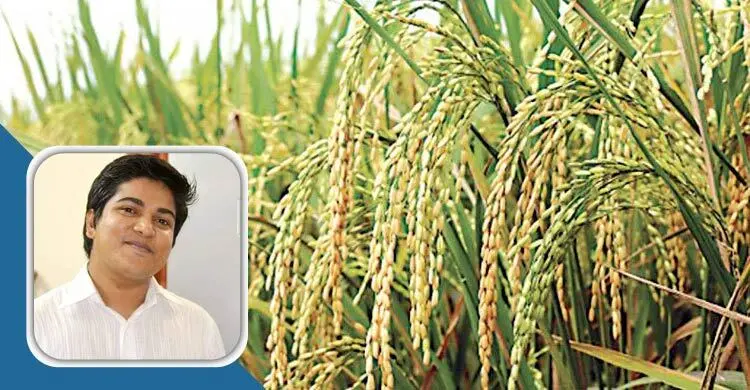
Agriculture is one of the main drivers of Bangladesh's economy and of people's livelihoods, and rice is its main crop. To meet demand for rice, the staple of the diet, most farmland is planted with rice season by season. Alongside traditional varieties, offices and research institutes under the Ministry of Agriculture are developing improved, high-yielding and climate-tolerant rice varieties and getting them to farmers. Rice is grown in the aus, aman and boro seasons. Shrinking farmland and a growing population are a major challenge to food security, along with natural disasters such as drought, floods, tidal surges, salinity, cold waves and hailstorms. Farming scientifically in the face of these can deliver the desired output.
The aman season, known as the winter crop, is now under way. Aman planting was completed in July-August, and the crop is now being tended. This season, recent floods caused by heavy rain and flash floods from upstream inundated various districts, reducing the area available for aman and delaying planting in places. Farmers regard aman as a safe crop. Choosing the right variety and good seed, land preparation, planting seedlings of the right age on time, weeding, fertiliser and water management, supplementary irrigation and managing diseases and pests all play an important part in yield. Using varieties developed by the Bangladesh Rice Research Institute (BRRI) can deliver the desired output.
Varieties for favourable conditions
Notable high-yielding varieties for favourable conditions:
- Long duration: BR22, BR23, BRRI dhan30, BRRI dhan34, BRRI dhan40, BRRI dhan41, BRRI dhan44, BRRI dhan46, BRRI dhan51, BRRI dhan52, BRRI dhan54, BRRI dhan93, BRRI dhan94.
- Medium duration: BRRI dhan32, BRRI dhan49, BRRI dhan70, BRRI dhan72, BRRI dhan73, BRRI dhan79, BRRI dhan80, BRRI dhan87, BRRI dhan95, BRRI dhan103, BRRI hybrid dhan4, BRRI hybrid dhan6, BADC hybrid dhan 2 and other approved hybrid varieties.
- Short duration: BRRI dhan33, BRRI dhan56, BRRI dhan57, BRRI dhan62, BRRI dhan66, BRRI dhan71, BRRI dhan75, BRRI dhan90, BINA dhan-16, BINA dhan-17, BINA dhan-22.
- In the Faridpur region, BRRI dhan39, BRRI dhan66, BRRI dhan71, BRRI dhan72, BRRI dhan73 and BRRI dhan75 can be grown as a relay crop with jute.
Varieties for stress-prone areas
- Drought-prone areas: BRRI dhan56, BRRI dhan57, BRRI dhan66, BRRI dhan71.
- Flood-prone areas: BRRI dhan51, BRRI dhan52, BRRI dhan79, BINA dhan-11, BINA dhan-12.
- Saline areas: BR23, BRRI dhan41, BRRI dhan53, BRRI dhan54, BRRI dhan73, BRRI dhan78.
- Non-saline tidal areas: BR23, BRRI dhan44, BRRI dhan52, BRRI dhan76, BRRI dhan77.
- Saline tidal areas: BRRI dhan78, BINA dhan-23.
- Non-saline waterlogged areas: BR10, BR23, BRRI dhan30, BRRI dhan78, BRRI dhan79, BINA dhan-23.
- Medium-low land (water up to 1 metre deep): BRRI dhan91.
- Hill valley areas: BRRI dhan49, BRRI dhan70, BRRI dhan71, BRRI dhan75, BRRI dhan80, BRRI dhan87, BRRI dhan103, BRRI hybrid dhan6, BINA dhan-16, BINA dhan-17.
- Premium quality: BRRI dhan34, BRRI dhan70, BRRI dhan75, BRRI dhan80, BRRI dhan90.
- Late planting after floods: BR22, BR23, BRRI dhan34, BRRI dhan46, BRRI dhan54, Binashail, Nigershail, Gainja, Malshira and other local varieties suited to the area.
Growth stages
Effective agronomic management at the right time at each growth stage of the rice plant is very important. From germination to maturity the plant passes through three growth phases: vegetative, reproductive and ripening. The vegetative phase runs from germination to maximum tillering, and the plant needs the most care during this time.
To raise healthy, strong seedlings, use plump, healthy seed and sow in an ideal seedbed. Seedlings should not be planted deeper than 2-3 cm; planting deeper reduces the number of tillers and later lowers the yield.
The maximum tillering stage and panicle initiation occur close together. The last third of the urea should be applied at maximum tillering, 5-7 days before panicle initiation. This final top-dressing of urea plays a special role in the number, growth and filling of grains in the panicle. Nitrogen fertiliser is very important at this time, because the number of panicles per hill and grains per panicle depend on the plant's food reserves. There are ten distinct steps from panicle initiation to flowering that are crucial for high yield, so water must be kept in the field throughout this phase. The ripening phase has four steps: milk, soft dough, hard dough and mature grain. The period up to the middle of this phase is very important, and water must be kept in the field. If disease or pest attack is above the damaging threshold, the correct pesticide should be applied quickly at the proper dose. At the hard dough stage, water should be drained from the field, and harvesting should be arranged when 80 per cent of the grains from the top of the panicle are ripe.
Seedling age and planting time
Seedling age should be 25-30 days for long-duration, 20-25 days for medium-duration, 15-20 days for short-duration and 30-45 days for late varieties.
The right time to transplant long- and medium-duration transplanted aman varieties is the whole month of Shrabon (15 July-15 August). For short-duration varieties it is 10-31 Shrabon (25 July-15 August). Seedlings of late varieties can be planted until 31 Bhadro (15 September) at the latest, and can be sown directly in the main field from the first to the second week of Bhadro (third to fourth week of August). If a temporary lack of rain causes drought at any stage, supplementary irrigation must be given.
Fertiliser doses
- Long- and medium-duration varieties: urea 23 kg, DAP 8 kg, MOP 14 kg, gypsum 9 kg. Apply all the DAP, MOP and gypsum at the final ploughing. Apply urea in three equal instalments: the first 7-10 days after transplanting, the second 25-30 days after transplanting and the third 5-7 days before panicle initiation.
- Short-duration varieties: urea 20 kg, DAP 7 kg, MOP 11 kg, gypsum 8 kg. Apply one-third of the urea and all the DAP/TSP, MOP and gypsum at the final ploughing. Apply the rest of the urea in two equal instalments: the first 10-15 days after transplanting and the second, final one 5-7 days before panicle initiation.
- Late-planted varieties: urea 23 kg, DAP 9 kg, MOP 13 kg, gypsum 8 kg. Apply two-thirds of the urea and all the DAP, MOP and gypsum at the final ploughing, and the rest of the urea 5-7 days before panicle initiation.
For BRRI dhan32 and aromatic varieties such as BRRI dhan34, BRRI dhan37 and BRRI dhan38, apply urea, DAP, MOP and gypsum at 12, 7, 10 and 6 kg per bigha respectively. On light-textured soils, applying MOP in two instalments (two-thirds at the final ploughing and one-third with the last urea top-dressing) makes the fertiliser more effective and reduces disease.
Weeds and pests
Keep the field weed-free for 35-40 days after transplanting by hand, with a weeder or with herbicide. Pre-emergence herbicide should be used within 3-6 days of transplanting (before weeds emerge) and post-emergence herbicide within 7-20 days of transplanting (after weeds emerge). There should be 1-3 cm of water in the field when herbicide is applied.
In the transplanted aman season, avoiding insecticide for 30 days after transplanting increases the number of beneficial insects, so insecticide may not be needed at all or only once. Stem borer, leaf roller, green leafhopper and rice bug attacks can be reduced by pushing branches into the field (perches) and using light traps or solar light traps. Draining the field reduces attacks by caseworm, brown planthopper, white-backed planthopper and leaf miner, while flooding the field reduces ear-cutting caterpillar attacks.
If pest attacks are still heavy, for stem borer and caseworm use a cartap-group insecticide such as Suntap 50 powder or Rider 50 powder at 180-190 g per bigha, or any approved insecticide at the correct dose. For brown and white-backed planthoppers, apply an isoprocarb-group product such as Mipcin 75 powder or Sopsin 75 powder at 175 g per bigha. For leaf roller, caseworm and ear-cutting caterpillar, apply a carbaryl-group product such as Vitabril 85 powder or Sevin 85 powder at 228 g per bigha. Synthetic pyrethroid insecticides such as cypermethrin, alpha-cypermethrin, lambda-cyhalothrin, deltamethrin and fenvalerate must not be used against rice pests.
Diseases
The main diseases in the aman season are sheath blight, bacterial leaf blight, blast, tungro, bakanae and false smut. Sheath blight can be controlled successfully with fungicides such as Folicur, Nativo and Score at approved doses. At the early stage of bacterial leaf blight, mix 60 g of MOP and 60 g of Thiovit in 10 litres of water and apply to 5 decimals of land. Neck blast may attack aromatic rice this season; in that case apply a fungicide such as Trooper or Nativo at the approved dose at the late booting stage or as soon as the tip of the panicle emerges. If tungro symptoms appear on a scattered plant or two, pull up and bury the affected plants. In tungro-prone areas, to control the green leafhopper that carries the disease, apply an approved insecticide such as Mipcin, Sopsin or Sevin 8-10 days after sowing in the seedbed and 4-5 days before uprooting seedlings. To control false smut, set the planting time so that flowering does not go beyond 15 October; in addition, apply a propiconazole-group fungicide such as Tilt or Propen twice at seven-day intervals at the flowering stage.
The writer is a senior information officer at the Ministry of Agriculture.
Source: Jagonews24. First published in Bengali on The Agro News.

Comments
(0)