
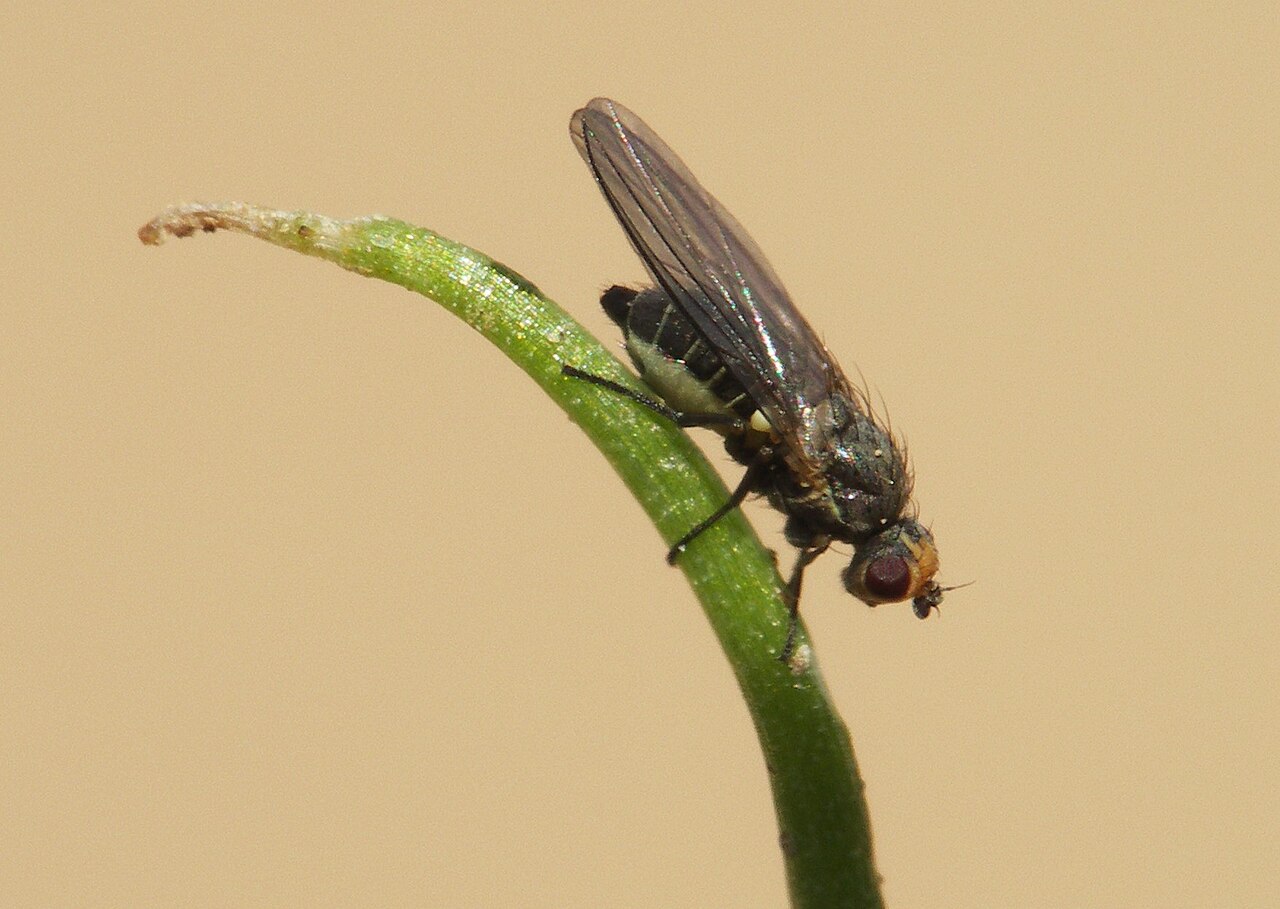
The allium leafminer, a fly that attacks onions, leeks, garlic and other alliums, is emerging now in southeastern Pennsylvania, Morning Ag Clips reports from Penn State Extension. The first sign is a line of round white dots on allium leaves, made by the female as she feeds and lays eggs. The adult can be recognised by an orange patch on its head and wings folded flat over its back; the flies sit at leaf tips in the morning, and green onions and leeks are the best places to look.
The pest has two generations a year. It spends the winter as a pupa in leaf tissue or nearby soil, emerges in spring and flies for four to five weeks, laying eggs in allium leaves. The larvae develop into pupae that then rest through the summer, and the adults do not appear again until autumn, which is the flight now under way.
Control is needed only during the adult flight and very shortly afterwards, to catch the developing larvae. Row covers work if they go on before the flies are active, so fields must be scouted first to avoid trapping adults underneath, and the covers stay until the end of emergence, generally four to six weeks, or until the first hard freeze.
Among insecticides, extension names foliar sprays of dinotefuran (Scorpion or Venom), cyantraniliprole (Exirel) and spinetoram (Radiant) as the most effective against both adults and larvae in the leaves; chemigation does not work. Allium leaves are very waxy, so a spreader-sticker is recommended. For organic growers, the advice is two consecutive sprays of spinosad (Entrust) with a 1% to 5% soap solution, applied two to four weeks after the first emergence is detected, plus a spray of pyrethrins with azadirachtin and an adjuvant that keeps the solution at or below pH 6.5.
Photo: Jochen Kreiselmaier / Wikimedia Commons (CC BY-SA 4.0)
Source: Morning Ag Clips
Comments
(0)