
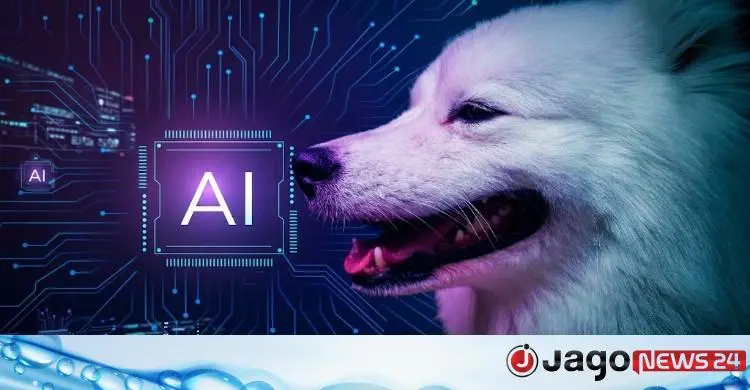
When discussing how artificial intelligence, or AI, will change society, it is worth recalling an older technology: the dog.
When humans began to domesticate dogs, the benefits were extraordinary. With a dog's sense of smell, people could detect distant prey; at night, a dog's hearing helped them sense an approaching enemy.
Humans became more effective at hunting and war as a result. Some anthropologists believe dogs were one of the reasons Homo sapiens, modern humans, got ahead of the Neanderthals and eventually came to dominate the earth.
But the start of domestication was far from risk-free. People literally had to let wild animals into their caves, and train them so that they would not become dangerous to humans.
Even thousands of years later, pet dogs sometimes get out of control, but on the whole people consider the relationship a success.
A faster-evolving companion
AI optimists think in much the same way. In their view, AI will enhance human capabilities rather than take away people's jobs: humans and AI working together will become more productive.
The problem is that the evolution of dogs cannot be compared with that of AI. AI is changing extremely fast. If in future AI begins building more advanced versions of itself, it is hard to be sure what will happen.
With dogs, people can be fairly sure they will not one day open bottle tops on their own or plot to imprison humans. No such assurance can yet be given about highly advanced AI.
Two books on how AI could change future society have recently attracted particular attention: one by the Nobel-winning economist Daron Acemoglu, the other by the Pulitzer Prize-winning historian Jill Lepore.
Lepore: the people behind the technology
For the Harvard historian Jill Lepore, the core problem also lies with the people building the technology. In her view, many powerful figures in the tech industry are making plans for the future that could pose risks to democracy and human society.
In "The Rise and Fall of the Artificial State", Lepore argues that tech entrepreneurs want to create a future in which people are governed by machines and many people are replaced by them.
She fears this could weaken liberal democracy and also damage the natural environment.
The entrepreneurs' own words are one basis of her concern. OpenAI's chief Sam Altman once spoke of the possibility of an AI that could make decisions by understanding the preferences and needs of the world's people.
Elon Musk, for his part, has voiced the fear that in an age of superintelligent robots, humans might end up like pet labradors.
Lepore also questions the big tech entrepreneurs' plans for the future. Some talk of going into space, some of settling humans on Mars, and some see virtual worlds as an important future home.
In Lepore's view, such plans may suggest that tech leaders are not very worried about the risk of catastrophe on earth.
But such criticism of tech entrepreneurs has a limitation. The future of AI will not depend only on the personal political ideology of Elon Musk, Sam Altman or any other billionaire.
How technology changes society will depend much more on the technology's own capabilities and on how people use it. This is where the economist Daron Acemoglu's analysis matters.
Acemoglu: pro-worker AI
In "What Happened to Liberal Democracy?", Acemoglu analyses the relationship between technology and democracy. He believes liberal democracy long encouraged economic progress and innovation.
Spreading the benefits of growth through taxation and public services, and protecting citizens through regulation, are also important features of the system.
But in Acemoglu's view, things began to change after computers and digital technology spread widely.
He argues that digital technology sharpened inequality by raising demand for knowledge work relative to physical labour, which increased the social and political influence of a highly educated class.
At the same time, how people in the United States socialise has changed. Over the past two decades, time spent with friends in person has fallen markedly, and political debate has become fiercer and more toxic.
Acemoglu fears AI could make these problems worse. On the one hand, AI could speed up innovation and greatly enrich people's lives; on the other, it could create mass joblessness.
That could produce a divided society in which a few people control technology and production while another large section loses work and social standing, putting heavy strain on democracy.
Acemoglu, however, proposes an alternative: "pro-worker AI", meaning AI that raises the value of workers' labour rather than replacing them.
Just as prehistoric hunters became more effective by adding a dog's sense of smell and speed to their own skills, modern workers can put AI to use in the same way.
Electricity workers are one example. AI can analyse sensor data to spot possible problems in the power grid, and by analysing records of past problems and their solutions, help workers make faster decisions.
Similar uses are possible in education. AI can analyse students' test answers and suggest dividing them into groups according to their needs, allowing teachers to give more targeted lessons.
An open question
It is hard to disagree with this idea of AI that complements humans. If AI increases people's ability to work, the social unrest caused by the technology may be relatively smaller.
The big question, though, is how that goal will be reached. AI development is moving extremely fast, and its future capabilities are still not fully known.
That is why predicting AI's course is difficult. On the one hand, pessimism about AI is growing faster than optimism; on the other, there is no sign of the technology's development slowing.
In the end, humans will have to invite this new "dog" into the cave. The United States and China, which lead in AI, are rivals, and neither wants to be in a position where the other builds superintelligent AI first and secures a strategic advantage.
So whether AI will become a loyal companion like the dog, or one day slip beyond human control, is still unknown. One thing is clear: AI has already entered the human cave. What remains to be settled is how far people can keep it tame.
The article drew on The Economist.
Source: Jagonews24. First published in Bengali on The Agro News.
Comments
(0)