
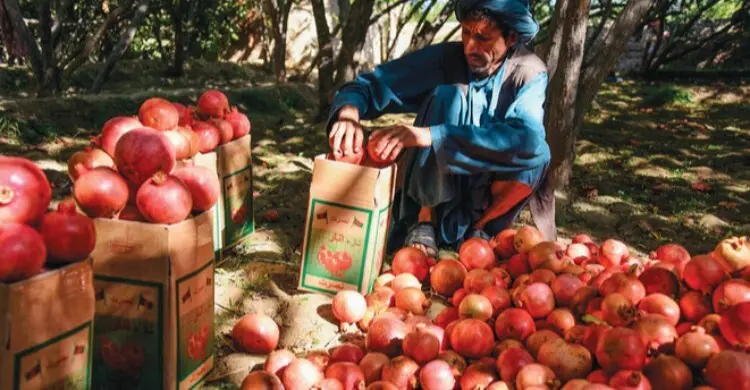
Afghanistan, a landlocked country in south-central Asia, has long been known for high-quality fruit and farm produce. Its capital is Kabul, and it borders Pakistan, Iran, Turkmenistan, Uzbekistan, Tajikistan and China. In this country of more than 30 million people, war, political instability and prolonged conflict damaged the potential of agriculture for many years. In recent years, however, fruit and dried fruit exports have made notable progress.
Over 300,000 tonnes of fresh fruit exported in 2025
According to Afghanistan's Ministry of Industry and Commerce, the country exported about 317,517 tonnes of fresh fruit in 2025, worth about 142 million dollars. The fruit went to the United Arab Emirates, Turkey, Pakistan, several European countries and various Central Asian markets. It included apples, pomegranates, apricots, grapes, melons, watermelons, figs and other fruit.
The Afghan government has prioritised building modern cold stores across the country to preserve farm produce, and has announced a five-year tax exemption on cold-store construction to encourage private investment in the sector.
Pomegranate success
About 21,870 tonnes of pomegranates were exported from the southern province of Kandahar in 2025. Kandahar's agriculture director Aimal Hakimi said that exports more than tripled in 2025 from only 7,000 tonnes the year before. Kandahar's pomegranates now go mainly to Malaysia, Russia, Pakistan and Uzbekistan.
Officials said exports rose in Kandahar, known as the "pomegranate capital", because of higher production, better post-harvest management and stronger trade ties with foreign buyers. Pomegranates are one of Afghanistan's main sources of export income.
Grapes the most widely grown fruit
A nationwide survey in 2019 found that grapes covered about 48 per cent of Afghanistan's total fruit-growing area.
Dried fruit exports also rising
According to the Ministry of Industry and Commerce, Afghanistan exported about 205,000 tonnes of dried fruit in 2025, worth 667 million US dollars. Ministry statistics show that, compared with the year before, earnings from exports of figs, raisins, almonds, pistachios and pine nuts rose by between 3 million and 34 million dollars, which suggests growing international demand for Afghan dried fruit and a strengthening farm export sector.
The Herat Chamber of Commerce and Investment said 3,140 tonnes of dried fruit worth 7.6 million dollars were exported from Afghanistan in April-May 2026. The chamber's executive director Mohammad Yousuf Amin said the goods went to Iraq, Austria, the United Arab Emirates, neighbouring countries and various European countries. They included raisins, almonds, pistachios, dried figs, watermelon seeds and other dried fruit.
Afghan dried fruit is now sold in about 20 countries, and better packaging is increasing its acceptance on international markets. Exporter Mohammad Usman Ansari said Afghan dried fruit used to be sent abroad in sacks and repackaged there, but traders in Herat now package it to international standards.
Economic analyst Nazir Ahmad Sadid said that in today's world market not only product quality but branding, marketing, packaging and buyer confidence matter. In his view, this is why Afghanistan's market share is still smaller than that of Turkey, Iran, the United States, China and Uzbekistan.
Main exports and markets
Afghanistan's main exports in 2024 were:
- Raw cotton: 226 million dollars
- Grapes: 172 million dollars
- Tropical fruit: 167 million dollars
- Various nuts: 128 million dollars
- Natural resin (insect resin): 123 million dollars
Its main export destinations were:
- India: 665 million dollars
- Pakistan: 659 million dollars
- Uzbekistan: 44.7 million dollars
- China: 42.1 million dollars
- Turkey: 34.3 million dollars
India and Pakistan have historically been the largest markets for Afghan fruit and dried fruit, and new trade corridors have also raised exports to Uzbekistan, Kazakhstan and Russia. The United Arab Emirates and Saudi Arabia have become important markets for Afghan pistachios, dried figs and raisins, while demand for Afghan dried fruit, nuts and pine nuts is growing in Germany, Canada and the United States.
Experts say that with a favourable four-season climate and organically produced fruit, Afghanistan's farm produce has even greater potential on international markets, but realising it fully will need more investment in infrastructure, marketing, branding and modern storage.
Source: Jagonews24. First published in Bengali on The Agro News.


Comments
(0)