
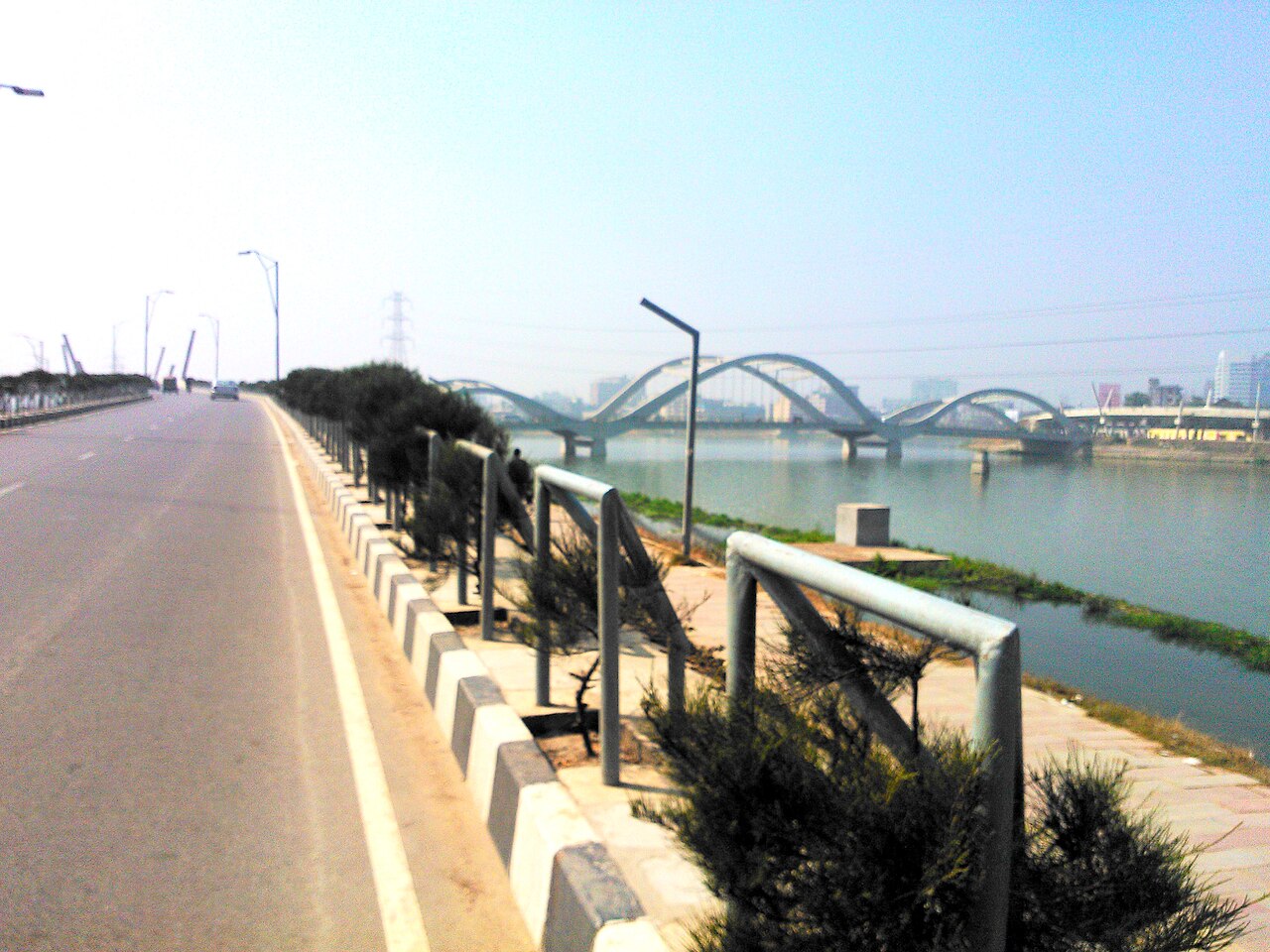
Part of the water in Dhaka's Hatirjheel lake has turned pink for more than two weeks. The Capital Development Authority (RAJUK), which manages the lake, does not know why and has asked the chemistry department of the Bangladesh University of Engineering and Technology (BUET) to find out.
Travelling by water taxi from FDC to Gudaraghat on Monday afternoon, Prothom Alo's reporter saw a pink tint near FDC, Madhubagh bridge and Police Plaza. Nesar Uddin, a regular passenger, said he first noticed the colour near FDC last week and that passengers had been discussing it. A water taxi ticket checker, who asked not to be named, claimed that RAJUK staff had sprayed a chemical into the water about a week earlier.
"We cannot find any reason why this colour suddenly appeared in the water or where it came from," said Md Shahinur Alam, a member of RAJUK's administration and finance wing.
Professor Ayesha Sharmin of BUET's chemistry department said her team took water samples from several places and depths on 3 November. Initial tests found the water quality poor on almost every measure. Sewage and household waste have left phosphate and nitrate levels very high, a condition scientists call eutrophication. Lime was added to reduce the smell, which raised the water's pH.
Under these conditions, she explained, purple sulphur and purple non-sulphur bacteria can grow and produce pigments that turn water pink; cyanobacteria may also be present. The team has found some new bacteria in the lake, but which one changed the colour is not yet confirmed. BUET hopes to give RAJUK its detailed results by the end of the month.
A project to restore the waste-choked lake began in 2007 on 302 acres. After several extensions it was completed in 2021 at a cost of Tk 2,236 crore. Roads, flyovers and dredging followed, but sewage still flows into the lake and the smell still spreads to the surrounding area.
Reported by Mostafa Yousuf for Prothom Alo.
Photo: NahidSultan / Wikimedia Commons (CC BY-SA 3.0)
Source: Prothom Alo

Comments
(0)