
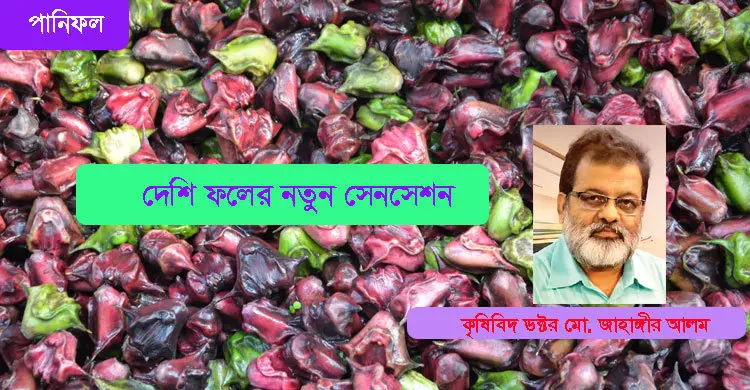
It is called panifal, or water fruit, because it grows in water. Water chestnut is believed to have been cultivated in China for about 3,000 years. For the past few decades it has also been grown in Bangladesh, here and there, out of the personal interest of a few people, although there has been no real research or proper planning on it yet.
Commercial cultivation has now begun in Debhata in Satkhira and in Naogaon. The plant grows in still or slow-flowing water. Because the fruit looks much like a singara (samosa), people in Satkhira simply call it "sengara" fruit, and in some parts of the country it is known as singara fruit.
What it is
It is an annual aquatic plant. Its English name is water chestnut, its botanical name Trapa bispinosa, and its family Onagraceae. Though called water chestnut in English, it is known in different places as water caltrop, buffalo nut and devil pod. The species name bispinosa, meaning two spines, shows that the fruit has two spines.
Water chestnut is usually grown in China, Japan, India, Pakistan, Sri Lanka, Indonesia, Italy, the Philippines and Africa. Although many call it a water nut, it has none of the characteristics of a nut; it is entirely a watery fruit. It can be eaten raw, or boiled, cooked or processed.
In China it is cooked mixed with other vegetables, and it is a popular and essential part of the Chinese diet. The Chinese dry water chestnut to make flour, from which they make pitha, cakes and biscuits for sale. They use it commercially. In some places it is also used as cattle feed. In Bangladesh this very familiar village fruit has found a place not only in villages but on pavement fruit stalls in cities, although the dark green fruit has yet to reach the big fruit shops.
Nutrition and medicinal value
Water chestnut is full of nutrition. It has about 90 per cent carbohydrate and 60 per cent starch, along with a good amount of fibre, riboflavin, vitamin B, potassium, copper, manganese, protein and vitamins. In nutritional terms it contains 65 kilocalories of food energy, 84.9 g of water, 0.9 g of minerals, 1.6 g of dietary fibre, 2.5 g of protein, 0.9 g of fat, 11.7 g of carbohydrate, 10 mg of calcium, 0.8 mg of iron, 0.18 mg of vitamin B1, 0.05 mg of vitamin B2 and 15 mg of vitamin C. It has medicinal as well as food value.
Eating bread made from the dried flesh reduces allergies and swelling of the hands and feet. It is very beneficial for diarrhoea and lower abdominal pain. If a hairy caterpillar or another insect bite causes burning, grinding raw water chestnut and applying it to the wound quickly relieves the pain. Raw water chestnut is strengthening and an easily digestible food for weak and sick people. It contains plenty of carbohydrate and protein, and the flesh can be dried and eaten later.
Botany
There are several species of water chestnut. The plant propagates from the fruit and can grow up to 5 metres long. Its roots are in the soil under water and its leaves float on the surface. Thick, soft, triangular leaves, dark green or reddish green, float in a circle around the main stem. A leaf is 8 cm long and about 6 cm wide with toothed edges. The leaf stalks are hairy, and the leaf blade is fleshy, thick and glossy.
The flowers are small, white and bisexual. The fruit is three-cornered like a singara, with two hard spines on either side. Looked at closely, the fruit resembles a cow's head: the two spines are like horns, and the shapes of eyes, nose and mouth are very clear. The fruit is bluish green or blackish green. Peeling the thick soft skin reveals soft white flesh, heart-shaped or triangular. The soft flesh of the raw fruit is juicy, sweetish and tasty. The roots are in the mud, the stem is submerged, and the leaves, flowers and fruit float on the water.
The leaves are arranged in two layers in a circle on the stem, like rose petals facing opposite ways. They look somewhat like water hyacinth leaves, but are smaller, thicker and dark green, and because they are fleshy the veins are hard to see. The stem is tubular like a rope and as thick as a pencil. The plant can survive in water up to 5 metres deep and is often regarded as an aquatic weed. The small four-petalled flowers are very attractive. Planted early, each plant produces 10-12 branches; planted late, 6-7. Each branch bears 6-7 fruits. Experience shows the plant keeps growing until it flowers. Fruit on late branches is somewhat smaller and weaker.
Growing season
Seedlings are planted when rain comes in June, though some plant in May if water is available. Seedlings can be planted from the Bengali month of Asharh to Bhadra-Ashwin. At the end of the season mature fruit is kept in a pond, a waterlogged place or a pot of muddy water, and after a few months seedlings sprout from it. These are planted in the main field the following season. Flowers appear 60 to 65 days after planting, that is, in Agrahayan-Poush.
The fruit is mature enough to pick 15-20 days after flowering. The fruits remain able to germinate for 10-12 years, although they germinate within 2 years. Water chestnut is available from September to January, most plentifully in November-December.
How it is grown
The crop has a total life of 7 to 8 months, and mature seed must be planted in the month of Jyoishtho. It can be grown cheaply, in water. Farmers plant seedlings in ponds or beels when the water is 1 to 1.5 feet deep, 1 to 1.5 haat (cubits) apart, varying the spacing with the time of planting. In some cases, the part of the field meant for raising seedlings is left unharvested; the mature fruit drops to the bottom and seedlings grow from it, with one new seedling giving many more. Seedlings are planted when rain starts in May-June.
Flowers come 60-65 days after planting, and the fruit is ready to pick within 15-20 days of flowering. Before planting, MoP, DAP, TSP and gypsum fertilisers are applied to dry or waterlogged soil. Doses are not the same everywhere, because farmers set them by their own judgement.
In some cases farmers set the dose with help from the agriculture office, and some also use organic fertiliser. Fruit growing begins in Bhadra-Ashwin and the fruit is harvested in Agrahayan-Poush. The fruit is red when young, then green, and turns black when mature.
The plant can purify dirty, polluted water. So some people plant water chestnut in shallow, dirty, abandoned ponds where fish cannot be farmed, clean the water that way and farm fish there the following year. The plant is probably native to this subcontinent; some think its original home is India. It is reported that water chestnut was introduced and first grown in North America in 1874. In this country it grows in low-lying water bodies.
The plant grows from seed, and seeds of ripe fruit usually germinate within the first two years. Water chestnut is generally not troubled much by disease or pests, but waterborne diseases or leaf-eating insects sometimes cause problems and reduce production somewhat. Farmers then contact the agriculture office, take measures and protect the crop.
Costs and income
Water chestnut is an annual crop. Picking starts roughly 4-5 months after planting and continues for up to a year. It is grown on fallow waterlogged land. Each bigha yields 2 to 2.5 tonnes, which works out at 18 to 20 tonnes a hectare. Growing it in a water body costs Tk 4,000-5,000 a bigha and brings in Tk 25,000-30,000 a bigha. One farmer in Satkhira will sell about 500 maunds from 12 bighas of water. The current wholesale price is Tk 800-1,000 a maund, or Tk 20-25 a kg. At the start of the season, though, it sells wholesale at Tk 1,200 a maund and at Tk 2,000-2,400 in retail markets.
Water chestnut is not grown in every district, so people know it less. Recently, however, it has been going from Satkhira to Dhaka and other parts of the country. It is now grown in various parts of Kaliganj, Satkhira Sadar and Kalaroa upazilas. Growing it has also created work for many unemployed labourers, and because it is so profitable its cultivation is increasing day by day, benefiting farmers and reducing unemployment. Few crops give such a high yield from so little capital. Water chestnut is now grown commercially in several districts including Satkhira, and farmers in the region have become keen on it for its high profits.
Singara fruit
Many people confuse water chestnut with singara fruit, so a description of it follows too. Singara fruit is very hard: inside its hard brown shell is a nut-like kernel, and it has to be cut forcibly with a da (machete). It is named for its singara-like shape, but it too is a kind of water chestnut. Its flesh and shell are hard, like wood, and it has four thin, hard and very sharp spines. The plant is a floating annual aquatic plant with triangular, dark green leaves.
Its roots and tubers are in the mud, the stem is in the water, and the leaves, flowers and fruit float on the surface. The fruit is roughly triangular, prism-like and hard. It is cut open to eat the white flesh inside, which is mildly sweet and pleasant to chew. In some places the flesh of ripe fruit is cooked like potatoes.
The flesh can even be dried and ground to be eaten later. The raw fruit is diuretic, stimulates the appetite and is strengthening. Singara fruit has been found in Beel Kuraria in Pabna and in the haors of Sunamganj.
A new opportunity
Water chestnut is not very well known across the country, and many may still not recognise it. It is a valuable fruit, rich in nutrients and medicinal properties, produced by simple methods. Growing it costs next to nothing and the profit is much higher. Above all, it can easily be grown on land where other crops cannot.
Fallow land can be brought under cultivation profitably, and in that way water chestnut can open a new door for our agricultural development. But extensive research is needed on its production, processing and use.
Special advice and approval are needed on fertiliser and pest management. With everyone's combined effort and investment, water chestnut can take us a long way.
Source: Jagonews24. First published in Bengali on The Agro News.
Comments
(0)