
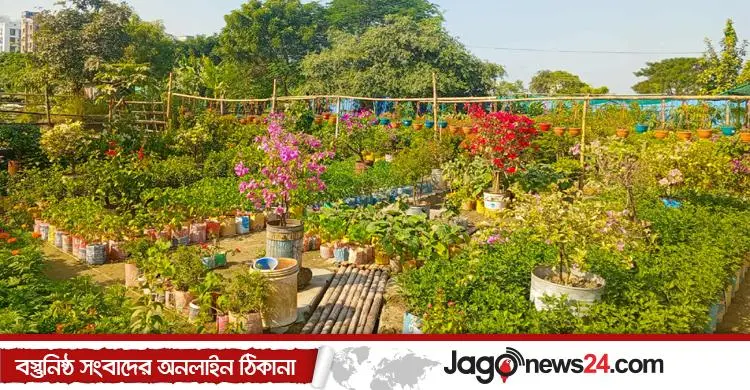
Diabari in the capital's Uttara has long been a popular destination for its quiet surroundings. Now the area has become a sprawling green business centre. More than a hundred nurseries, large and small, have grown up in rows along the riverbank in Uttara's sectors 15 and 16. People of all ages come here every day from Dhaka and neighbouring districts to buy plants for homes, offices and rooftop gardens.
South of bridge No 11 in sector 15, rows of nurseries line both sides of the road, like a long stretch of green embroidery, and there are more to the north of the bridge. In all, the Diabari area has more than a hundred nurseries, which greatly add to its green beauty. From a distance the colours of the plants, the varied shapes of the leaves and the bright flowers make the whole place a striking sight. Passers-by stop as they walk; some smell the flowers, some look at new seedlings, and some simply enjoy the rows of green.
Diabari's nurseries are now one of the capital's most reliable sources for government and private development projects, rooftop gardening entrepreneurs and ordinary buyers. Some offer large fruit saplings, others rows of indoor plants, and others local and foreign flower and fruit trees, as well as ornamental and medicinal plants. This variety is the area's biggest attraction; almost every kind of seedling and plant can be found here.
Winter season rush
While fruit and forest saplings sell most in the monsoon, the nurseries have been transformed with the arrival of winter. Traders have become busier, and owners and workers barely have time to breathe, because November marks the start of the key season for winter flower seedlings. Marigold, violet, calendula, cosmos, gerbera and petunia are in the highest demand.
Workers are busy preparing seedbeds for winter flowers, selecting seedlings, preparing soil and pots and tending plants, working from dawn until night. The nursery quarter has become a living green workshop. Each nursery has three to five permanent workers, with extra day labourers hired depending on the season and workload. Women work in the nurseries alongside men.
Besides plants, the nursery quarter sells mixed soil, drums, pots, hanging baskets, GI stands, organic fertiliser, pesticides, spray bottles and all the other equipment a garden needs, so buyers can get everything in one place. A worker named Imran, watering a seedbed, said he had been working in the nurseries here since the coronavirus period.
"Preparing seedbeds, planting seedlings, watering, mixing fertiliser: everything has to be done on time," he said. "Demand for flowering plants is much higher in winter, so our workload rises from the start of the season as we raise seedlings of flowers and winter vegetables. Workers in every nursery work from dawn to night."
If good seedlings are ready in time for the winter season, the nursery market will be lively, he said. Another worker, Abul Hossain, said he had worked in nurseries for a long time. "I water the seedbeds and plants several times a day. If any leaf or stem is damaged, I act immediately."
Rooftop gardeners the biggest customers
As space in Dhaka homes shrinks, many people now use their rooftops as small farms, growing vegetables, flowers and fruit. This has created a large customer base for the nurseries.
Nursery owners say 40-50 per cent of their buyers are now rooftop gardeners. Besides plants, these customers take services such as building beds, mixing soil for pots, drainage, rooftop garden design and pesticide management from the nurseries.
"Many people don't know at first which plant should go where," the owners said. "We lay out the plan for the whole roof. That is why rooftop gardeners are now our biggest customers."
This ready-made service has become popular with busy Dhaka residents. Demand is rising not only for rooftops but also for balconies, office receptions and restaurant decoration.
Every day, crowds come from Dhaka and nearby districts to buy plants for homes, offices, restaurants and rooftop gardens. Some come to start a new garden, others to add plants to an old one. Families, young people, garden entrepreneurs and corporate representatives keep the green market busy from morning to evening.
Azim, an employee, came from Hazaribagh in Dhaka to furnish a new rooftop garden. He had a shopping list and two assistants, and a budget of Tk 20,000-25,000. They went from nursery to nursery, looking and bargaining to buy the best plants within the budget.
Azim said he had been given responsibility for his employer's new rooftop garden, so he had come to collect the flowers, fruit trees and ornamental plants needed. "I'm buying mango, malta, lemon and various local and foreign fruit trees. With so many nurseries here, there is more chance to pick good plants," he said.
Azim will also buy pots, prepared soil, drainage materials, organic fertiliser and other garden supplies, and the nursery workers explained various aspects of rooftop garden care to him.
A green source for the city
Diabari is not just a business centre but a major source of the city's greening. Most of the plants used in government and private projects, road development, schools and colleges, offices, shopping malls and parks come from here. Besides beautifying Dhaka, the nurseries make an important contribution to protecting the environment: every plant cleans the air, lowers the temperature and gives shelter to birds.
In this way, Diabari's hundred-plus nurseries have built a unique green kingdom in the heart of the city. Many people come here to escape the crowds and dust, to get a touch of green, to get to know familiar and unfamiliar plants and in search of peace of mind. With city life full of stress, fatigue and restlessness, plants have become a source of mental calm.
Source: Jagonews24. First published in Bengali on The Agro News.

Comments
(0)