
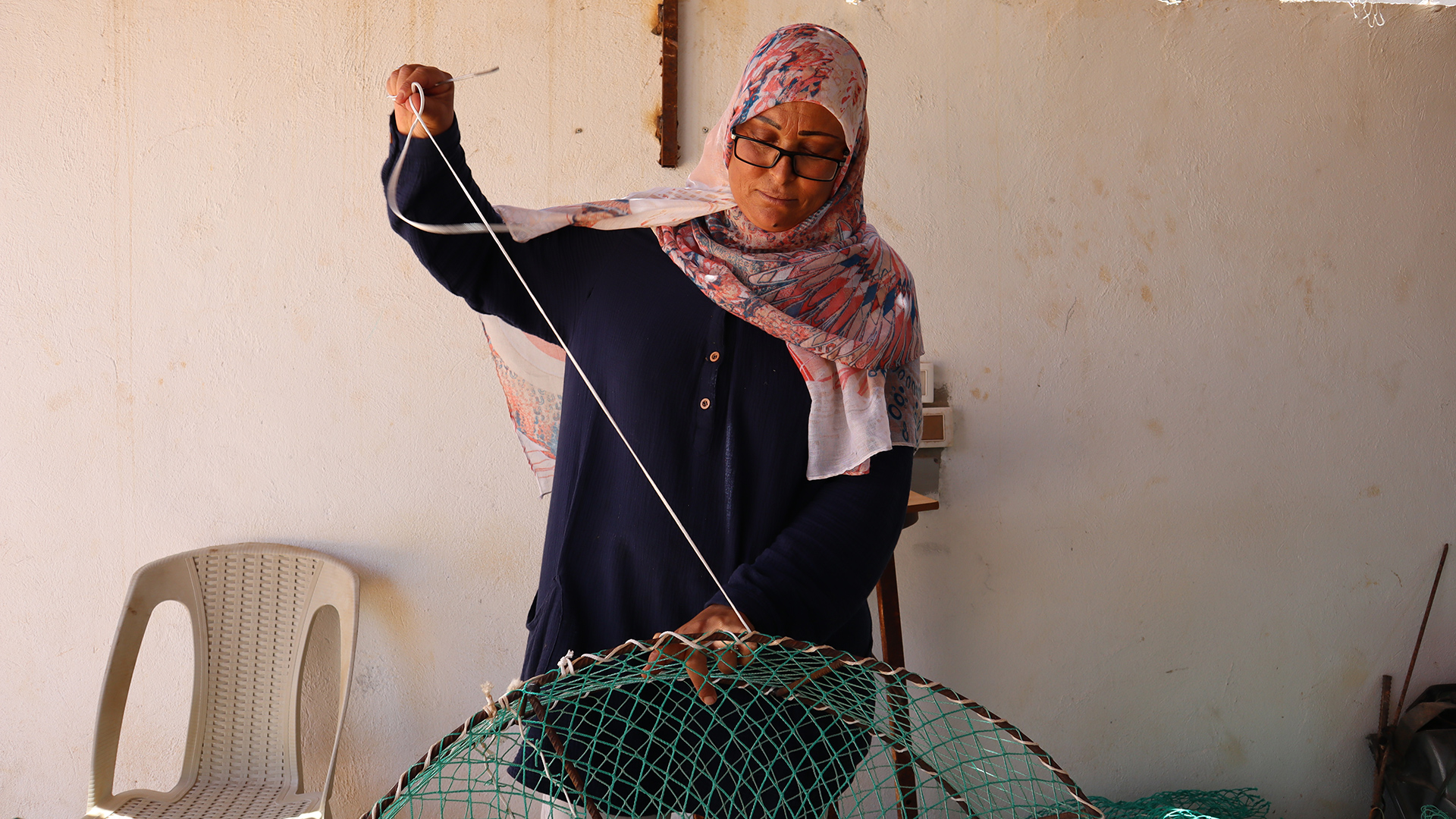
On the Tunisian island of Djerba, Fattouma Ben Chagra bends wire into crab traps and repairs the ones fishers bring back damaged. She and her brother, a blacksmith, taught themselves the craft when demand for traps rose with the blue swimming crab catch. The traps sell, the repairs sell, and the work gives her a steady income — but no pension, no insurance and nothing to fall back on if the crab ever disappears.
"Like most of the women who do this work, we don't have social protection," she says. Her worry is the one that now hangs over Tunisia's whole blue crab fishery, according to a feature story published by the Food and Agriculture Organization of the United Nations (FAO) on 17 September.
The blue swimming crab first appeared in Tunisian waters in 1993 and multiplied fast. By 2014 it was doing serious damage to the fishing sector, tearing nets and disrupting traditional catches. Sassi Aleya, president of the Groupement de développement de la pêche de Ghannouch, remembers losing both nets and the usual species while discarding large quantities of crab. Working with the government, fishers then developed more selective gear. "Today, we have a circular trap specifically for blue crabs," he says.
The groundwork was laid by the FAO MedSudMed regional programme, which began in 2001 with funding from the Italian Ministry of Agriculture, Food Sovereignty and Forests. In Ghannouch it brought fishers, scientists, authorities and civil society together to build a management plan for small-scale fisheries and to monitor the crab's spread. A market grew, and the fishery expanded with it.
Growth did not remove the insecurity. Catches fall, weather keeps boats ashore, illness interrupts work, and the seasonal, often informal nature of the trade leaves many fishers and fish workers outside any social scheme. FAO's SocPro4Fish programme, funded by the Government of Norway, gathered social and economic data on the sector and found three recurring barriers: many fishers do not know which programmes exist, others fail eligibility rules written for year-round formal jobs, and others give up on the paperwork.
To work through those barriers, the project set up an inter-institutional technical committee of fisheries authorities, social protection institutions, fishers' representatives and researchers, tasked with finding ways to extend coverage and make it fit fishing livelihoods.
A new FAO-led initiative, developed with the Monterey Bay Aquarium in California, United States of America, now builds on MedSudMed and the SocPro4Fish findings in Tunisia and is expanding to the Philippines. It is looking at how social protection can support fishing households through seasonal income swings and shocks, including those linked to invasive species. Alongside it, the Global Environment Facility-funded FishEBM MED project, run by the General Fisheries Commission for the Mediterranean (GFCM), is studying the socioeconomic effects of the crab fishery along its value chain. For fishing families, FAO argues, resilience needs both a resource that lasts and the security to plan a future around it.
Source: FAO Newsroom. Photo: ©FAO
Comments
(0)