
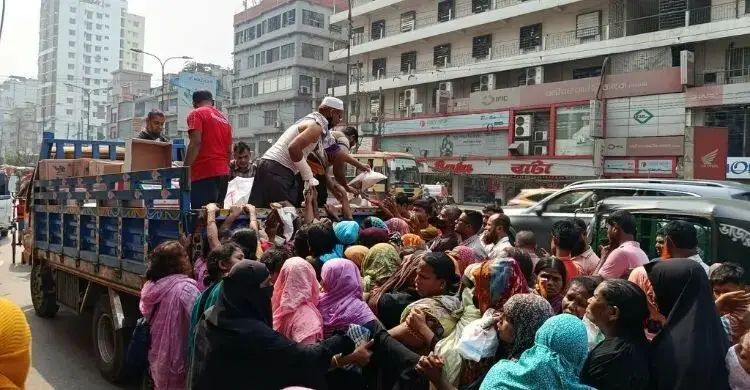
Under the Trading Corporation of Bangladesh's (TCB) new guideline, family card holders will as before receive edible oil, sugar and lentils every month, with dates and chickpeas added in Ramadan. Beyond these, scented soap, detergent powder, laundry soap, salt, tea, flour (atta) and spices will be sold as "optional products", which anyone, not just card holders, will be able to buy.
TCB will also be able to sell any kind of product, including onions and potatoes, in an emergency, subject to permission.
The Ministry of Commerce has drawn up the new guideline with these provisions, and it is expected to be issued soon. Once issued, all earlier circulars will be cancelled and future activities will follow the guideline. Besides TCB's sales plan, the government has tightened beneficiary selection, dealer monitoring and distribution.
How people will get the goods
Under the guideline, each listed family will receive 2 litres of edible oil, 2 kg of lentils and 1 kg of sugar a month at subsidised prices, plus 5 kg of rice subject to the Ministry of Food's allocation. Chickpeas and dates will be added in Ramadan, and staples such as onions and potatoes from time to time by special government decision.
To ease TCB's subsidy burden, several "optional products" will be added to the sales: three kinds of soap, salt, tea, flour and spices. These are optional for family card holders; they may take them or not.
Dealers may not force card holders to buy these products in any way. Dealers may also sell them to ordinary consumers at the set affordable price. TCB may add new items to the optional list if needed, but only with the government's prior permission.
Who gets priority for TCB cards
The new policy says the truly destitute, day labourers, the landless, farm and tea workers, people affected by river erosion, and the poor and those unable to work will get priority for cards. Families of widows, abandoned wives or with disabled children will also be given family cards.
Beneficiaries of any other government social safety net programme cannot be included in the list. Well-off families will not get cards, nor can more than one member of the same family, such as husband, wife and children. From now on, card holders must also sign a written undertaking.
Digital database and card activation
To ensure transparency, beneficiaries' details must be verified in the "TCB Sheba Apps" database using their NID, their spouse's NID and an active mobile number registered in their own name. A lost card can be reapplied for on payment of a set fee, and a new card must be reactivated through the app.
Strict watch on dealers
Dealers must display a price list and a banner saying the shop sells goods at TCB subsidised prices in a visible place at their designated shop or sales point. Goods may be handed over only after scanning the point-of-sale machine or smart card. Subsidised goods may not be sold to anyone other than card holders.
Money transactions have also been made transparent. No cash may be handled anywhere other than TCB's designated bank account. Goods will be released from the warehouse only after the bank deposit is matched through digital API confirmation.
Field monitoring and security
Multi-level monitoring committees have been formed to prevent irregularities in TCB sales. The guideline calls for committees led by the mayor in city corporations, the deputy commissioner at district level, the Upazila Nirbahi Officer at upazila level and the chairman in unions.
A "tag team" must also be formed in every ward. Goods must be released and distributed in the presence of the tag team's officer, and the team will check on the spot whether dealers are giving the correct weight and quality.
The guideline also directs that enough police and executive magistrates be deployed at sales centres to prevent any breakdown of law and order or irregularities.
Source: Jagonews24. First published in Bengali on The Agro News.


Comments
(0)