
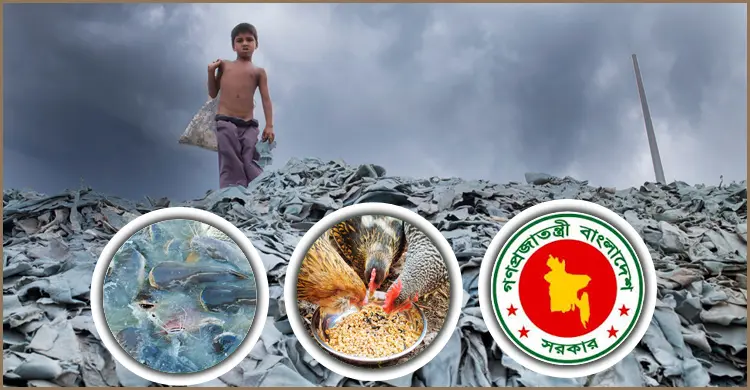
The use of tannery waste in fish and animal feed has not stopped. Despite laws and rules, unscrupulous traders cannot be kept from using tannery waste as a source of animal protein in fish and livestock feed. The government is therefore preparing a guideline to strengthen oversight of how fish and animal feed is made and marketed.
A "Fish Feed and Animal Feed Production and Marketing Management Guideline, 2020", aimed at safe production and marketing of fish, meat, eggs and milk, is being processed at the Ministry of Fisheries and Livestock.
Why feed makers still use tannery waste
An official of the ministry said that because the natural food sources in closed water bodies are not enough for higher yields, dependence on processed feed is growing. Likewise, with grazing land shrinking, the feed needs of foreign and crossbred cattle, and the push for more milk and meat, reliance on artificial or processed feed is rising. As a result, a fish feed and animal feed industry is growing in the country.
He said a writ was filed in the High Court in 2010 to stop the use of tannery waste as a source of animal protein in fish and animal feed. After the hearing, the court ordered a guideline to be prepared to protect feed quality. The government then enacted the Fish Feed and Animal Feed Act, 2010, the Fish Feed Rules, 2011 to implement it, and the Animal Feed Rules, 2013 for the livestock sector.
Those two sets of rules lay down provisions for quality control and inspection procedures. If tannery waste is used in making fish feed, or evidence of its use is found, legal action can be taken under the act and rules. Even so, tannery waste is still being used illegally as an animal protein source in fish and animal feed, with the unethical cooperation of tannery-linked businesses. That is why the guideline is being made, the ministry said.
Fisheries and Livestock Secretary Rawnak Mahmud told Jago News: "A draft of the guideline has been prepared. Opinions on the draft have been sought from the Public Security Division, the Ministry of Industries, the Ministry of Commerce, the Ministry of Agriculture, the Health Services Division, the Ministry of Food, BSTI, the Bangladesh Food Safety Authority, the Department of Environment, BSCIC and associations related to fish farming and livestock rearing. Opinions can be submitted until 16 September. It will be finalised once they are received."
The secretary said the guideline is being made to comply with the High Court's order in the writ petition, to keep feed safe, to ensure hazard-free and risk-free feed production and supply, and to monitor compliance with the law and rules.
Tannery waste is still being used in poultry and fish feed. It is being caught and the feed destroyed, and punitive action is being taken, but it has not stopped.
M Abdul Momin, a former chief scientific officer of the Bangladesh Agricultural Research Institute, said at an event recently that some 20 kinds of chemicals are used from start to finish in processing leather. They include the heavy metal chromium, sulphuric acid, sodium, chloride sulphate, aluminium sulphate, formaldehyde and chloride. Even soil cannot digest these, yet they are entering the human body through fish and animal feed.
Sharif Jamil, secretary of Bangladesh Poribesh Andolon (BAPA), told Jago News: "Until tanneries are brought under integrated and participatory management, making feed from tannery waste will not stop."
He said: "Tanneries have many other kinds of by-products, and many people's livelihoods depend on them. There are many bad sides, and some good sides too. So unless integrated management is adopted, this will go on. Tannery waste has to be managed."
What the draft guideline contains
The draft proposes a national committee on feed production, import, export, marketing and quality control. The 24-member national committee will be headed by the Fisheries and Livestock Secretary.
The committee will review and advise on reports presented by the directors general of fisheries and livestock on feed demand, production, imports and exports, quality testing and law enforcement. It will also update the laws and rules in force and take decisions consistent with them in the interest of feed production and quality.
The director general will form a five-member committee to monitor factories, with a director from the head office as convener.
That committee will check a factory's licence, production process, laboratory, feed ingredients, especially the sources of animal protein, stocks of all ingredients and finished feed, the hygiene of the factory and its records, and will report to the director general, with photographs where needed.
The committee will inspect at least three factories a month, and the director general will present all the reports in combined form to the national committee, the guideline says.
A sub-window on the department's web page must list licensed factories, what feed each is licensed to produce and when each licence expires, kept up to date.
Divisional deputy directors will inspect factories in their jurisdiction, if any, at least once a month. The committee will also check factory licences, production processes, laboratories, ingredients and animal protein sources, stocks, hygiene and records, and report to the director general with photographs where needed.
District fisheries officers and district livestock officers will supervise and coordinate the guideline's implementation in the field. Upazila livestock officers and senior upazila or upazila fisheries officers will take steps to bring every factory, feed seller, wholesaler or agent and retailer in their upazila under licence.
They will inspect at least two feed factories, wholesalers or agents, or retail shops each month, and submit a report on a set form to the district office within seven days of each inspection. If they find a fault in the safe storage of any feed, they will advise the seller and, where they see fit, take legal action through a mobile court.
If the physical properties of any feed raise doubts about its quality, they will collect samples according to the rules and send them quickly to a designated testing centre.
Feed produced by unlicensed factories must be seized and destroyed immediately under the law or rules.
If tannery waste or banned industrial waste is found at a factory in any form, or if feed tests show heavy metals above the set limit, or in special cases present at all, legal action must be taken against the factory. The source of the tannery or industrial waste must also be investigated and reported to the director general, who will work with BSCIC or the Department of Environment to control or prevent the source of heavy metals, the guideline says.
It also says animal feed sacks must carry the words "contains no prohibited animal products", and fish feed sacks "suitable for use as fish feed only".
Source: Jagonews24. First published in Bengali on The Agro News.

Comments
(0)