
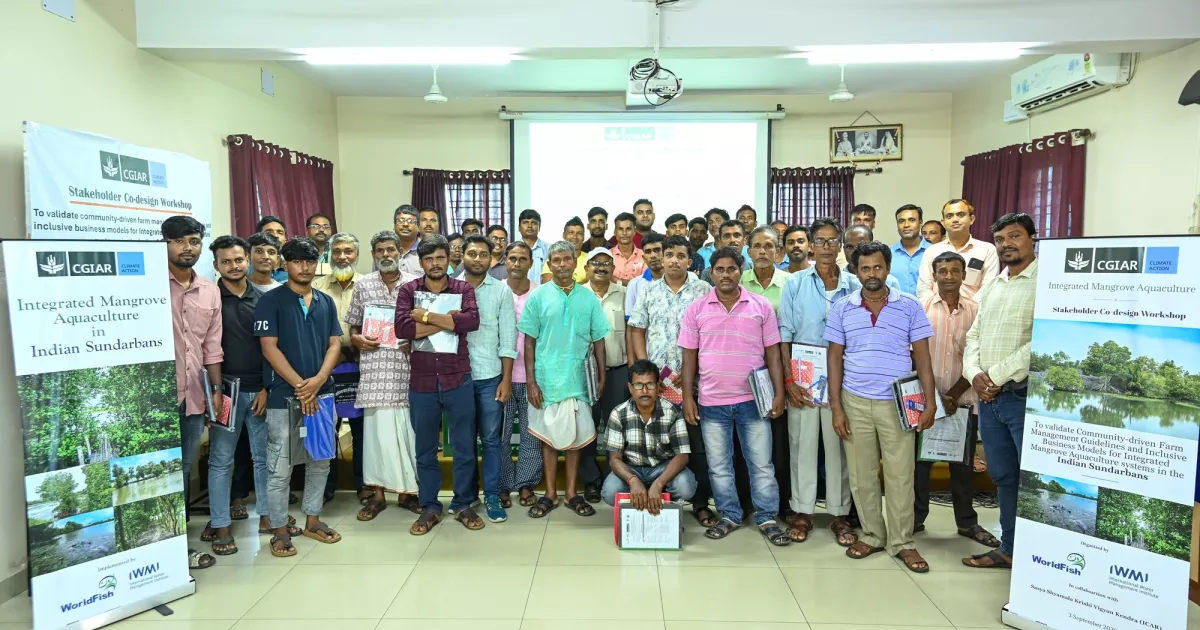
Farmers in the Indian Sundarbans have tested draft management guidelines and business models for integrated mangrove aquaculture (IMA), a system that combines brackish-water fish and shrimp ponds with the conservation, restoration or planting of mangroves, at a co-design workshop in West Bengal.
The workshop, held on 3 September in South 24 Parganas, was organised by WorldFish and the International Water Management Institute (IWMI) under the CGIAR Climate Action Program, with Sasya Shyamala Krishi Vigyan Kendra. About 60 people took part, around 50 of them farmers from six community development blocks. Aquaculture there has to cope with salinity, cyclones, storm surges and erosion.
The draft guidelines cover site selection, farm design and the choice of mangrove species through to pond management, fish health, harvesting, record-keeping and risk. Their central principle is that IMA must be fitted to each site rather than applied as a single model. Farmers asked which mangroves to plant, how to handle overgrown stands, which fish and shrimp to stock and how much pond area can go to mangroves without cutting production, and weighed the labour, investment and returns of each practice. Soil and water quality monitoring was also discussed.
Three business pathways were put to the farmers: upgrading existing silvofisheries or IMA ponds, converting conventional brackish-water ponds to include mangroves, and combining IMA with crops or horticulture where the site allows. Their feedback will feed into cost, labour, risk and market-access analysis of each model.
Farmers were also introduced to carbon accounting and to measurement, reporting and verification (MRV), since mangroves store carbon in their biomass and soils. The organisers stressed that carbon finance is not an assured income: it would depend on credible methods, eligibility, independent verification, certification and market conditions, and grouping small farms may ease some of the costs but needs further study.
No final model came out of the workshop. The next steps are to fold in the recommendations, continue field testing under different pond conditions, prepare training materials and assess what carbon accounting would require. The report was published by CGIAR Climate Action.
Source: CGIAR
Comments
(0)