
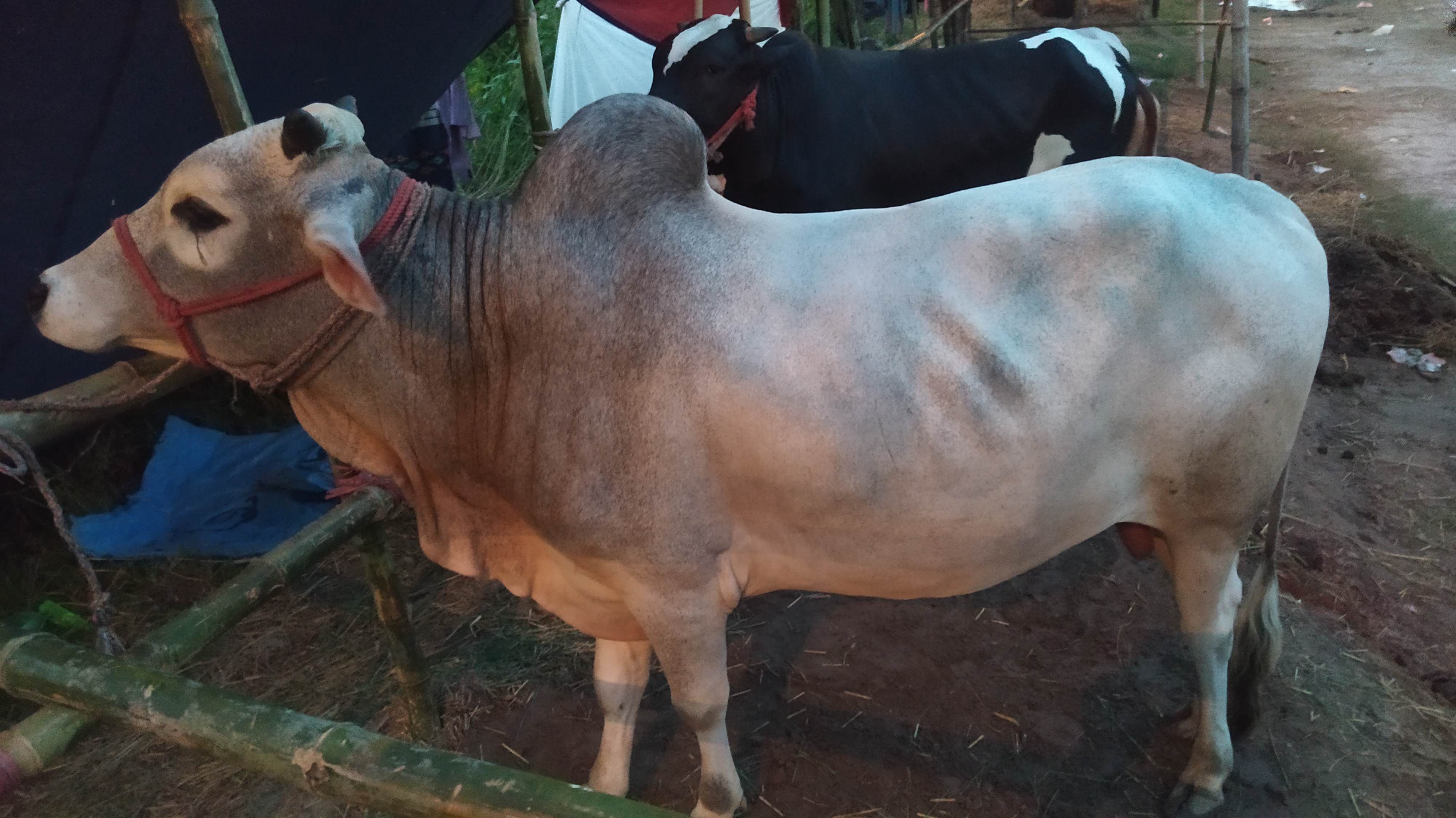
Two unusually large cows brought from Pabna drew crowds of curious visitors at the temporary Qurbani cattle market on the Sun Valley Balur Math ground next to Aftabnagar in Dhaka in the week before Eid-ul-Azha 2026. Jagonews24 reported on the evening of Tuesday 26 May 2026 that the trader who brought them, Bahar Ali of Pabna, was asking Tk 11 lakh for the larger animal and Tk 10 lakh for the other. He described both as Brahman-breed cattle and claimed that the larger one would give about 25 maunds of meat and the smaller one 22 to 23 maunds. These were his own asking prices and his own estimates; the paper did not report a sale.
The report opened with the wider picture at the capital's markets that week: trading had picked up ahead of Eid, and alongside the small and medium cows that most buyers were looking for, a few very large animals were catching people's eyes. At Sun Valley, people gathered around Bahar Ali's two cows. Some took pictures on their mobile phones, others stood and expressed surprise on hearing the price, many walked round the animals to look at them from every side, and some asked the price and moved on. According to the paper's photographs, the larger animal is white and black and the smaller one red.
The trader's account and his asking prices
Bahar Ali told Jagonews24 that the two cows were born of his own cow and that he had raised them with great care for about six years. Feeding one of them in the village, he said, cost Tk 1,000 a day. He said that besides farm feed they had mostly been given natural food, that he had not used any kind of harmful drug, and that he had raised them with a great deal of care. These statements about how the animals were fed and treated are the trader's own; the report did not say that any official had examined the cattle.
He set out his prices in the same conversation. One cow, he said, would give about 25 maunds of meat and he was asking Tk 11 lakh for it; the other would give 22 to 23 maunds and he wanted Tk 10 lakh for it. If someone took both together, he said, he would let them go for close to Tk 20 lakh.
Bahar Ali also told the paper that a buyer at the market had already offered Tk 15 lakh for the pair, but that he had not agreed to sell at that price. Before he brought the cattle to Dhaka, he said, a trader in his village had offered Tk 16 lakh. He had raised the animals with so much effort, he explained, that he thought he might get a better price in Dhaka, and that was why he had brought them to the capital.
Talking to the trader, the paper learned that he had arrived at the Sun Valley Balur Math market with the two cows on Saturday 23 May. At first he had asked Tk 16 lakh for the larger cow and Tk 15 lakh for the smaller one, but with Eid drawing near he was asking somewhat less by the time of the report.
What buyers and other traders said
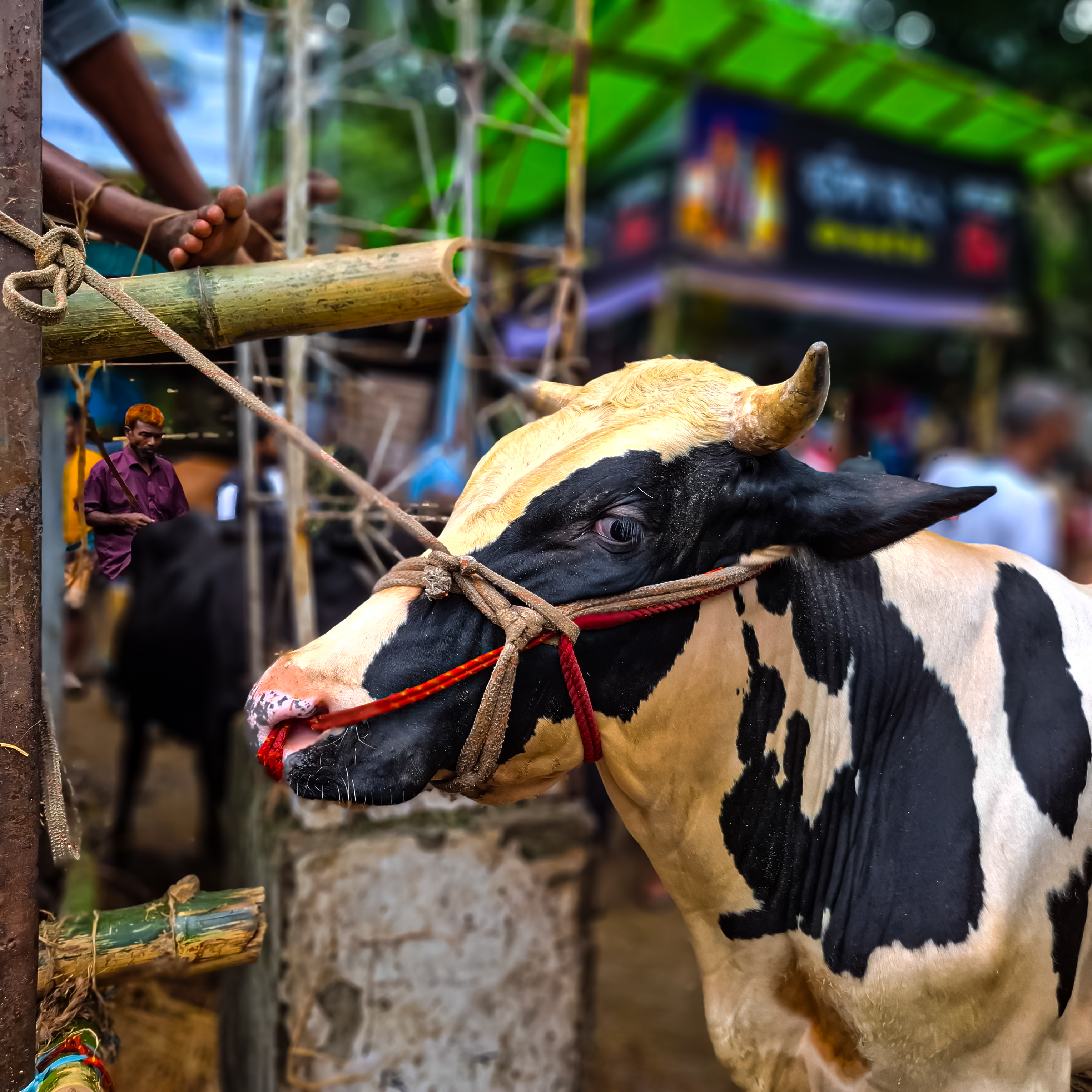
Many of the buyers Jagonews24 spoke to at the market said there was less interest in big cows this year. Fewer large animals had come to the market, they said, and traders were asking high prices for the few that had.
Badrul Islam Khokon, a businessman who had come from Badda, said the two cows looked very handsome, but that Tk 10 to 11 lakh was beyond the reach of ordinary people and that, to him, the asking price seemed too high. Another buyer, Nasir Uddin, said not many big cows were to be seen at the market this year and those that had come were being offered at high prices; small and medium cows were also dearer this year, he said. He doubted the trader's estimate: the trader claimed the big cow would give 25 maunds of meat, but he thought it would give less. Very few people could afford to buy a cow for Tk 10 to 11 lakh, he said; if a wealthy person liked them, he might buy the two, but it was not possible for ordinary people to buy such cows.
Other traders at the market told the paper that demand for big cows was low this year and that people were bargaining more over small and medium animals. With transport and feed costs up, they said, prices were a little higher than before.
Reports from other Dhaka markets in the same days described the same pattern. On 25 May the news agency UNB, in a report carried by The Business Standard after visits to three city markets including Gabtoli and Aftabnagar, wrote that medium-sized cattle priced between Tk 1 lakh and Tk 2 lakh were dominating buyer demand, because many residents planned to share one animal for the sacrifice with relatives, neighbours or friends, while prices of premium cattle were still high. A trader from Kushtia told UNB that higher feed and transport costs had pushed prices up somewhat, and a volunteer at the Aftabnagar market said the crowds were growing every day, especially in the evenings.
Twenty-five maunds: what the figure means
The maund (মণ, mon) is the traditional unit in which Bangladeshi buyers and sellers talk about the size of a sacrificial animal. It is an old South Asian measure of weight: the Bengal Presidency standardised it in 1833 as 40 seers, and after independence India and Pakistan defined it as 37.3242 kilograms. In Bangladesh's everyday trade a maund is reckoned at 40 kilograms.
When a trader at a Qurbani market speaks of a cow of so many maunds, he usually means the meat he expects it to give rather than its live weight, and that is how Bahar Ali put it: the larger cow, he said, would give about 25 maunds of meat. The figure is an estimate made by eye, not the result of weighing, and one of the buyers quoted in the same report openly doubted it. The original report gave no weight for either animal.
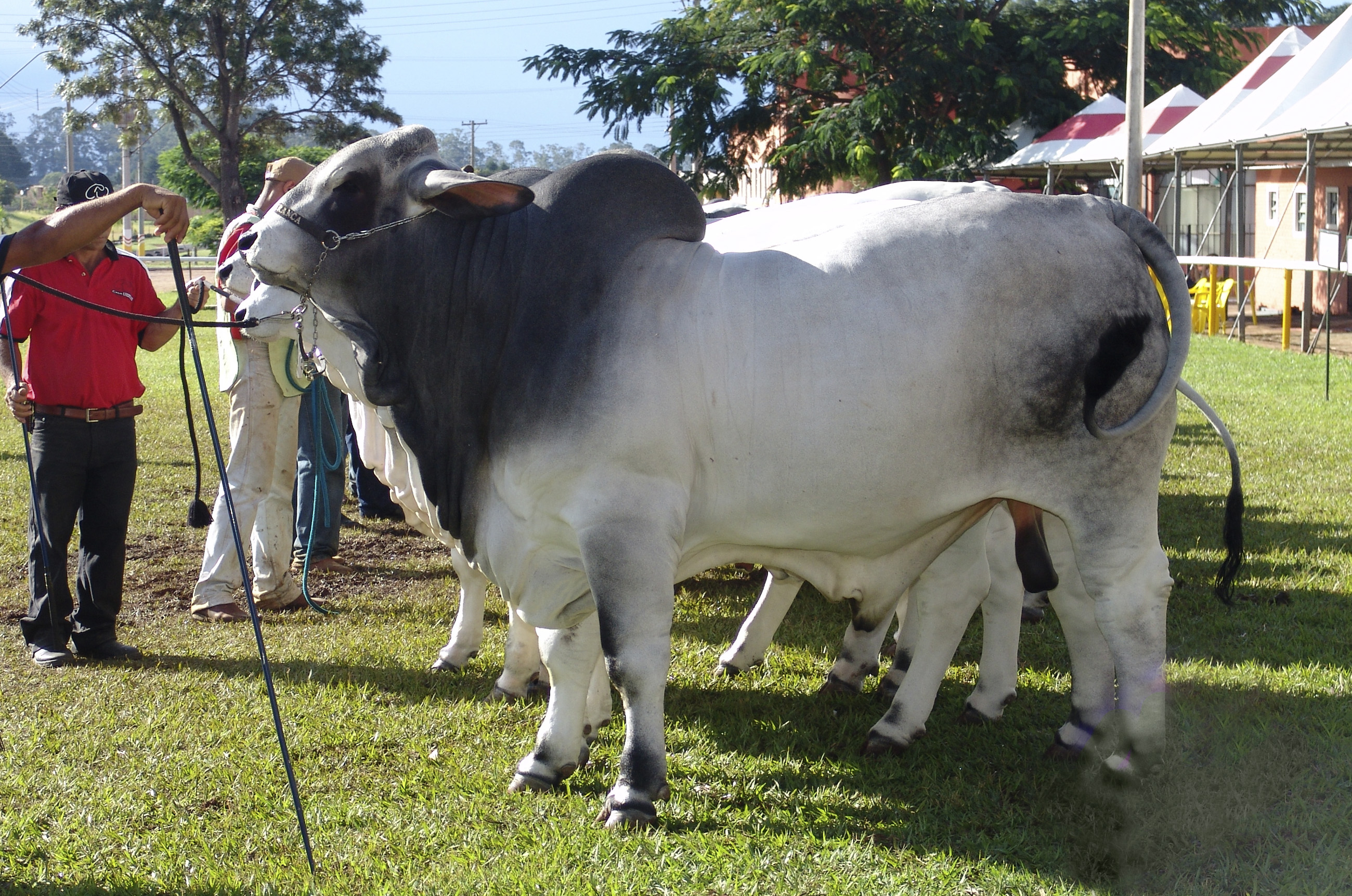
For comparison, the encyclopedic description of the Brahman breed, drawing on standard breed references, gives an adult Brahman bull a weight of about 887 kilograms and an adult cow about 450 to 675 kilograms. Bangladesh's own cattle are much smaller. Banglapedia describes most of the country's cattle as non-descript indigenous zebu-type animals, and the Pabna cattle of the Pabna and Sirajganj area as a medium-type local variety.
The Brahman breed and its status in Bangladesh
The Brahman is a beef breed developed in the United States from humped zebu cattle brought from India. According to the breed's history as summarised in reference works, a pair of grey bulls was brought directly from India to Texas in 1885, other small groups followed until about 1906, and further zebu stock came from Brazil in the 1920s; Gir, Guzerá and Nelore cattle were the main ancestors. The American Brahman Breeders Association was founded in 1924. The breed is known for its tolerance of heat and humidity and its resistance to insects, and for doing well on poor feed. The Dhaka Tribune noted in 2024 that the breed is popular for beef in the United States and South America because it withstands environmental stress.
Bangladesh tried the breed through the government. The Business Standard reported in July 2021 that the Department of Livestock Services (DLS) ran a Beef Cattle Development Project from 2008 to 2017. In its pilot phase, artificial insemination with Brahman semen was carried out in 11 upazilas for three years; in 2013-14, 60,000 doses of Brahman semen were imported and used on native cows; and in 2016-17 the work was extended to 185 upazilas in 48 districts.
The plan, the DLS's director of artificial insemination told the paper, had been to open Brahman breeding to farmers when the project ended, but instead its production had to be stopped. Farmers had begun using Brahman semen in an unplanned way, and some government and private insemination workers had applied it to cows outside the project, which was not allowed. Officials argued that female calves born from native cows bred to Brahman bulls did not give milk, and the director said that widespread production of Brahman cattle would therefore threaten the country's milk output. The DLS stopped Brahman production, import, semen import and insemination; the department's director general told the paper that importing such cattle required prior permission.
In a July 2024 explainer, the Dhaka Tribune wrote that Brahman cattle were not technically banned in Bangladesh, but that the import of any livestock needs permission from the authorities, including the DLS, and that the breeding policy then in force did not include the breed. The paper quoted the DLS's artificial insemination director as saying that until a policy was decided, no government or private body had been permitted to produce or sell Brahman semen. The 2016 amended artificial breeding policy, it said, had set criteria for semen imports and proposed experimental crossing of Brahman with local breeds for meat.
Against this background, Bahar Ali's description of his two cows as Brahman remained his own claim. The report did not say how the animals had been bred, and no official assessment of their breed was published.
Pabna, a district of cattle
Bahar Ali's home district lies on the Padma and the Jamuna. Banglapedia gives Pabna an area of 2,376.13 square kilometres and nine upazilas: Atgharia, Ishwardi, Chatmohar, Pabna Sadar, Faridpur, Bera, Bhangura, Santhia and Sujanagar. Its rivers include the Padma, the Jamuna, the Baral, the Ichamati, the Atrai, the Hurasagar and the Chiknai, and part of the Chalan Beel wetland lies within it. The 2011 census counted 2,523,179 people in the district, and agriculture is the main source of income.
Pabna has long been known for cattle. Banglapedia lists Pabna, Sirajganj, Chittagong and Munshiganj as the places where the best local cattle are found, and names Pabna cattle as one of four improved indigenous varieties of Bangladesh, with Red Chittagong, Munshiganj and North Bengal Grey cattle. A Pabna cow gives about three to five litres of milk a day. The area also has the bathan, a seasonal pasture of about 6,000 hectares along the Baral and Gohala rivers that floods in the monsoon and dries out from November to April, when black gram and grass pea grown there are grazed by cattle.
The district was preparing far more animals than it needed for the 2026 Eid. Desh Rupantor reported from Pabna on the morning of 26 May that, according to the district livestock office, 653,000 sacrificial animals had been raised on farms and in households against a local demand of 336,572, and that more than 300,000 surplus animals were going to markets in Dhaka, Chattogram and other districts. The district livestock officer told the paper there was no shortage of sacrificial animals in the district, and that 25 approved markets had security arrangements and 25 medical teams to treat sick animals. Sellers and farmers there blamed higher prices on the sharply increased cost of feed such as grass, bran and oil cake. Buyers in Pabna, too, were most interested in small and medium cattle.
Fattening drugs: what the law and the ministry said
Bahar Ali's statement that he had used no harmful drug touched on a concern raised every Eid season. On 14 May 2026, The Daily Observer reported allegations that some farm owners and seasonal traders were using hormone-based drugs and steroids to fatten sacrificial cattle in several districts, among them Pabna, Sirajganj and Kushtia. Livestock officials told the paper that such practices were prohibited but had not been completely eradicated. Sources in the livestock sector named the steroid dexamethasone, and veterinary experts quoted in the report said such drugs cause water to be retained in the body, which they described as artificial swelling rather than genuine weight gain. The signs listed in the report were fluid build-up in the body, unusual softness when pressed and excessive salivation. A researcher at Bangladesh Agricultural University estimated that steroid use might affect 10 to 15 percent of sacrificial cattle in some markets; this was his estimate, not an official figure.
At a press conference on 3 May 2026, reported by the state news agency BSS, the fisheries and livestock minister said that the Department of Livestock Services does not allow the import of cow-fattening injections or any steroid, warned that some unscrupulous traders might collect such medicines to fatten animals, and said the DLS would destroy illegal drugs through drives across the country. Expert veterinary teams under DLS supervision were to work at every cattle market in the country to treat sick animals. The Daily Ittefaq's English edition, citing BSS, reported on 20 May that veterinary medical teams would examine animals at the major markets and that no animal would be allowed for sale without health clearance.
Two laws apply. The Fish Feed and Animal Feed Act 2010 (Act No. 2 of 2010) says in section 14 that antibiotics, growth hormones, steroids, pesticides and other harmful chemicals may not be used in fish feed or animal feed, and that breaking this rule is an offence. Under section 20, an offence under the Act is punishable by up to one year in prison, a fine of up to Tk 50,000, or both.
The Animal Welfare Act 2019 (Act No. 12 of 2019) counts as unnecessary cruelty the deliberate and needless feeding or injecting of a drug or substance that is harmful to an animal or not meant to be given to it. Under section 16, unnecessary cruelty is punishable by up to six months' simple imprisonment, a fine of up to Tk 10,000, or both.
Care of animals at the market under the law
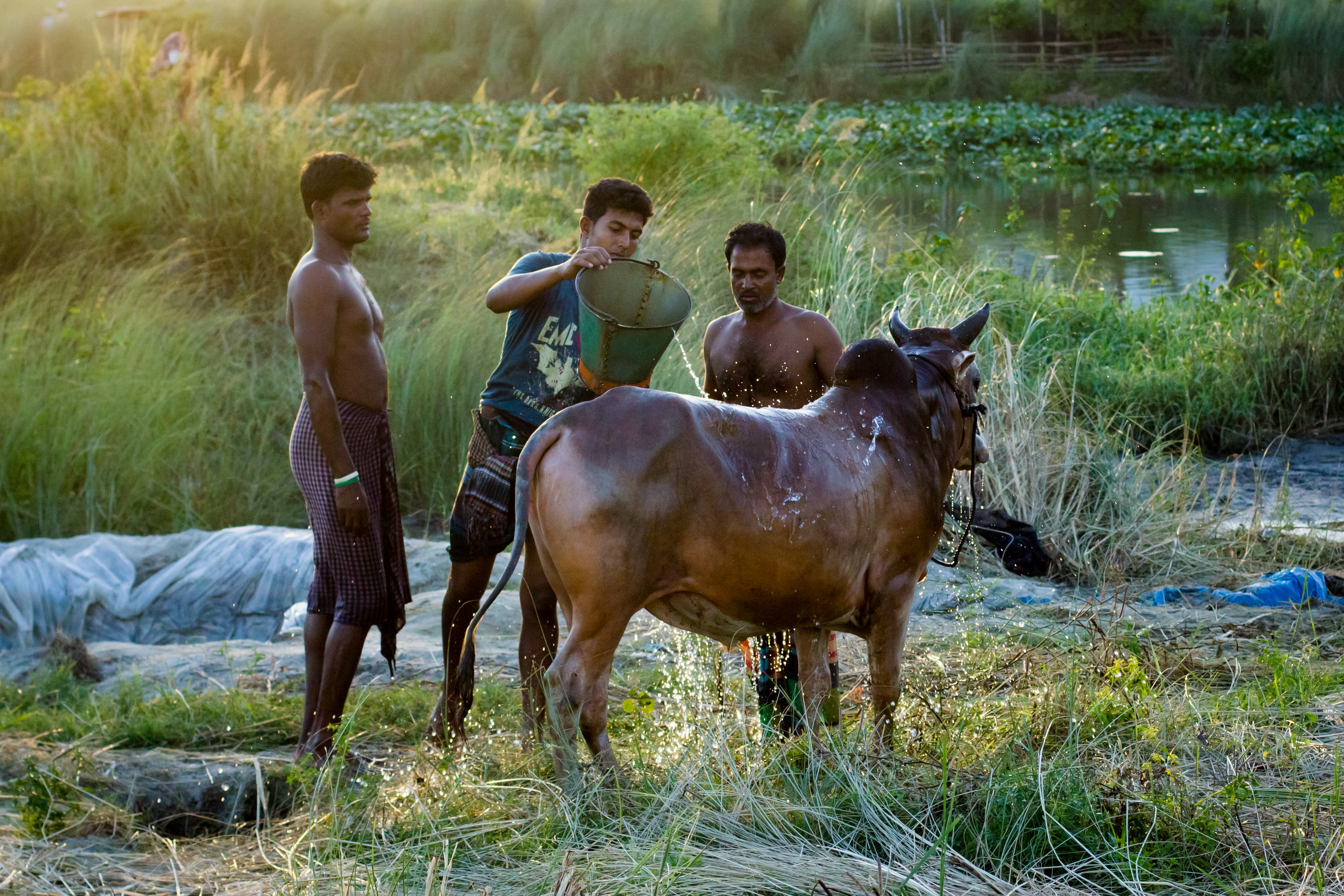
The 2019 Act also sets out what the owner or keeper of a cow owes it during the days at a market. Section 4 makes every owner or keeper responsible for treating an animal kindly and humanely and for not being cruel to it without reasonable cause. Among the acts that section 6 counts as unnecessary cruelty are:
- making an animal overwork or beating it unnecessarily;
- not giving an animal the food and water it needs, or forcing it to take too much;
- tying, confining or carrying an animal in a way that does not let it stand, sit or lie down naturally;
- striking an animal with a sharp metal object to control it;
- offering for sale an animal that is suffering from injury, hunger, thirst or other cruelty without arranging treatment for it.
The same section states that acts done by a follower of any religion in keeping with his own religious practice, when slaughtering an animal for food or sacrificing it for a religious purpose, are not counted as unnecessary cruelty.
Dhaka's Qurbani markets and the national supply in 2026
Sun Valley Balur Math was one of the temporary sites around the capital that year. According to the government, 27 cattle markets were to operate in Dhaka for the 2026 Eid, 16 under Dhaka North City Corporation and 11 under Dhaka South City Corporation, with an Aftabnagar market among the south's sites, and more than 3,600 makeshift and permanent markets across the country. In Dhaka, markets were allowed only at designated sites, not on roadsides. bdnews24 reported that trading began on Sunday 24 May at 24 markets of the two city corporations.
The ministry's figures showed a large surplus. According to the Department of Livestock Services, as reported on 20 May, 12,333,840 animals were available for sacrifice against a projected demand of 10,106,334, a surplus of around 2.2 million. The minister had said on 3 May that, as in the previous year, no animals would be imported for the Eid and that the leasing of border cattle markets remained suspended; on 24 May, after visiting the Diabari market, he said domestic production was enough to meet demand. Buyers purchasing animals online would not pay the market levy (hasil), which applied only to purchases at a market.
UNB's 25 May report listed the districts Dhaka's cattle were coming from: Kushtia, Chuadanga, Rajshahi, Pabna, Sirajganj, Faridpur, Jashore and Dinajpur. It also gave the place of livestock in the economy: 1.90 percent of Bangladesh's GDP and 16.52 percent of agricultural GDP in the 2021-22 fiscal year. The government had fixed the price of salted cowhide at Tk 62 to 67 per square foot in Dhaka and Tk 57 to 62 outside the capital.
Eid-ul-Azha and the sacrifice
The National Moon Sighting Committee, meeting at the Islamic Foundation in Baitul Mukarram, set Eid-ul-Azha in Bangladesh for Thursday 28 May 2026 after the Zilhaj moon was sighted, bdnews24 reported on 19 May. The government declared a seven-day holiday from 25 to 31 May.
Banglapedia describes Eid-ul-Azha, known in Bangladesh as Kurbanir Eid or Bakra Eid, as the festival of the 10th of Zilhaj, when the sacrifice commemorates Hazrat Ibrahim (A) and Hazrat Ismail (A). In Bangladesh cows, goats and buffaloes are usually sacrificed. The animal must be of the prescribed age and free of defects such as blindness, a broken leg or a separated horn or ear. A camel, cow or buffalo may be sacrificed on behalf of up to seven people, while a sheep or goat counts for one, which is why so many Dhaka households share a medium-sized cow rather than buy a very large one alone. The sacrifice begins after the Eid prayer and may continue until sunset on the following two days, or three by some opinions, and the meat is customarily divided into three parts: for the household, for relatives and for the poor.
Photo: Md. Ekram Hossain Bhuiyan / Wikimedia Commons (CC BY-SA 4.0). The top picture shows the Aftabnagar Qurbani market in Dhaka in 2022, as background; it is not of the two cows in the report.
Sources: Jagonews24 (26 May 2026), BSS (3 May 2026), The Daily Ittefaq English (20 May 2026), The Daily Observer (14 May 2026), bdnews24 (19 and 25 May 2026), UNB via The Business Standard (25 May 2026), Desh Rupantor (26 May 2026), The Business Standard (15 July 2021), Dhaka Tribune (5 July 2024), Fish Feed and Animal Feed Act 2010 and Animal Welfare Act 2019 (bdlaws), Banglapedia, Wikipedia (Brahman cattle; Maund)
Comments
(0)