
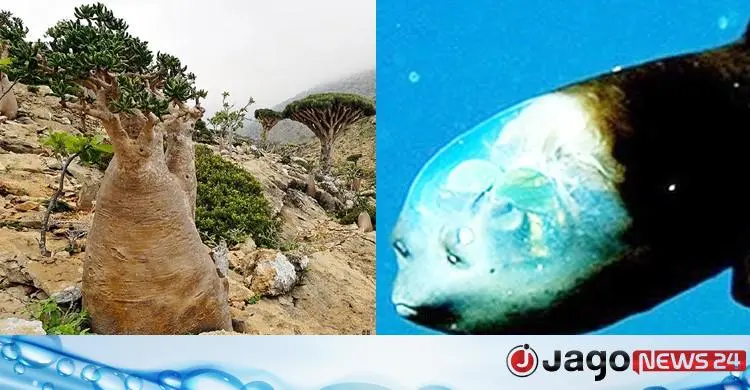
In the middle of the Arabian Sea lies an island that is called the "alien island" because of its geography and the shape of its plants. It lay uninhabited for millions of years; now people live there. Its name is Socotra, and it resembles nowhere else on Earth: its trees are strangely shaped, and so are its animals and birds. The "alien fish", however, does not come from this island. Researchers say it is a deep-sea fish, and it has been seen off Monterey, California, in the United States.
Socotra, the 'alien island'
Socotra rises out of the Arabian Sea, but it is not a single island: the Socotra archipelago is made up of four islands, most of them belonging to Yemen. It was declared a province in 2013 and covers 3,796 square kilometres. Politically the islands are part of Yemen, but geographically Socotra and the other islands belong to the African continent, which is why Yemen is counted as a country lying across two continents.
UNESCO declared Socotra a World Heritage site in 2008. The island was once part of the supercontinent Gondwana, and it matters because it sits beside several major sea trade routes. Its capital, Hadibu, is the largest town in the region. In 2001 a team of Belgian speleologists working on a project found a very deep cave called Halah on Socotra, along with a number of tablets, stones and archaeological objects. Archaeologists have also found human bones and bone marrow on the island dating back 1.7 million years.
In ancient times the island was one of the centres of trade, and most of the writing on the stone pieces found there is in the Indian Brahmi script. The average temperature is 20 degrees Celsius and very little rain falls in a year. In 1990 United Nations biologists carried out a survey and recorded about 700 species of native plants. In 2004 three critically endangered and 27 endangered plants were listed for Socotra. Of the 825 plant species on the island, 307 are endemic, meaning about 37 per cent of its plants are found nowhere else in the world.
The island's strangest tree is the dragon's blood tree, which can be frightening at first sight. It looks like a giant mushroom. Growing in the island's dry soil, it can reach 32 feet. As the trunk grows upwards it splits into countless branches, and the oddly shaped, umbrella-like tree gives off a red, sticky substance. This resin is used to make dyes and varnish, and the plant was very probably used as a medicine and in cosmetics as well.
Another special plant is Dendrosicyos, a kind of cucumber tree. Its variously shaped trunk grows tall and forms a crown on which yellow and pink flowers bloom. Researchers believe this bisexual tree originated twice as long ago as the island itself. It is the odd form of these plants above all that has earned Socotra its name as the island of aliens. There is also a flowering plant called pomegranate, which grows two and a half to four feet tall and usually flowers and fruits in December and January. Its wood is very hard and is used to make small pieces of furniture.
A total of 31 animal species are found on the island, 29 of them, or 94 per cent, endemic and seen nowhere else. Skinks, legless lizards, many kinds of spider and three kinds of freshwater crab live here, as do a number of butterflies. Apart from bats, however, no mammal has been found. Though there was little human settlement over the past two thousand years, people have been settling over the last two centuries. Large crocodiles and lizards have appeared, and the island's distinctive local animals are heading towards extinction.
An airport was built on the island in 1999; until then cargo ships were the only way to reach it. Socotra airport lies 12 kilometres west of the main town. Climate change has begun to have negative effects on the island.
The 'alien fish'
The alien fish does not belong to the alien island. Researchers say it is a deep-sea fish that has been seen off Monterey, California. Creatures with such transparent heads live in the Atlantic, Pacific and Indian oceans, at depths of 2,000 to 2,600 feet. The US-based Monterey Bay Aquarium Research Institute studies the underwater world using a remotely operated vehicle called Ventana, fitted with a high-resolution camera, and it was in that camera's frame that this strange creature was recently caught.
In more than 27,600 hours of video recorded by the remotely operated vehicles Ventana and Doc Ricketts, the fish was captured on camera only nine times. It is also known as the spook fish, and scientists call this transparent-headed creature Macropinna microstoma. The rare fish is six inches long. Most of its alien-like body is black or indistinct, but the top of its head is transparent. Unlike any other sea creature, it has a pair of bright green eyes inside its see-through head.
The transparent-headed fish was first seen in 1939. Until 2019 it was thought that its eyes were fixed in place and that what lay directly above its head was only "tunnel vision". A new study that year found, however, that the eyes can rotate within the transparent shield on top of the head, search for food and even watch what the fish is eating.
The fish can turn its eyes through 360 degrees in search of food, and it was this eye movement that first set off the research. According to biologists, the fish lives in a harsh environment that sunlight cannot reach, and as a result it has developed a powerful sense of sight.
Source: Jagonews24. First published in Bengali on The Agro News.


Comments
(0)