
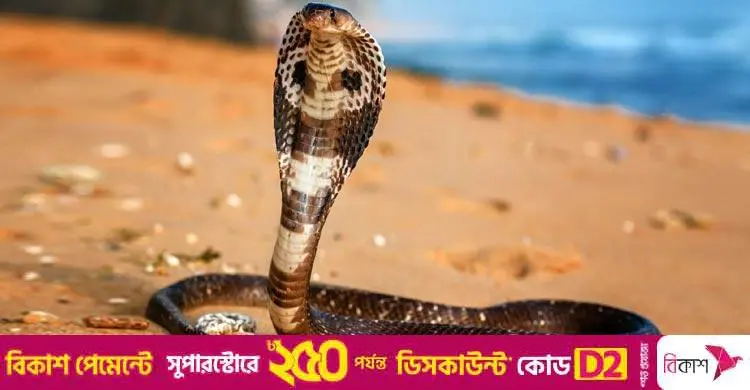
An average of 6,000 to 7,000 people die of snakebite every year. A snake bites a person only when it sees that person as a danger to itself. Yet some species can bite even after death. It sounds surprising, but several such incidents have come to light recently.
All the incidents were in India. Three strange cases occurred in 2022 and 2023 in the north-eastern Indian state of Assam. In all three, a dead snake bit a person some hours later. The species involved included the monocled cobra and the black krait, both considered among the most venomous snakes in India.
That a snake can bite after death, and that its venom can even kill, is not a made-up story; several studies have shown it. A snake can bite three hours after dying, so the relief people used to feel after killing one may no longer be justified.
The danger does not end the moment a snake dies. A team of biologists and health experts in Assam found several pieces of evidence in their research. A BBC Bangla report said the venom-delivery system in a snake's body remains intact for several hours after death.
After the incidents in India, the research journal Frontiers in Tropical Diseases published a paper discussing why the risk of a bite remains even after a snake has died or been beheaded.
Three cases from Assam
The first case was in Sivasagar district, where a 45-year-old man saw a cobra in his poultry farm eating his chickens. Without thinking, he struck the cobra's head with a blade. He was about to throw it away, believing it dead, when the severed head bit his hand. The venom began spreading from his hand through his body, and he recovered after hospital treatment.
The second case was from the same area. A cobra was killed when it was crushed under the wheel of a farmer's tractor. A few hours later, when the farmer got down from the tractor to look, the dead snake bit his foot. The bitten area swelled and he began vomiting. He had to be given antivenom and antibodies and recovered after 25 days of treatment.
The third case was from Boko in western Assam, where a black krait was able to bite a person who approached it three hours after its death. At about 6:30 one evening, some people killed a black krait and threw it behind a house.
About three hours later, one of them went out of curiosity to look at the dead snake and picked it up by hand. It bit him on a finger of his right hand. At first his family did not take it seriously, as there was no pain at the bite and no swelling, and he said the snake had already been killed.
At about 2am, however, neurotoxins began to affect him; a neurotoxin is a venom that attacks the human nervous system. He was in pain and his body began to go numb. He was taken to hospital and recovered after 16 days of treatment.
Why a dead snake can still bite
The research team reviewed these incidents. According to their study, some snakes retain the ability to bite three hours after death, because the venom system in the snake's body stays active for several hours and can affect people.
Dr NS Manoj, founder and chief scientist of the Universal Snakebite Education and Research Institute, says this ability is greater in front-fanged species with venom fangs. Snake venom is in effect like human saliva. The venom gland is connected to the fangs, and the system works much like a syringe: when a snake bites, venom leaves the gland and reaches the victim's body through the fangs.
The paper also discusses the snake's "false bite" or dry bite. Sometimes a venomous snake bites an enemy without injecting venom, to warn it off.
A dead snake, however, has no control over whether venom is injected. So if pressure on a dead snake's body causes its fangs to strike something, venom can come out through them without the snake having any control, and venom left in the gland can enter a human body.
Dr Manoj said there are such examples with rattlesnakes, a kind of viper. These species are widespread in America and are highly venomous.
Dr SR Ganesh, research director at the Kalinga Foundation in Karnataka, said there are also examples of this with the brown snakes of Australia and the cobras found in China.
Among the species found in India, the danger is greatest from the Russell's viper, saw-scaled viper, bamboo pit viper, Malabar pit viper, coral snake and banded pit viper. It can happen even with water snakes such as the konda kondai and neerkoli, which look as if they would do no harm.
Stay careful
The best course is to stay careful and aware. Dr Manoj said many people want to pick up and touch a dead snake, which is dangerous. "Medical science has a precise definition of death for humans, but there is no such definition for snakes or other reptiles. We assume a snake is dead if it has been cut, its head has been cut off, or it has lain still for a long time. Whether you see a snake alive or dead, the best course is to inform people who know about these matters and let them take action."
The article draws on BBC Bangla.
Source: Jagonews24. First published in Bengali on The Agro News.

Comments
(0)