
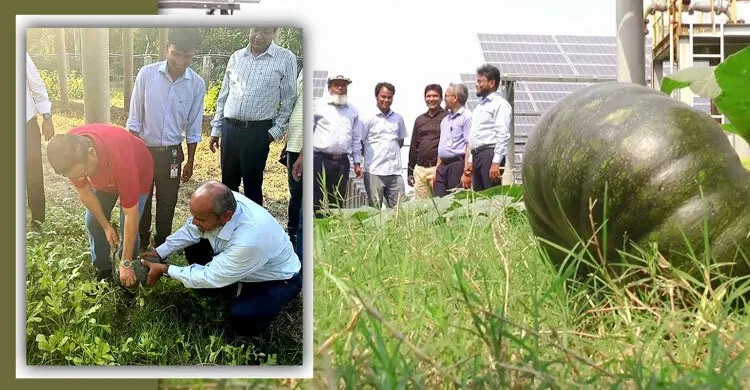
The North-West Power Generation Company's 7.6 MW power plant began operating in 2022 at Saydabad in Sirajganj, beside the Jamuna river west of Bangabandhu Bridge. Pumpkin, watermelon, taro and other vegetables are now being grown on 22 acres of land that lay unused because it is waterlogged for most of the year. The vegetables are being grown experimentally as a pilot project. A 68 MW solar power plant is being built next to the project, where there are plans to raise ducks and fish and grow vegetables alongside generating electricity from sunlight.
North-West Power Generation Company Chief Engineer Shafiqul Islam told Jago News: "Senior Secretary of the Power Division Habibur Rahman visited to inspect the progress of these projects and expressed satisfaction. There are 22,650 solar panels on the solar plant's 22 acres. Vegetables are being grown so that the wide space under the panels is not wasted, which will play an important role in the country's agriculture. We are also working on what other vegetables can be grown under the panels."
Welcoming the initiative, Babul Kumar Sutradhar, deputy director of the district Department of Agricultural Extension (DAE), told Jago News: "In the developed world, projects are carried out like this while saving farmland. It will increase environment-friendly renewable energy and agricultural production."
Ownership and cost
Project officials said the plant, spread over a total of 214 acres in the Saydabad area west of Bangabandhu Bridge with joint Bangladesh-China investment, is owned equally by Bangladesh's state-owned North-West Power Generation Company Limited (NWPGCL) and China's state-owned China National Machinery Import and Export Corporation (CMC).
Construction of the plant, costing 87.71 million US dollars (about Tk 921 crore at an exchange rate of Tk 105 to the dollar), is nearly complete. Under the power purchase agreement, the Bangladesh Power Development Board (PDB) will buy electricity from the plant for 20 years at 10.2 cents, or about Tk 11.22 (at an exchange rate of Tk 110 to the dollar), per unit.
Panels raised for boats, fish and ducks
They said tomatoes, pumpkins, taro, puin shak (Malabar spinach) and other vegetables are being grown under the solar panels. The pilot was carried out by engineer A M Khorshedul Alam, former chief executive officer and managing director (MD) of NWPGCL, who is now MD of Bangladesh-China Renewable Energy Company Limited (BCRECL). Drawing on that experience, work is under way to make more varied use of the land of the new 68 MW plant.
BCRECL Assistant Engineer Shakirul Rahman told Jago News: "The solar panels have been raised high and set with some space between each pair of rows, so that boats can pass through and sunlight reaches the ground below. So fish and ducks can easily be raised in the monsoon and vegetable crops in winter. This gives multiple benefits for fish farming and agriculture alongside power generation. It was once thought that building a solar plant made land useless, but with improved technology much less land is now needed than before, and the land can be put to multiple uses."
Project Assistant Manager Rezwan Talukder told Jago News: "The solar panels are mounted on pillars about 10 feet above the ground. On 27,000 such tall pillars, 1 lakh 56 thousand 576 panels of 545 watt-peak each will be installed, with a total capacity of 85.33 MW. The plant will produce 68 MW of electricity."
Dr Jannat Ara Henry, member of parliament for Sirajganj-2 (Sadar and Kamarkhanda), told Jago News: "In Sirajganj this is not just a power plant; besides generating electricity it will play a special role in improving local socio-economic conditions. Being on the bank of the Jamuna, it will also be quite different from other plants."
Source: Jagonews24. First published in Bengali on The Agro News.


Comments
(0)