
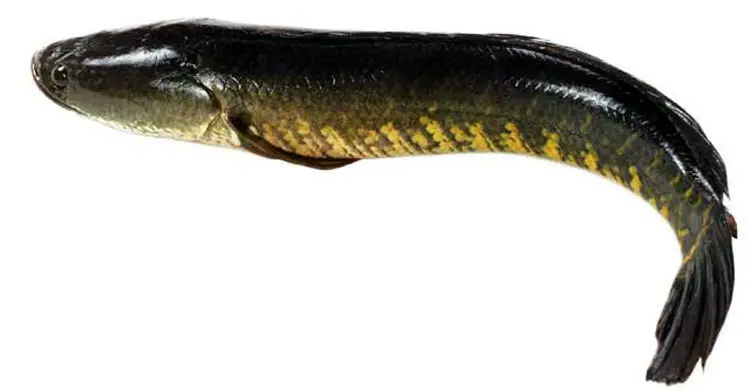
We call shol a "predatory fish". It is an expensive fish in the market, yet very cheap to farm. It can withstand all kinds of disasters and adverse conditions, and the mother shol nurses the eggs and rears the fry herself.
Stocking fry
Because shol is not farmed commercially in Bangladesh, fry must be collected from the wild. Baishakh is the breeding season: shol start producing young from the beginning of the month, and the young stay together in a shoal. At that time, collect week-old fry from haors, baors and ponds. If fry cannot be found, collect large shol and release them into the pond.
For single-species farming, 10 fish can be stocked per decimal; for mixed farming, 4 per decimal. An adult shol can be 2.5-3 feet long.
Preparing the pond
Shol can be farmed in any pond, provided it has a suitable environment. Water hyacinth or water spinach (kalmi) in the pond is good because shol like to hide, but the pond must not be choked with hyacinth. A net fence at least 5 feet high must be put up around the pond, or the fish will jump out during the rainy season.
Feed
Shol usually do not eat feed made from oil cake or bran; small fish are their main food. Fry love dried fish powder, so give them finely ground dried shrimp. After 15 days of this the fry will be about 2-3 inches. Once 2-3-inch fry are stocked, carp hatchlings can be given as feed, along with small frogs or tadpoles. Larger fish can be given small fish, and they eat fresh dead fish eagerly.
Mixed farming
There is little prospect of farming shol on its own in Bangladesh, because it is not possible to supply so much raw fish, dried fish, frogs or tadpoles. So shol can be farmed alongside other fish. In six months each shol may reach 700-1,000 grams.
Disease
Shol suffer from ulcer disease in winter, so seek a fisheries officer's advice at that time.
Everyone should come forward to increase fish production and keep native species alive. Otherwise, in a few years people will find no trace of native fish.
Source: Jagonews24. First published in Bengali on The Agro News.
Comments
(0)