
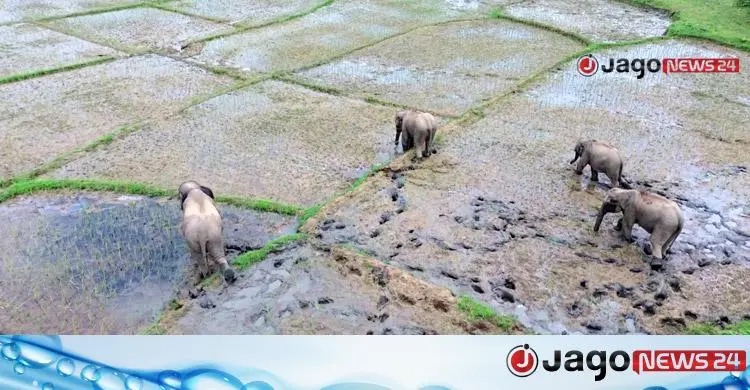
The Garo Hills were once a safe haven for wild elephants. Deep in the hills were dense green forest, natural streams and waterfalls, and many of the trees elephants love to eat: amloki, haritaki, bohera, wild banana and bamboo. The elephants found food inside the hills and drank from clear streams, so raids on villages were rare.
The situation is now completely different. Farmers' crops for the whole year are trampled, and homes are broken. To protect their crops and homes, people set electric traps and poisoned bait, which kill elephants, while elephant attacks also take human lives.
Human encroachment, deforestation and the effects of climate change have left the forest unable to give elephants food and water, and that crisis has gradually brought people and elephants face to face. The hills that were once the elephants' refuge are now pushing them towards villages.
This picture of environmental damage and human-elephant conflict in the hill areas of Jamalpur and Sherpur in Mymensingh division emerged from interviews with zoologists, the forest department and local residents.
Deaths on both sides
According to the forest department, 49 people were killed by elephants in the region from 2014 to 2026. Over the same period, 35 wild elephants died from electric traps, poisoned bait and other causes.
Of the four districts, Sherpur has suffered the most, with 30 people killed by elephants and 30 elephants dead. In Mymensingh, 10 people were killed. In Netrokona, five people and two elephants died. In Jamalpur, four people were killed by elephants and three elephants died from various causes.
The forest department says the highest number of elephant deaths in the region in a single year was seven, in 2015. Experts say man-made barriers and revenge are among the main causes.
Why the elephants come down
An adult elephant needs 140 to 270kg of food a day and can drink 200 to 300 litres of water, depending on weather and surroundings. Grass, leaves, bark, roots, banana plants and young bamboo shoots are its main food. Much of this food and water was once found in the hill forests.
That natural larder has shrunk. Along with tree felling, parts of the hill forest have been occupied and brought under cultivation, reducing the elephants' food. Changing rainfall patterns due to climate change are drying up natural water sources.
Locals say elephants have been coming into villages regularly for the past 10 to 15 years, a sight that was rare even 20 years ago.
The hill environment of the Balijuri range in Jamalpur and Sherpur is in crisis. The streams and waterfalls that were once the elephants' main water sources have largely dried up, so the animals come down to the plains in search of water as well as food, using village ponds, ditches and water bodies.
This brings new dangers. Elephants get stuck in quicksand, come into contact with toxic chemicals, or die in electric traps set to stop them entering villages.
Blocked corridors
Elephants have their own ancient routes, used for generations to move from one part of the hills to another. Over time, many sections of these corridors have been taken over by homes, farmland and other structures, blocking the animals' movement.
When a herd follows an old route and finds human settlement, conflict follows. Sometimes frightened people chase the elephants; sometimes angry elephants attack. Both sides lose lives.
To protect their fields and homes, many people in the border area string GI wire around their land and electrify it. Herds entering villages at night touch the wires and are electrocuted. In some cases, people angered by damage to crops and homes turn to revenge, killing elephants with poisoned bait and other methods.
Farmers bear the brunt. A herd can destroy acre after acre of crops within a few hours, not only eating but trampling whole fields into the ground. For a farmer who has borrowed to grow a crop, one night's elephant raid can wipe out a whole year's hopes. For farmers in Balijuri and other border hill areas, the elephant is both part of the forest and a serious threat to their livelihood.
What experts propose
Experts say that measures to keep elephants out of villages alone will not solve the crisis. The habitat must first be made liveable again, with dense planting of food trees such as wild banana, bamboo, amloki, bohera, haritaki and jackfruit inside the forest, and large artificial reservoirs or lakes deep in the hills.
The ancient corridors should also be identified and freed of encroachment. The safer and more natural the elephants' routes, the less conflict with villages there will be.
Those involved recommend replacing the dangerous electric wires now in use with government-installed solar-powered electric fences. An elephant touching such a fence gets a mild shock rather than a fatal one and is likely to return to the forest, protecting both crops and homes and the animals' lives.
According to the latest forest department figures, about 120 elephants now live in the 8,330 acres of forest in the Balijuri range, and officials believe the food and water there are not enough for them.
Work has begun to restore the forest environment. Gardens of elephant food plants are being created on about 115 hectares of forest in the Balijuri range, and under an elephant conservation project about 40 artificial reservoirs or lakes are planned in forests across the country.
But projects alone are not enough. They must be carried out quickly, alongside protecting hill forests, freeing corridors from encroachment, and ensuring compensation and crop protection for local people. An elephant does not want to come into villages; if the forest can give it food and water, it may not need to. And if homes and crops on the forest edge can be kept safe, fear and losses on both sides may fall.
Voices from the hills
Hill resident Joydango said: "Elephants have been coming to the area for about 15 years. Before that they stayed inside the hills. There was enough food there: banana plants, amloki, haritaki, bohera and many other forest trees. Now whenever we plant a crop the elephants come, and they come again at harvest time."
Ramzan Ali, a farmer in the border area of Balijuri, said: "It's not the elephants' fault, brother. There is no food or water for them in the forest. If they don't come down from the jungle to the plains, where will they go? But to stop them people set electric wire traps and chase them with torches. Then elephants die. And when an elephant gets angry, people die too. We want to be saved from this bloody war between elephants and people."
Zoologist Professor Dr Mohammad Rokonuzzaman said: "Because of climate change, rain does not come at the right time. Without timely rain, how will trees grow in the hills? How will the hill rivers and streams keep flowing? Where will the elephants get water to drink? Some of the trees elephants eat depend on rain. Droughts are occurring in various places, and the same problem is arising in the hills. That is why they gradually come down towards the slopes."
Md Sumon Mia, officer of the Balijuri range in Mymensingh division, said: "To reduce human-elephant conflict, we have taken steps to restore the forest environment and ease the elephants' food and water shortage. Gardens of elephant food plants have already been created on 147.5 hectares of forest in the Balijuri range. If we can increase the food supply in these gardens, elephants will come to villages less often in search of food. To tackle the water shortage in the hills, about 40 artificial reservoirs or lakes are planned in forests across the country under the elephant conservation project. If these are carried out, the food and water crisis will ease considerably and human-elephant conflict will come under control."
Source: Jagonews24. First published in Bengali on The Agro News.
Comments
(0)