
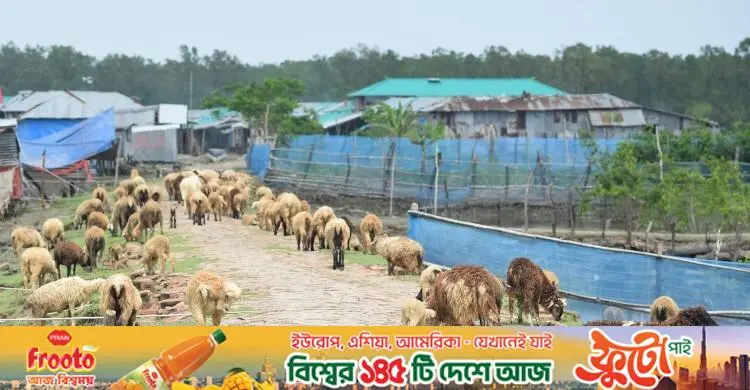
When Eid-ul-Azha comes, crowds swell at the country's cattle markets. Cows, goats and buffaloes draw bargaining, talk and a festive mood. While the markets ring with calls, a few sheep stand quietly in a corner, silent and waiting. There is no special interest in them, no crowd taking photos and little presence in social discussion. Bargaining over them is slow. Often sheep go unsold after days at the market, and when one or two are sold, prices fall short of expectations.
Alongside those sheep stand the hopes of hundreds of marginal farmers, who hope buyers will accept sheep as a normal sacrificial animal and that someone will come, make an offer and take one home. But the reality is different. In Bangladesh, demand for sheep at Qurbani is relatively low, even though in Islamic sharia the sheep is a fully valid and acceptable animal for sacrifice.
So why the reluctance? Why can farmers who raise sheep in open fields or char areas not feel very hopeful even in the sacrifice season? The answer reveals a complex picture of religious perceptions, social culture, economic realities and human psychology.
The pull of the big animal
In Bangladesh a strong social culture has developed around Qurbani alongside religious feeling, and at its heart is the tendency to buy a "big animal". For many, the sacrificial animal is not only part of religious practice but also a symbol of social standing, economic means and family prestige.
Md. Salauddin, a trader at a cattle market in the capital, said: "People still think a big cow means a big sacrifice. If you sacrifice a sheep, many may think you cannot afford more. It is even clearer in rural areas. So if they can afford it, people choose a cow, not a sheep."
"Bringing a big cow home, showing it to neighbours, relatives talking about it, all of this often creates an atmosphere of social competition around Qurbani," he added. "So most families that can afford it choose a cow, and those with less choose a goat. The sheep falls into an almost invisible middle position."
What religion says
Under Islamic rules, a sheep that has reached the required age is fully valid for sacrifice. One sheep can be sacrificed on behalf of one person, and religiously its importance is no less than that of a cow or goat. Several hadith accounts describe the Prophet Muhammad (PBUH) sacrificing sheep.
Still, misconceptions persist among ordinary people. Some believe sacrificing a sheep is "less important" or earns "less reward", which has no religious basis. Religious speakers say Islam gives weight not to the size of the animal but to intention, piety and means. But that message has not yet reached a large part of society.
Maulana Rashedul Islam, khatib of a mosque in Dhaka, said: "The essence of Qurbani in Islam is piety and ability, not the size or market value of the animal. But a competitive culture has developed in society in which big animals are given more importance."
In many Muslim countries, sheep and dumba (fat-tailed sheep) are far more popular for sacrifice than in Bangladesh. Middle Eastern countries, especially Saudi Arabia, have a long cultural tradition of sacrificing sheep, and many families there prefer sheep or dumba to cattle. Similarly, in Pakistan dumba are highly valued at Qurbani, and large, handsome dumba are sometimes seen as a status symbol.
Many in Bangladesh think sheep and dumba are the same animal, but they differ. A dumba has a large fatty tail and is relatively bigger and more attractive, while the local sheep is usually smaller and considered less attractive. So while dumba can create some interest in Bangladesh's sacrifice market, the ordinary local sheep has not yet won the same social acceptance.
Marginal farmers bear the brunt
The effect falls hardest on the country's marginal sheep keepers, especially people in char areas, open fields and coastal regions who have raised sheep for years to sustain their livelihoods. Small farmers and marginal families raise sheep in the open in Kurigram, Gaibandha, Jamalpur, Bhola and other areas. Because sheep can be raised relatively cheaply on char grass, open fields or crop residues, they are an important source of income for poor families. But even in the sacrifice season, their expectations go unmet.
At Gabtoli cattle market in Dhaka, afternoon turns to evening. There are crowds in front of the rows of cows, calls on the loudspeaker and the excitement of bargaining. A little further away sits Abdul Halim, a farmer from Char Fasson in Bhola, holding a rope, with four sheep beside him. Many people have looked at them since morning, but only two have made an offer.
"I raise the sheep all year, grazing them in the fields, thinking I will get a good price at Eid," Abdul Halim said. "But at the market I see people look at cows first, then goats. Many don't even look at the sheep." He complained that many buyers want to offer very low prices. "Some offer prices that make it seem this is not a sacrificial animal at all."
Hosne Ara Begum, a farmer from the char areas, described a similar experience. Raising a good-quality sheep takes no little time and labour, she said, but with low demand it is often hard even to recover costs. Without fair prices, many are gradually losing interest in the sector.
Eating habits and practical hurdles
In cities like Dhaka, some upper- and middle-class families now show interest in sheep, but it is still limited. One reason is that people are less familiar with mutton from sheep, and the habit of cooking it has not developed. Many also think one sheep does not provide enough meat for a large family, and for many beef is "the taste of Eid".
Afsana Rahman, a resident of Mohammadpur in the capital, said: "The idea that Eid morning means fried beef liver, nihari, rezala or kacchi is deeply rooted in many families. We don't eat sheep meat regularly, so a cow feels more comfortable for the sacrifice."
Many believe sheep meat has a stronger smell, although livestock experts say this depends largely on how the animals are raised and how the meat is cooked. Another reason for low demand is butchers' reluctance. Many butchers are used to slaughtering cows or goats but have less experience with sheep, and there are complaints that it is hard to find a butcher for a sheep at Eid. So many families turn to cows or goats to avoid the trouble.
The social reality of sharing sacrificial meat also matters. The meat of one cow can easily be divided among a large family or community, but a sheep yields less, and many do not think it enough. Especially in joint families or rural communities, where there is social pressure to send meat to many people, a cow is seen as more suitable.
Social media has made cattle's dominance of the sacrifice market even more visible. At Eid, timelines on Facebook, YouTube and TikTok fill with videos of giant cows, photos of specially named bulls and talk of lakh-taka animals. Online farms and traders also focus mainly on cattle-based promotion, while sheep are almost absent. As a result, the cow has taken a special place as the "attractive" sacrificial animal for the younger generation too.
A sector left behind
Bangladesh's sacrifice market is now a huge economic sector. Transport, online marketing, the feed business, temporary markets, digital promotion and farm branding have grown up around cattle. No such organised market system has yet developed for sheep.
Farmers say the sheep sector remains marginal in bank loans, government support, market management and marketing. So despite its potential, it cannot grow on a large scale.
According to experts, sheep are a promising animal given Bangladesh's climate. Because they survive on little feed, adapt easily to open environments and suffer relatively few diseases, sheep can play an important role in char and coastal areas.
Especially in river-erosion and drought-prone areas, sheep could be an effective means of sustainable livelihoods for small farmers and landless families. Amid the risks of climate change, many experts see the small livestock sector as a promising field for the future. Yet with low market demand, many sheep keepers find little incentive to stay in the sector in the long term.
The sheep standing at the sacrifice markets are therefore not just a few unsold animals. They reflect the silent struggle of Bangladesh's marginal farmers, a social bias in attitudes and a neglected livestock sector with promise.
Livestock experts say that when properly raised and processed, sheep meat has good taste and nutritional value. But there is a lack of long-term planning in research, market development, breed improvement and marketing for sheep, so the sector lags behind despite its potential.
Those involved say that if the sheep were positively accepted as a religiously valid and economically affordable animal, marginal farmers would benefit and the sacrifice market would become more diverse.
Source: Jagonews24. First published in Bengali on The Agro News.
Comments
(0)