

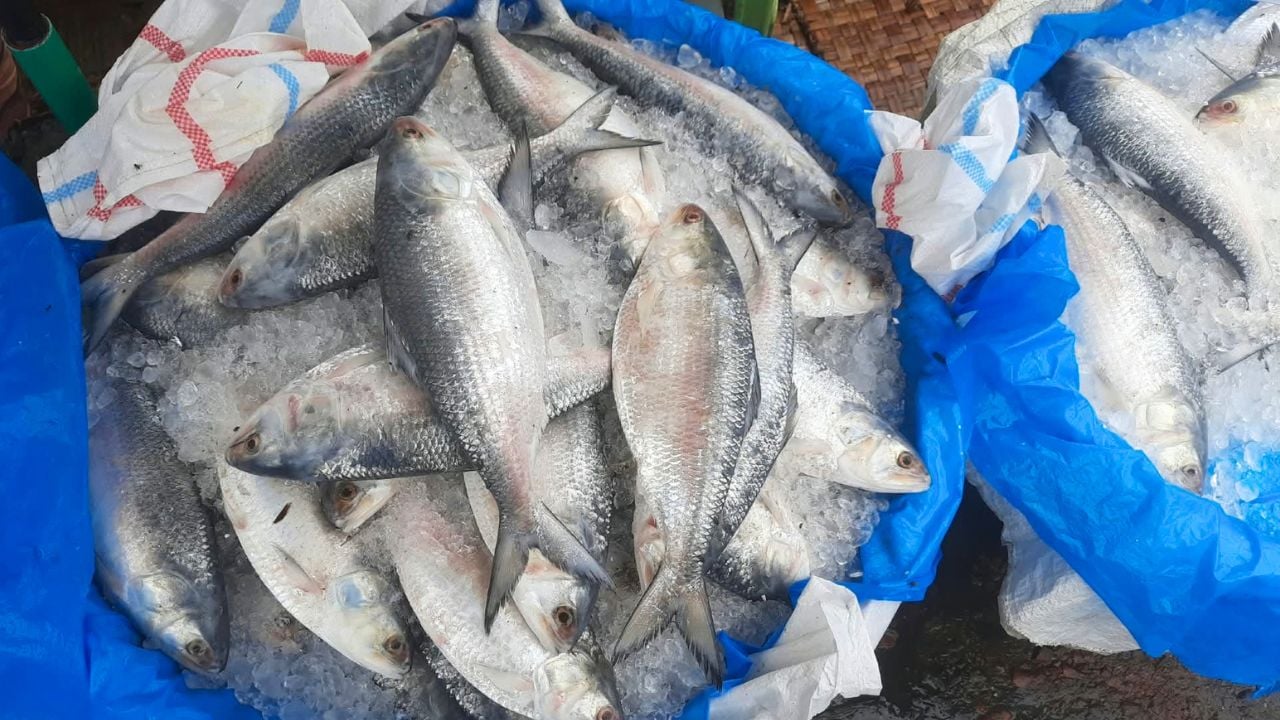
It is peak season, but fishers in Shariatpur's Padma and Meghna rivers are not finding the hilsa they hoped for. Burdened with loans and advances, the fishers of this area are worried. After casting nets all day, they catch only a few small hilsa now and then.
According to the district fisheries office, most people in the district make their living from fishing. Government figures show 35,274 registered fishers in the district's six upazilas. In past years, huge amounts of hilsa were caught in the peak season. Three years ago the district produced 4,528 tonnes of hilsa; that has since fallen to 4,001 tonnes. Climate change, encroachment, pollution and shoals rising in the rivers are steadily hampering hilsa production, so the rivers no longer yield the hilsa they once did.
Markets without fish
Local sources say Kuchaipatti and Kodalpur in Gosairhat, Sakhipur, Narasinghapur and Kanchikata in Bhedarganj, Sureshwar in Naria and Palerchar Bazar in Zajira are famous for hilsa. But these markets no longer have hilsa as before, and many traders and buyers go home empty-handed. The fish that are caught are expensive. Traders say hilsa of 1 to 1.5 kg sells for Tk 2,000 to 2,500 a kg, and half-kilogram fish sell for Tk 1,000 to 1,200. In some places small hilsa are sold by the hali, or four fish, for Tk 350 to 750. Because of these prices, ordinary people are deprived of the taste of hilsa, and they want prices brought within their reach.
On the Padma and Meghna, fishers were seen going out with boats and nets. After waiting several hours they caught a few small hilsa. Many have been forced to bring their nets ashore, mend them and put them away. Even the riverside wholesale depots have no fish; now and then one or two fishers bring a few fish on plastic trays to sell, mostly small.
Ilias Hossain, who came to buy fish at Sureshwar ghat, said: "I used to buy a large hilsa for under Tk 1,000. Now the price has more than doubled. Ordinary people cannot buy hilsa. If the administration plays the right role in protecting mother hilsa and jatka in the next drive, I hope production will rise."
Local resident Borhan Uddin Rabbani said many seasonal fishers catch mother hilsa during the ban drives, evading the administration, and the administration has not been able to protect jatka properly either. "That is why hilsa production is falling day by day. We want the administration to take strict action in the coming drives," he said.
Fishers deep in debt
Whether the rivers are hiding their fish in their vast expanse or production has stalled, the fishers do not know. Unable to find fish, they are in financial hardship and want government support. Mohammad Mainuddin, a fisherman from the remote char area of Dularchar in Bhedarganj upazila, took a Tk 2 lakh advance from a moneylender this year and is fishing with nets and ten fishermen at the mouth of the Padma and Meghna. But they are not catching the hilsa they need, not even earning the value of their labour, and are living in misery with their families.
Mainuddin said: "I borrowed Tk 2 lakh from the moneylender and went to the river with a new net and 10 boatmen. But we are not getting the fish we need. The little fish we catch every day does not even cover our costs. We are all suffering. If the government gave us a little financial help, we could survive."
Another fisherman, Abul Kashem Mia, said: "I owe the depot, and this time I am getting no fish at all in the river. I owe the moneylender, the shop, the fuel shop. I am drowning in debt. We have no way to survive unless the government helps."
Deen Ali Moral, a fisherman of Char Maijhara in Gosairhat, said: "In this season I used to get a lot of hilsa, bringing my boat to the ghat with maund after maund of fish. Now the river has dried up and I don't get much. If the river were dredged properly, the fish would come from the sea into the river."
Wholesalers are also frustrated. They say prices are rising for consumers because there is not enough hilsa, and they want effective steps to raise production. Badsha Sardar, a wholesaler at the Kanchikata depot, said: "A lot of hilsa used to come to the depot in this season. Now the fishers' nets catch nothing and no fish comes to the depot. Fish is very expensive. Because the drives are not carried out properly, production is falling day by day. We want proper steps to increase hilsa production."
District fisheries officer Biswajit Kumar Deb said hilsa production was being hampered by climate change, encroachment, pollution and other causes, and the government was taking steps to solve these problems. "We will make all preparations to increase hilsa production, and then the amount of hilsa in the rivers will grow. I will also speak to higher authorities about financial support for fishers," he said.
Source: Jagonews24. First published in Bengali on The Agro News.

Comments
(0)