
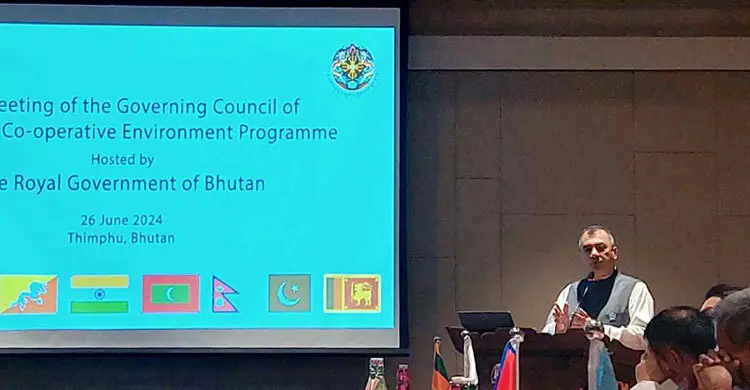
Saber Hossain, Minister for Environment, Forest and Climate Change, has called for greater regional cooperation, coordination and connectivity to control environmental pollution in South Asia.
The minister said this on 26 June as outgoing chairman at the 16th governing council meeting of the South Asia Co-operative Environment Programme (SACEP) in Thimphu, Bhutan.
He said concerted efforts are needed to solve the cross-border problem of pollution. He also stressed the combined need to fight pollution, biodiversity loss and climate change in South Asia.
SACEP projects on plastic pollution
Highlighting several notable achievements of SACEP, Saber Chowdhury said its ongoing projects include fighting plastic pollution through 12 regional grant projects and 18 innovation grant projects run across Bangladesh, Bhutan, the Maldives, Nepal, Pakistan and Sri Lanka. These initiatives ensure the participation of the private sector, entrepreneurs, academia and women. SACEP also gives technical support to public sectors for national policies, strategies and capacity building.
The minister said that although Bangladesh contributes only 0.48 per cent of global greenhouse gas emissions, it is highly vulnerable to climate change. He highlighted the melting of Hindu Kush Himalayan glaciers, rising sea levels and threats to the survival of wildlife. Stressing the need to limit global warming to 1.5 degrees Celsius, he called for greenhouse gas emission targets to be set.
The environment minister noted Bangladesh's notable success in fighting pollution over the past 15 years under the current government. He mentioned the establishment of Bangladesh's Climate Change Trust Fund and the recent formation of the Bangladesh Climate Development Partnership as examples of the nation's proactive steps.
As outgoing chairman, the environment minister handed over the chairmanship to Gem Tshering, Bhutan's Minister for Energy and Natural Resources.
Source: Jagonews24. First published in Bengali on The Agro News.
Comments
(0)