
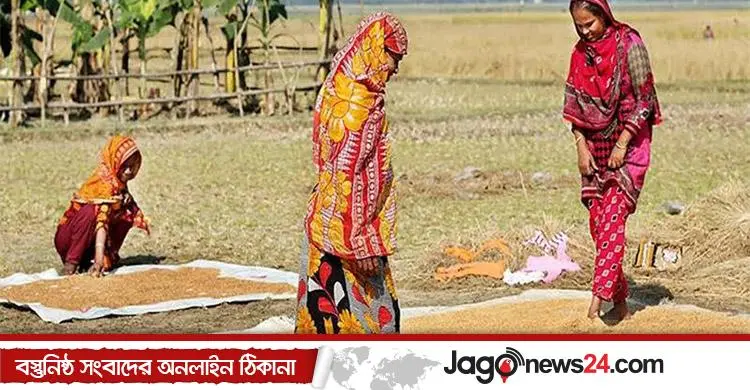
The woman who sweeps the yard, feeds the cow and puts rice on the stove before the sun rises holds the life of this country's villages. As the day's work begins, her selfless labour brings the whole household to life. Yet she is known only as a "housewife", although alongside the housework she plays an important part in her family's economic progress. Many families have come through hard times because of such women, and small village enterprises and cottage industries have grown up because of them. Still, their work is seen only as duty and is not properly valued.
Much of Bangladesh's rural economy today rests on women's shoulders. They do not just run their households; they make an invaluable contribution to keeping the country's economy moving. From threshing paddy to other farm work, rearing ducks and chickens, growing vegetables in the homestead, sewing and making nakshi kantha quilts, women are present everywhere. As small entrepreneurs, they have also become the main source of family income.
Small dreams made real
With the help of microcredit many women have turned small dreams into reality. Some make pitha, some work with clay, others weave cloth on the loom and run their households their own way. These enterprises do not just raise family income; they set a new example of self-reliance in society.
There is another contribution, often invisible, that matters to everyone. Women have taken on themselves the job of making sure children go to school regularly and have the right environment to study. They also make their families follow hygiene rules and keep clean, protecting them from disease, and they play an important part in caring for the environment, planting trees and saving water. Rural women, in short, are the driving force of change not just in the family but in society as a whole.
Labour seen as duty, not work
Yet despite their remarkable contribution, the reality is very different and sad. Their labour is still often not properly valued, especially in economic terms. We have often seen their hard work as "duty", not as "work" or a real achievement. Despite countless tasks inside and outside the home, their work goes unrecognised in many families and in much of society. Its results and successes are taken for granted and never seem worthy of praise.
Especially in today's digital age, when technology makes life easier every day, rural women need access to information technology. With mobile banking they can make financial transactions easily; through online markets they can sell their own products and earn more; and with farm information they can raise output and yields. They could become the digital entrepreneurs of the future and play a stronger part in the economic progress of their families and the country.
Both the state and society have a duty to take the lead in protecting women's rights. Training, credit support, a safe working environment and social recognition would take rural women a long way. With credit, they can succeed in small business and as entrepreneurs and create jobs for other women. A safe workplace is also essential, where women can work without fear and their safety and dignity are protected.
Above all, it is not just about development statistics: proper respect for women must begin in the family, and men must come forward to help with their work, which will give women more courage to move ahead. Rural women are not the background story of society but the heroines of the story ahead. Recognising their contribution is not just an expression of gratitude but a demand for fairness and for humanity. The day every woman gets the value of her labour, knowledge and dignity, a truly developed Bangladesh will be built, with every woman shining on the map of development.
Source: Jagonews24. First published in Bengali on The Agro News.


Comments
(0)